Quality you can stand on.
Paver driveways, patios, pool decks and walkways, built on a base that keeps them flat for decades.
A crew that got tired of doing it somebody else’s way
We started this company because we were tired of working for other people and wanted something we could be proud of putting our name on. Between us there is about twenty years of doing this work, and a fair amount of that was spent watching corners get cut on jobs we did not control.
Almost every paver problem we get called out to is a base problem wearing a surface disguise. The pavers themselves are fine. They are concrete or stone, and they will outlast most of us. What moves is what is underneath them.
Our ground is sand over limestone in most of the region, and sand drains fast right up until it does not. Add an afternoon storm that drops two inches in an hour and the base either handles it or it starts washing.
So we do the unglamorous part properly. Excavate to the depth the job actually needs, compact the aggregate in lifts instead of one dump and a quick pass, screed the bedding flat, and lock the perimeter down so the field cannot creep. Then the pretty part stays pretty.
Everything we do, laid out plainly
Driveways, patios, pool decks, walkways, repairs. 225 different jobs, and they are not the same job.
Driveways
The one surface that takes a vehicle every day. Base depth is the whole conversation.
All 17 in Driveways →Walkways
Level, edged, laid to drain. A quarter inch of lift is a trip waiting to happen.
All 14 in Walkways →Outdoor
Kitchens, fire pits, courtyards, lanais. Rooms without a roof, floored properly.
All 16 in Outdoor →Restoration
Cleaning and sealing that lift the grime without stripping the color out.
All 18 in Restoration →Materials
Brick, concrete, travertine, porcelain, stone. What it should be made of, and why.
All 14 in Materials →Before, and after
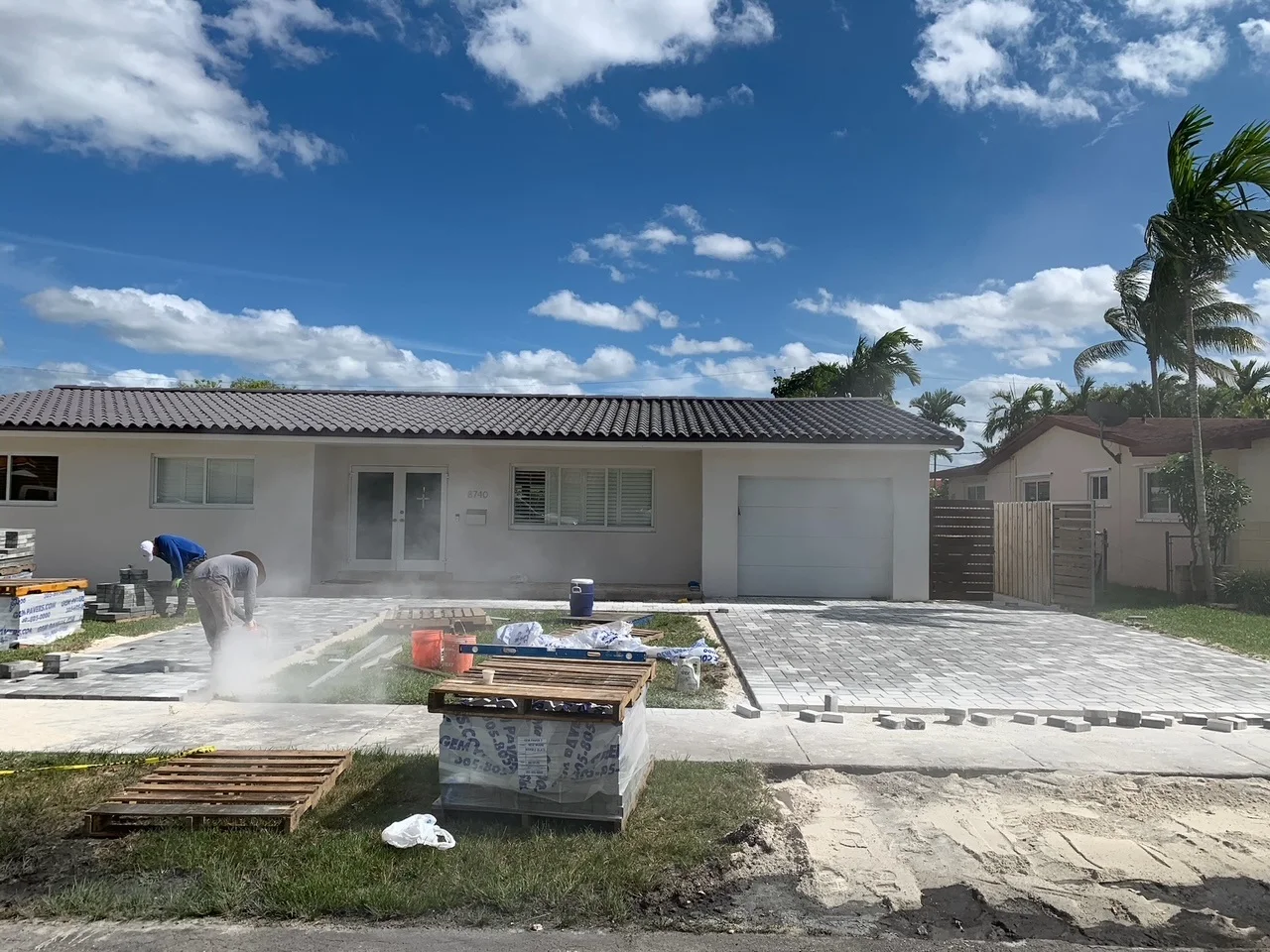
Two frames from the same property. The surface on the right is what happens when the base underneath gets rebuilt instead of patched.
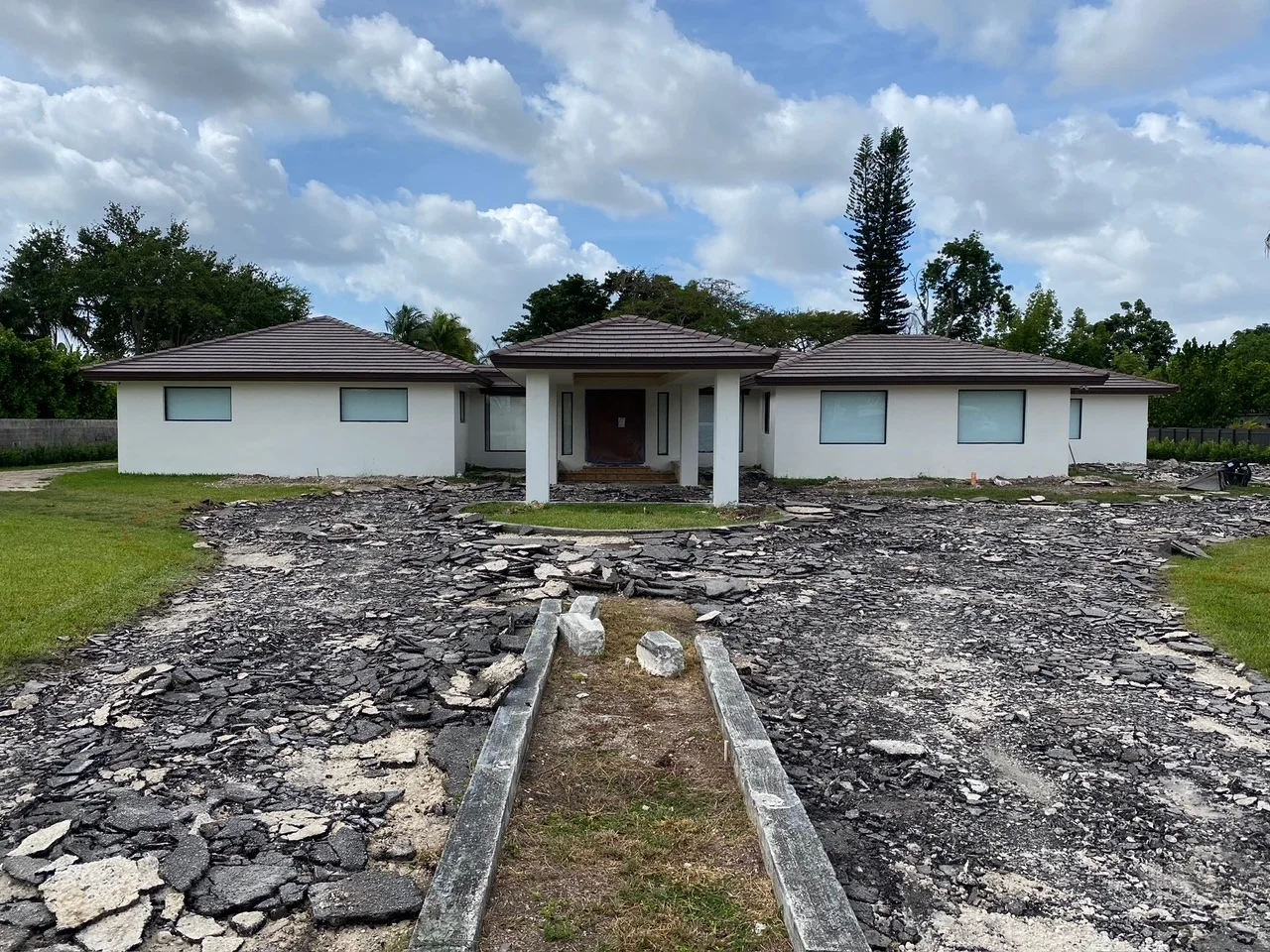 Before
 After
AfterWhat we are actually doing down there
Depth is decided by what the surface has to carry. A walkway that only ever sees people can sit on a shallower base than a driveway that takes a loaded pickup every day, and a commercial drive that takes delivery trucks needs more again. Anybody who quotes the same base depth for a garden path and a driveway is not measuring, they are guessing.
Compaction has to happen in lifts. That means putting the aggregate down in layers of a few inches and compacting each one before the next goes on. Dump the whole depth in at once and run a plate over the top and you get a hard crust over loose material, which behaves fine for a year and then starts settling in patches. This is the single most common corner cut in the trade and it is invisible on day one.
A paver surface is really four layers and only one of them is visible. Under the pavers there is a thin bedding course of sharp sand, screeded dead flat. Under that is the base, which is compacted crushed aggregate and does the actual structural work. Under that is the subgrade, which is whatever your property is made of. The pavers on top are a wearing surface. They spread load and they look good, but they are not what holds the thing up.
If nobody talks to you about drainage, they are quoting a different job.
Water is the thing that ends most paver surfaces, and it almost never arrives from where people expect. It is rarely the rain landing on the pavers, because a properly jointed field sheds most of that. It is the downspout discharging at the edge, the irrigation head spraying the same spot twice a day, or the neighboring grade sending runoff across the corner.
Fall matters more than people think. A paver surface wants a slope of roughly an eighth to a quarter inch per foot away from the building. That is subtle enough that you will not notice it walking on it and steep enough that water leaves instead of standing. Get it flat and you get puddles; get it backwards and you send water at the foundation.
Where the water goes once it leaves the surface is a real design question. On a tight lot with no fall available, that can mean a channel drain across the low edge, a permeable section that lets water through into a stone reservoir, or a regrade of the adjacent planting bed. All of those are cheaper to build now than to retrofit.
Separation
Geotextile between subgrade and base stops fine soil migrating up and destroying the aggregate structure.
Base depth
Set by what the surface carries, not by habit. A walkway and a truck-bearing drive are not the same excavation.
Compaction
Aggregate goes down in lifts and each one gets compacted. One dump and a quick pass gives you a crust over loose material.
What it can be made of
The material changes the price, the feel underfoot, and how it ages. We will tell you which ones actually make sense for your exposure rather than which one has the best margin.
Brick Pavers
Clay brick that keeps its color because the color is the material.
Concrete Pavers
The workhorse: the widest range of shapes, colors, and price points.
Travertine Pavers
Natural stone that stays cool underfoot and reads high-end.
Porcelain Pavers
Dense, low-absorption, and close to stain-proof.
Natural Stone Pavers
Cut stone where every unit is slightly its own thing.
Permeable Pavers
Surfaces that let stormwater through instead of shedding it to the street.
Limestone Pavers
Limestone, which is the rock most of this region is built on.
Marble Pavers
Marble where the property calls for it and the exposure allows it.
Driveway Pavers
The units that hold up under a vehicle every single day.
Patio Pavers
Units chosen for bare feet, furniture and how they sit in the sun.
Decorative Pavers
Shape, texture and color chosen to be looked at.
Large Format Pavers
Big units, which need a flatter base than anything else.
Textured Pavers
Texture for grip, and for the way the surface reads in the light.
Interlocking Pavers
Units shaped to lock together and spread the load across the field.
What actually happens, start to finish
We come look at it
One of us walks the property with you, looks at where the water goes, and gives you a straight read on what we see. If it is smaller than you feared, we say so.
You get the plan in writing
Scope, materials, schedule, and cost on paper before a shovel moves. The number you approve is the number, not an opening position.
We build the base first
Excavation to the depth the job needs, compacted aggregate in lifts, and a screeded bedding layer. This is the part nobody sees and the part that decides whether the surface is still flat in ten years.
Pavers go down and get cut in
Laying the field is the fast part. The care is in the cuts at the edges and the restraint that locks the whole field in place.
Joints get filled and the site gets cleaned
Joints filled and set, everything washed down, our own debris on our own truck. The site is yours again the same day we finish.
The failures we get called out to fix
None of these are visible on the day the work finishes, which is exactly why they keep happening.
Using the wrong sand in the bedding
Bedding wants sharp, angular concrete sand. Rounded mason sand or beach sand behaves like ball bearings under load and lets the pavers wander.
Sealing too early
A new concrete paver needs to cure and let its efflorescence work out before it gets sealed. Seal it in the first month and you can lock a white haze under the sealer permanently.
Laying over the old surface
It is quick, it is cheap, and it inherits every problem underneath. If the base was the reason the old surface failed, putting a new one on top of it just hides the failure for a season.
Skipping the geotextile
A separation fabric between the subgrade and the base stops the two from mixing. Without it, fine soil migrates up into the aggregate, the base loses its structure, and you get settlement that no amount of surface work will fix.
The edge restraint is the piece nobody thinks about and the reason the field holds.
Things people ask before they call
Do I need to be home while you work
No. We need access and a water source. Most people go to work and come home to a finished section. If we hit something unexpected we call you that day, not at the end.
Will the new pavers match what I already have
Sometimes exactly, sometimes closely. Concrete pavers change color a little with sun and age, and older lines get discontinued. If we cannot match, we will show you the options before we order anything, including pulling units from a less visible area to patch a visible one.
What happens to the old surface
We break it out and haul it off. Concrete and old pavers go to a recycler where one is available. That is included in the scope, not added on after.
How do you keep it from settling again
By fixing the reason it settled. That usually means correcting drainage and rebuilding the base properly, and sometimes it means dealing with a root or a downspout that is dumping water in the wrong place.
Do you work with HOAs and property managers
Regularly. We are used to submittals, board timelines, and phasing work so residents keep access. Tell us what your approval process looks like and we will work inside it.
Do you cover Miami, FL
Yes. Miami, FL is inside our regular working area and we are out that way most weeks. Call and we will tell you honestly when we could get to you.
Have somebody come look at it
Call and describe it, or send pictures. You will get a straight answer about what is wrong and what it takes to put right, including when the honest answer is that it can wait a year.
Quality you can stand on