Paver work done properly in Bonita Springs
Bonita Springs sits between Naples and Fort Myers and gets the coastal exposure of both.

What we see on Bonita Springs properties
Bonita Springs sits between Naples and Fort Myers and gets the coastal exposure of both.
When a paver surface goes wrong in Florida, the pavers are rarely the thing that failed. Water got into the base, the base moved, and the surface followed it down. Fix the surface only and you are back in two years.
Two inches of rain in an hour is the kind of afternoon storm we plan for, and our soil is mostly sand over limestone. Fast-draining sand handles light rain without complaint. Under that kind of downpour it reaches its limit, and the base above either holds together or begins to wash.
The other thing that lifts pavers here is roots. Ficus, black olive, and a lot of the older shade trees run their roots shallow and wide, and they will follow the moisture right under a walkway.
We are out this way most weeks, so a look at the property is usually a matter of days rather than months. If it turns out the honest answer is that it can wait, we will tell you that too.
How a job here runs
We come look at it
If the problem turns out smaller than you feared, you will hear that from us. We walk the property with you, look at where water is going, and tell you plainly what we see.
You get the plan in writing
Scope, materials, schedule, and cost on paper before a shovel moves. The number you approve is the number, not an opening position.
We build the base first
Excavation to the depth this job actually needs, aggregate compacted lift by lift, bedding screeded flat. The slow part, and the part that decides whether the surface is still flat in ten years.
Pavers go down and get cut in
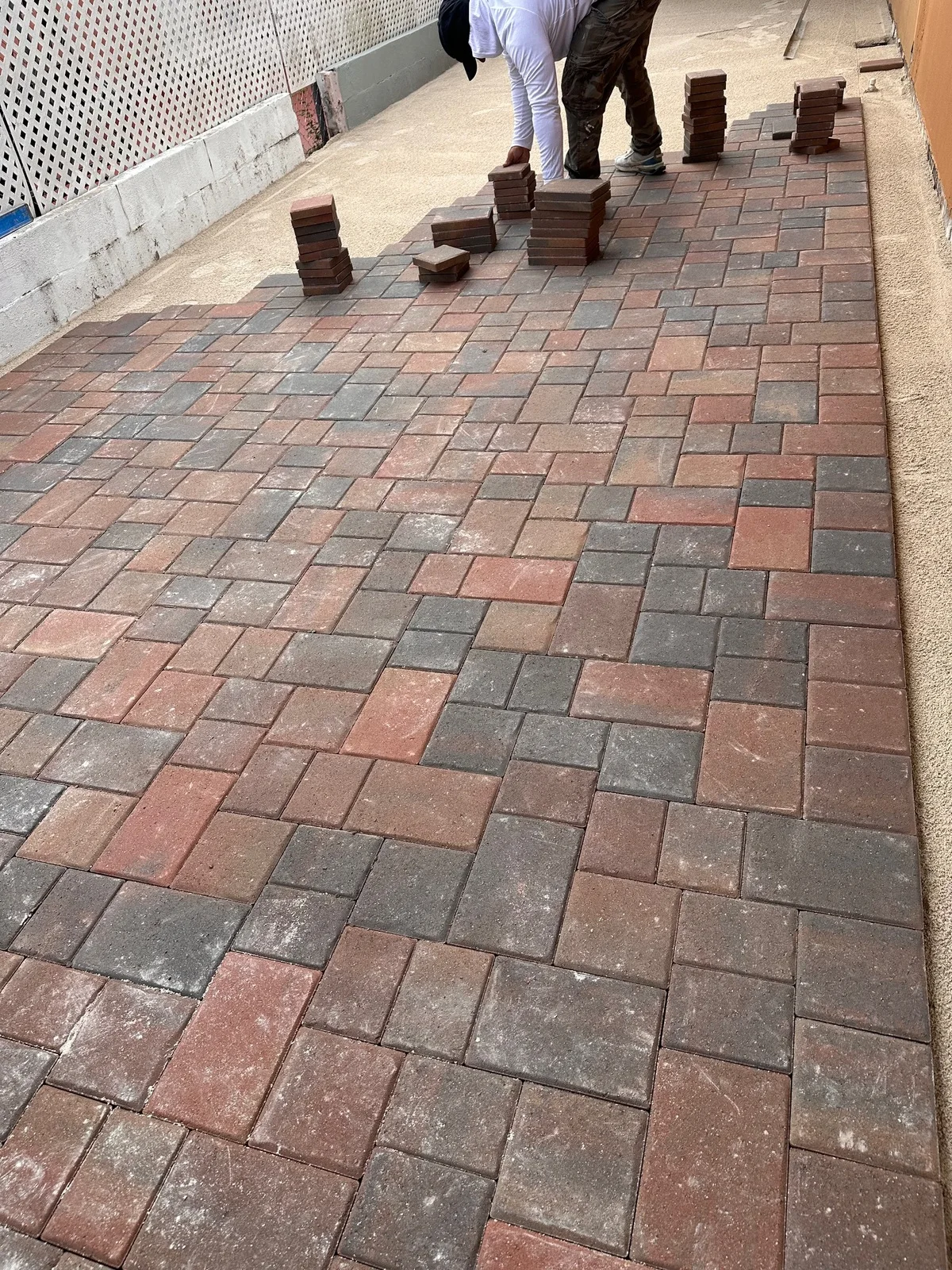
Laying the field is the fast part. The care is in the cuts at the edges and the restraint that locks the whole field in place.
Joints get filled and the site gets cleaned
Sand swept in and compacted, surface washed, debris hauled by us. You get the property back the way we found it, minus the problem.
The ground under this part of the county
Base depth is the most important number on a paver quote, and you cannot check it once the job is done. It should change with the load. A path that only ever sees people needs less, a driveway taking a loaded pickup every day needs more, and a commercial drive for delivery trucks needs more again. When two quotes differ, ask each contractor what depth they priced and why. A good one has an answer tied to your traffic.
If you watch one part of the install, watch the base go in. Aggregate should arrive in thin layers, a few inches each, with the compactor running over every layer before more is added. A crew that dumps the whole depth and runs one pass over the top is leaving loose material underneath a firm crust. That base will look perfect and behave for about a year before patches start dropping.
If you are comparing contractors, ask them about the three layers you will never see. A paver surface has four. The pavers on top are the wearing surface. Under them sits a thin bedding course of sharp sand, screeded flat. Under that is the base of compacted crushed aggregate, the layer that does the structural work. Under that is the subgrade, your native soil. A contractor who only wants to talk about paver colors is skipping the part that holds the thing up.
The edge restraint is the piece nobody thinks about and the reason the field holds.
Getting water off the pavers is half of the drainage job on a commercial property. The other half is deciding where it lands. On a tight lot with no fall to spare, we usually choose between a channel drain at the low edge, a permeable section that lets water through to a stone reservoir, and a regrade of the planting bed next door. Building that in now costs less than coming back for it.
Before we design anything, we find out where the water on the site comes from. The usual sources are a downspout discharging at the edge, an irrigation head spraying the same patch twice a day, and a neighboring grade sending runoff across a corner. Rain falling evenly on jointed pavers matters far less.
Getting the fall right is quiet work. It means setting the base so the finished surface drops about an eighth to a quarter inch per foot away from the building, then checking it as the job goes. Done right, nobody notices it. Done wrong, you either get standing water or water pushed back against the foundation.
Joint sand
Structural, not cosmetic. It transfers load between units, which is the whole reason a field of loose pavers behaves like a surface.
Separation
Geotextile between subgrade and base stops fine soil migrating up and destroying the aggregate structure.
Base depth
Set by what the surface carries, not by habit. A walkway and a truck-bearing drive are not the same excavation.
What Bonita Springs calls us for
Also nearby in Collier County:
What we tend to use around here
Of everything we install for homeowners, porcelain is the newest. What it brings is density: it soaks up almost no water and resists staining better than nearly anything else. What it demands is precision, both in the base, which has to be truly even, and in the cutting.
One practical reason we steer a lot of people toward concrete pavers is the future. Lines change, and a material that is easy to match makes a later extension or repair look like it was always there. They also offer the widest choice of shape and color. Plan on the color shifting slightly over the first year or two while they cure.
Clay brick costs more than concrete pavers and offers fewer shapes. What you get for that is color that does not fade, because the color is the fired clay itself. If the surface needs to look the same two decades from now, brick earns its price.
You can see this on almost any failing driveway. The middle usually looks fine and the outer two feet are a mess with wide joints and rocking units. That is not the edge wearing out faster, it is the edge restraint having failed and the field unlocking from the outside in.
The edge restraint is the piece nobody thinks about and it is what stops the whole field from spreading. Pavers work by interlock, which means each unit is held by its neighbors. Take away the restraint at the perimeter and the outermost course starts creeping outward, the joints open, the sand washes, and the failure marches inward from the edge.
Finding us in Bonita Springs
We are based in Miami and out this way regularly.
The shortcuts that surface two years later
Each of these hides under a clean new surface. Since the owner cannot see them at the end, they keep getting done.
Using the wrong sand in the bedding
Cheap, rounded sand in the bedding layer is how pavers end up drifting. Mason sand and beach sand roll under load. Bedding should be sharp, angular concrete sand.
Sealing too early
Leave new concrete pavers unsealed through their first month. They are still curing, and efflorescence is still working out of them. Seal over that and the white haze can be locked under the sealer permanently.
Laying over the old surface
An overlay inherits everything beneath it. Settled spots and a soft base stay exactly where they were. If the base is what sank the old surface, the new layer just hides it for a season before the same failure comes back.
Skipping the geotextile
A separation fabric between the subgrade and the base stops the two from mixing. Without it, fine soil migrates up into the aggregate, the base loses its structure, and you get settlement that no amount of surface work will fix.
If nobody talks to you about drainage, they are quoting a different job.
Common questions
What happens to the old surface
Old surfaces come out completely before anything new is built. We haul the debris away and recycle the concrete and pavers wherever we have a recycler to take them. Nothing about removal gets billed as an add-on.
How do you keep it from settling again
The answer depends on what made it settle, which is why we look before we price it. Drainage problems get corrected and a failed base gets dug out and rebuilt, and if a root is pushing, it gets dealt with too. Then the pavers go back down on a base with a reason to stay put.
Do you work with HOAs and property managers
Your rules come first. We regularly work for associations and property managers, which means board timelines and submittals are routine for us. Share your approval process and we will schedule the work, in phases if needed, so residents keep access.
Do you cover Bonita Springs, FL
Yes. Bonita Springs, FL is inside our regular working area and we are out that way most weeks. Call and we will tell you honestly when we could get to you.
Is there a warranty
Yes. Get any contractor’s warranty in writing and read what it excludes. Ours is written and covers our workmanship. It is also clear about its limits, like a root that arrives later or a drainage change. The pavers have separate manufacturer coverage, and we give you those papers.
Can you work around my pool being open
Usually. Pool deck work gets staged so you keep a safe path and the water stays covered while we cut. If there is a stretch where the pool has to be off limits we tell you which days up front.
Let us walk the property
Send a couple of photos or just call. We will tell you what we think is going on, what it would take to fix, and whether it needs doing now or can wait.
Quality you can stand on