Paver French Drain Integration, built on a base that holds
A french drain tied into the paver base so both work together.
What actually goes wrong
The failure is almost always below the pavers. Sand washes out of the joints, water gets down into the bedding, the bedding migrates, and the surface drops. Everything you can see is downstream of that.
Our ground is sand over limestone in most of the region, and sand drains fast right up until it does not. Add an afternoon storm that drops two inches in an hour and the base either handles it or it starts washing.
Look at what is planted nearby. A ficus, a black olive or an older shade tree can lift a walkway from a surprising distance, since their roots run shallow and wide and follow moisture underneath.
None of this is visible in a finished photo, which is why the cheap version and the right version look identical on day one. They stop looking identical around year two.
How we run this job
We come look at it
One of us walks the property with you, looks at where the water goes, and gives you a straight read on what we see. If it is smaller than you feared, we say so.
You get the plan in writing
Everything in writing up front: what we are doing, what it is made of, how long it takes, and what it costs. Nothing changes without you signing off on it.
We build the base first
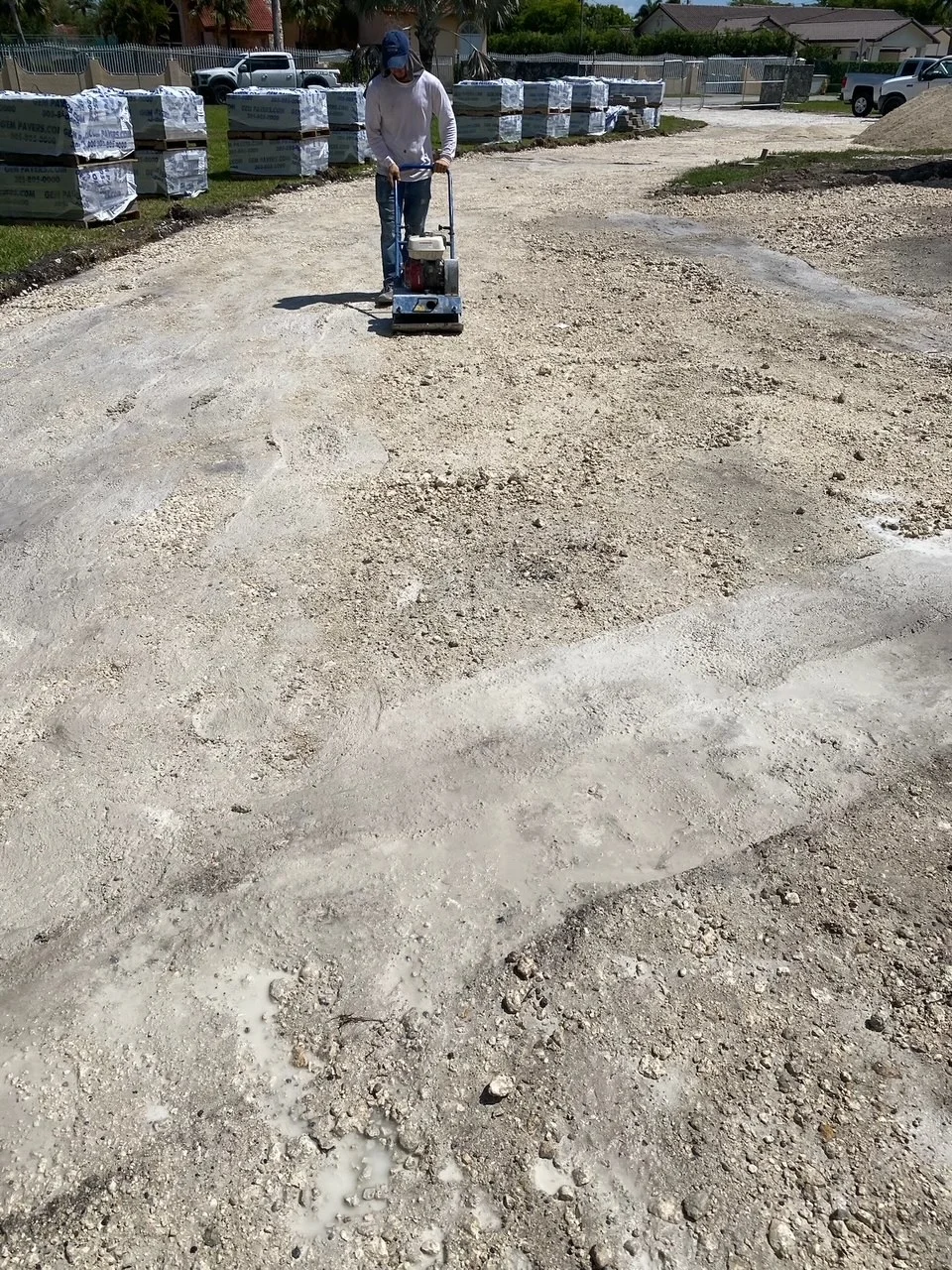
Excavation to the depth this job actually needs, aggregate compacted lift by lift, bedding screeded flat. The slow part, and the part that decides whether the surface is still flat in ten years.
Pavers go down and get cut in
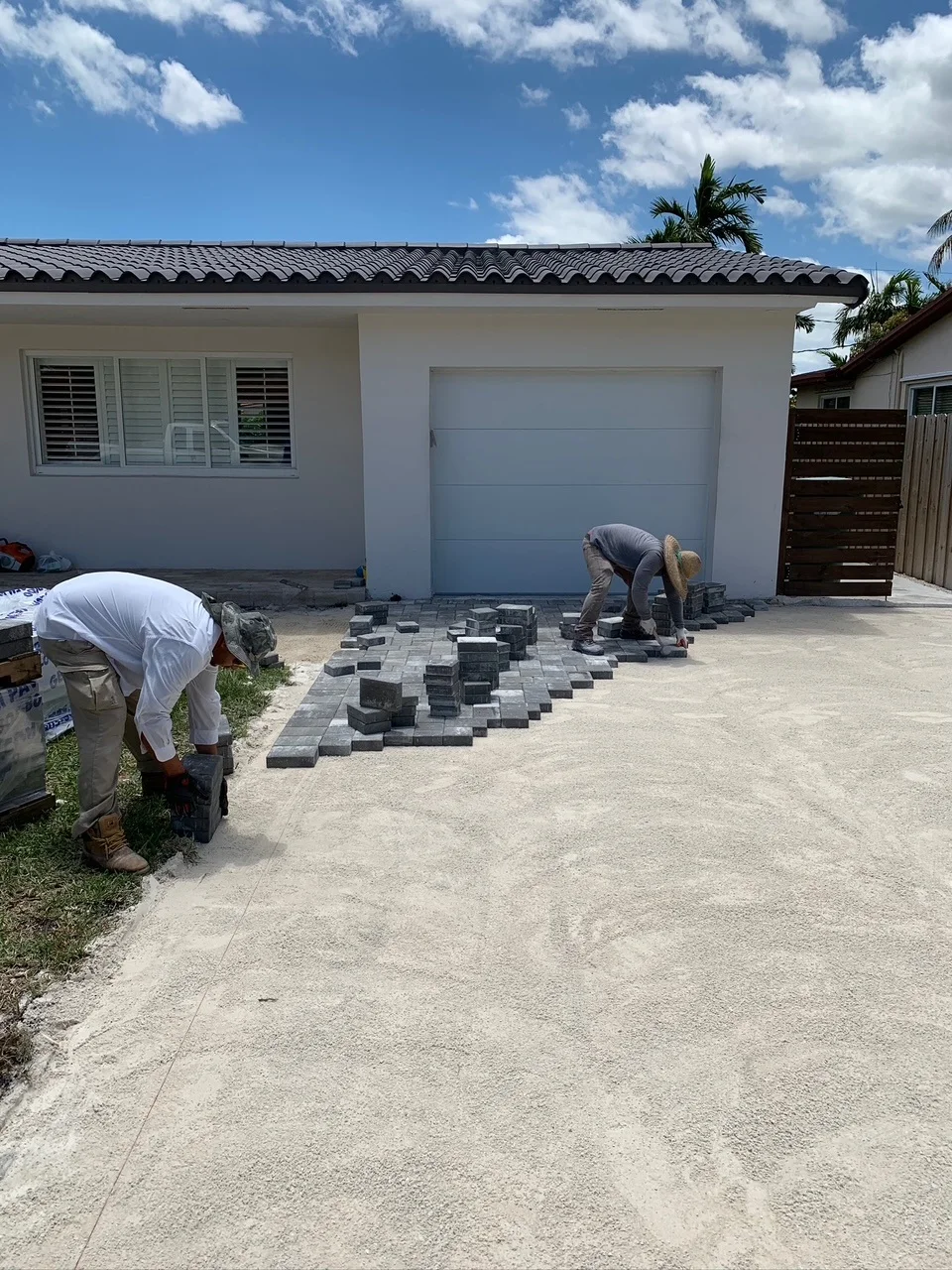
Field laid to the pattern, edges cut on site, and a restraint set around the perimeter so the field cannot creep.
Joints get filled and the site gets cleaned
Sand swept in and compacted, surface washed, debris hauled by us. You get the property back the way we found it, minus the problem.
Where the water goes when it rains here
Short version: the base gets as deep as the load needs. Foot traffic is light, so a walkway sits on a shallower base. A driveway is a different job the moment a loaded pickup parks on it every day, and a commercial drive taking delivery trucks is a bigger one again. We measure for the heaviest of those your surface will see. A contractor who quotes a garden path and a driveway at the same depth skipped that step.
The base is a stack of thin layers, each one compacted on its own. That is what building in lifts means. The shortcut is to spread all the aggregate in one go and compact the surface, which leaves a firm top over material that never got pressed down. For a while you cannot tell the difference. Then, about a year in, the surface starts settling in uneven spots.
Think of the pavers as the finish floor and the base as the foundation. Nobody would judge a house by its tile, and a paver job works the same way. Underneath what you walk on there is a thin bed of sharp sand screeded flat, then a thick layer of compacted crushed aggregate, then the native subgrade. The aggregate is what actually holds the weight. The pavers wear well and look good, and they ride on everything below them.
If nobody talks to you about drainage, they are quoting a different job.
Polymeric sand binds when it is wetted and resists washout better than plain sand, which is why it has become the default. It has to go in dry, get swept properly off the surface before wetting, and be watered in the way the manufacturer specifies. Rushed installation is why some jobs end up with a hazy residue over the pavers.
A paver that rocks under your foot usually has an empty joint beside it. The sand between pavers is what passes load from one unit to its neighbors, so a step on one is shared across several. Once that sand washes out, each paver carries its own weight alone. That is when they start to move, and once they move, they start to crack.
Restraint
A perimeter edge restraint is what stops the field creeping outward and the joints opening from the outside in.
Joint sand
Structural, not cosmetic. It transfers load between units, which is the whole reason a field of loose pavers behaves like a surface.
Separation
Geotextile between subgrade and base stops fine soil migrating up and destroying the aggregate structure.
More drainage work
This service runs across our whole region. Some of the areas where we do the most of it:
What it asks of you afterwards
A lifted edge is the one problem worth fixing the week you notice it. Past about a quarter inch it becomes a trip hazard. Catching it early usually means resetting a few pavers. On a commercial property, waiting also means carrying a liability question until it is done.
Debris in the joints is the thing to stay ahead of. Leaves and grass clippings break down into soil, and soil in a joint is where weeds start. Sweep it out, keep the sand topped up, and a well-built surface will ask very little else of you.
Sealing is maintenance you sign up for. Once a surface is sealed, it looks best if it gets recoated every few years, and skipping that leaves it patchy. In exchange you get deeper color and stains that lift with less scrubbing. Some owners love that look. Others prefer pavers left natural. Either is a reasonable choice, and we will tell you which suits your surface.
Porcelain is the material where installer skill shows most. It is dense and close to stain-proof, yet it will not hide an uneven bed, and it takes the right blade and patience to cut cleanly. It has only come into residential work fairly recently.
Concrete pavers are the easiest material to live with over the long run. If one cracks or a section needs resetting, matching it is usually straightforward. The color is part of the paver itself, so it softens gradually in the sun. It also changes a little in the first year or two as the units cure, which surprises some owners, so we mention it up front.
Clay brick keeps its color essentially forever because the color is the fired clay itself. It costs more, comes in fewer shapes, and it is the right answer when you want a surface that looks the same in twenty years.
The failures we get called out to fix
Nothing on this list shows when the work is new. Each one waits a while before it surfaces, which is how it keeps getting repeated.
Using the wrong sand in the bedding
The grains matter. Sharp, angular concrete sand interlocks and holds a paver’s position. Rounded sand, such as mason or beach sand, keeps shifting under weight and lets the pavers wander.
Sealing too early
If a newly sealed paver job looks cloudy white under the shine, it was probably sealed too early. Concrete pavers need to cure and release their efflorescence first. Sealed in the first month, that haze stays locked beneath the sealer.
Laying over the old surface
Whatever made the old surface fail is still down there when you pave over it. If the base was the problem, a new layer on top only covers the failure for a season, and then it shows through again.
Skipping the geotextile
Fabric between the ground and the base is a small step that keeps the base doing its job. Sandy soil especially wants to wash up into the stone layer above it. When it does, the base loses its strength and you get low spots that come back no matter how often they are reset.
The pavers are a wearing surface. The base is the building.
Common questions
Will the new pavers match what I already have
What matters most is where the repair sits. In a back corner, a close match is usually fine. By the front door it needs to be better, and if the line is discontinued we can borrow pavers from a less visible part of the surface for that spot. Either way you see the options before we order.
What happens to the old surface
You do not have to deal with it. Our crew breaks out the old surface and hauls it away, and the concrete and pavers are recycled wherever a recycler is available. Haul-off is already in the scope.
How do you keep it from settling again
Find the water first. In most cases a settled spot traces back to drainage, like a downspout emptying at the edge, and the base under it has washed or softened. Correct the drainage, rebuild that section of base, and the pavers go back down on something solid.
Do you work with HOAs and property managers
Yes, HOA and condo work is part of what we do. We prepare submittals for the board and phase the job so residents still get in and out. Tell us your approval steps and we follow them.
Do you cover Miami, FL
Yes. Miami is where we are based, so it is about as close to home as our work gets. Give us a call and we will tell you when we can come out.
Is there a warranty
Yes. The written warranty is ours and covers how the job was built. The product warranty belongs to the paver manufacturer, and we include that paperwork. Some things sit outside our coverage, mainly new roots and changes to drainage, and we point those out clearly.
Tell us what you are looking at
Start with a phone call or a few photos. Tell us what you are seeing and we will tell you what we think is causing it and what fixing it involves. If it can safely wait a year, we will say that too.
Quality you can stand on