Interlocking Paver Installation, from the subgrade up
Units shaped to lock into each other and share the load across the field.

What actually goes wrong
When a paver surface goes wrong in Florida, the pavers are rarely the thing that failed. Water got into the base, the base moved, and the surface followed it down. Fix the surface only and you are back in two years.
We build every base with one storm in mind: the afternoon downpour that drops two inches in an hour. The region’s sand over limestone drains fast in light rain and then suddenly cannot keep up. When that happens, water moves sideways through the base, and only a well-built one stays put.
If the lifting is near a big tree, the tree is the first suspect. Ficus, black olive and many older shade trees run their roots shallow and wide, following moisture right under the walkway.
That is why the schedule on our jobs is mostly spent on the part you will never see again. The surface takes a day or two. The ground it sits on takes the rest, and the ground is what you are actually paying for.
How we run this job
We come look at it
One of us walks the property with you, looks at where the water goes, and gives you a straight read on what we see. If it is smaller than you feared, we say so.
You get the plan in writing
Scope, materials, schedule, and cost on paper before a shovel moves. The number you approve is the number, not an opening position.
We build the base first
Pavers sit on top of the work that matters. First comes excavation to the right depth for your job, then a compacted aggregate base laid in lifts, then a screeded bedding layer. None of it shows, and it is the reason the surface stays flat.
Pavers go down and get cut in
Field laid to the pattern, edges cut on site, and a restraint set around the perimeter so the field cannot creep.
Joints get filled and the site gets cleaned
Sand swept in and compacted, the surface washed down, and the property left the way we found it. We haul our own debris.
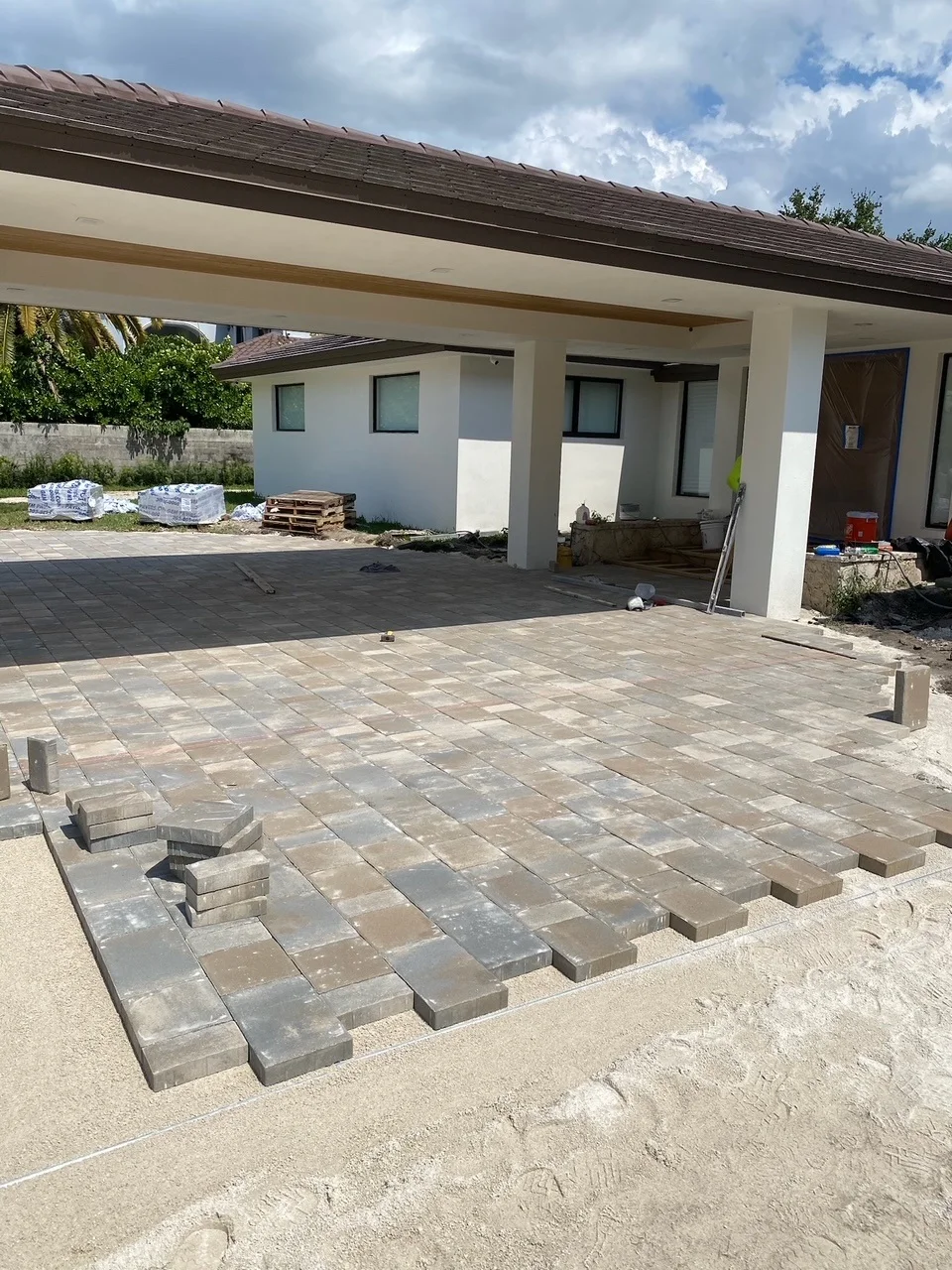
What a proper installation actually involves
Think of the pavers as the finish floor and the base as the foundation. Nobody would judge a house by its tile, and a paver job works the same way. Underneath what you walk on there is a thin bed of sharp sand screeded flat, then a thick layer of compacted crushed aggregate, then the native subgrade. The aggregate is what actually holds the weight. The pavers wear well and look good, and they ride on everything below them.
Before we dig, we ask what is going to drive on it. A garden path that only sees feet needs less base under it. A driveway that takes a loaded pickup every day needs more, and a commercial drive with delivery trucks needs more again. The excavation follows the answer. A quote that lists one base depth for every job tells you nobody asked the question.
Loose aggregate under a hard crust is the failure nobody sees coming. It happens when a base is dumped in at full depth and compacted only at the surface. The top tightens up and the bottom never does, and once traffic and water work on it, the loose part shifts and the pavers above it sink in patches. Laying the base in lifts of a few inches, compacting each one, prevents it.
Compaction in lifts is the difference between ten years and two.
A tight commercial lot with no fall available is a drainage problem before it is a paving problem. The surface can shed water, but something has to receive it. Our usual choices are a channel drain at the low edge, a permeable section that passes water through to a stone reservoir, or a regrade of the adjacent planting bed. We pick one while the site is open, because retrofitting any of them costs more.
People expect rain to be what wears out their pavers. In practice, a field with properly filled joints sheds most rainfall without trouble. The failures trace back to concentrated water: a gutter dumping at the border, irrigation hitting one spot day after day, or the neighboring lot draining across the corner.
The grade under a patio or walkway has one job: get water off and away from the building. The pitch that does it is roughly an eighth to a quarter inch per foot. Underfoot it feels level. In a downpour you can watch the water move. Lose that fall and you get puddles, or worse, water running back toward the foundation.
Joint sand
Structural, not cosmetic. It transfers load between units, which is the whole reason a field of loose pavers behaves like a surface.
Separation
Geotextile between subgrade and base stops fine soil migrating up and destroying the aggregate structure.
Base depth
Set by what the surface carries, not by habit. A walkway and a truck-bearing drive are not the same excavation.
More installation work
You will find us doing this across the region, often in these areas:
What it asks of you afterwards
Whether to seal is your call. A good sealer brings the color up a shade and makes an oil drip or a spill easier to clean off. The tradeoff is upkeep, since it wears and has to be reapplied every few years, and the wrong product can leave a plastic shine or trap moisture underneath. We will tell you which way we would go on yours.
Keep an eye on paver edges. A lip of roughly a quarter inch is where a surface stops being uneven and starts tripping people. At home that means a stubbed toe. On a commercial property it also means a liability question, so a lifted edge there should not wait for the next maintenance round.
Debris in the joints is the thing to stay ahead of. Leaves and grass clippings break down into soil, and soil in a joint is where weeds start. Sweep it out, keep the sand topped up, and a well-built surface will ask very little else of you.
Concrete pavers are the workhorse and cover most of what gets installed. Widest range of shapes and colors, most predictable to lay, and the easiest to match later. Color is pigment through the unit, so it fades gently with sun rather than wearing off, though it does shift over the first year or two as it cures out.
With clay brick there is no pigment to fade. The color comes from the clay as it is fired, so the paver looks essentially the same for as long as it lasts. The trade is a higher price and a smaller choice of shapes.
Pool decks are where travertine earns its place. Bare feet notice the difference right away: in direct sun it runs cooler than concrete. Keep in mind that every unit is a little different, since it is quarried stone, and that areas exposed to oil or heavy staining should be sealed.
What we see when somebody else did it
None of these leave a mark you could spot at the final walk. That is the whole reason they keep coming back.
Skipping the geotextile
Without a separation layer, the subgrade and the base slowly trade places. Soil particles ride water up into the stone while the stone presses down into the soil, and the base gets thinner every year. Surface repairs do nothing for that kind of settlement.
Using the wrong sand in the bedding
Bedding wants sharp, angular concrete sand. Rounded mason sand or beach sand behaves like ball bearings under load and lets the pavers wander.
Sealing too early
Everybody wants the new pavers sealed right away. That is the mistake. Concrete pavers need to cure and clear their efflorescence first, and sealing in the first month can lock a white haze under the sealer permanently.
Laying over the old surface
Skipping the tear-out saves time and some money. It also keeps every defect in the ground below. If a weak base is what wrecked the old surface, the new one hides that failure briefly and then repeats it.
The edge restraint is the piece nobody thinks about and the reason the field holds.
Common questions
Do I need to be home while you work
You can go to work as usual. We need to be able to reach the work area and use your water. If anything changes the plan, like what we find once the old surface is up, we call you that day.
Will the new pavers match what I already have
First we find out whether your paver line is still made. Older lines get discontinued, and even a current one can look a little different from units that have sat in the sun for years. If we can match, exactly or closely, we order. If not, we show you the options first, like pulling pavers from a less visible area.
What happens to the old surface
We break it out and haul it off. Concrete and old pavers go to a recycler where one is available. That is included in the scope, not added on after.
How do you keep it from settling again
Settling is a symptom. The cause is almost always water or a weak base, and occasionally a tree root. We correct whichever one it is, rebuild the base where it failed, and then relay the pavers, so the spot has no reason to drop again.
Do you work with HOAs and property managers
We put together submittals for HOA boards and property managers regularly. Tell us what your approval process requires and we will work inside it, including phasing so residents keep access.
Do you cover Miami, FL
Yes. Being Miami-based means we are in and around Miami, FL almost every week. Ask us about scheduling when you call and you will get a clear answer.
Let us walk the property
The quickest route to a straight answer is a visit. One of us comes out, walks it with you, watches where water heads, and writes it all down for you to keep.
Quality you can stand on