Apartment Paver Installation, from the subgrade up
Apartment drives, walks and courtyards on a maintenance minded spec.
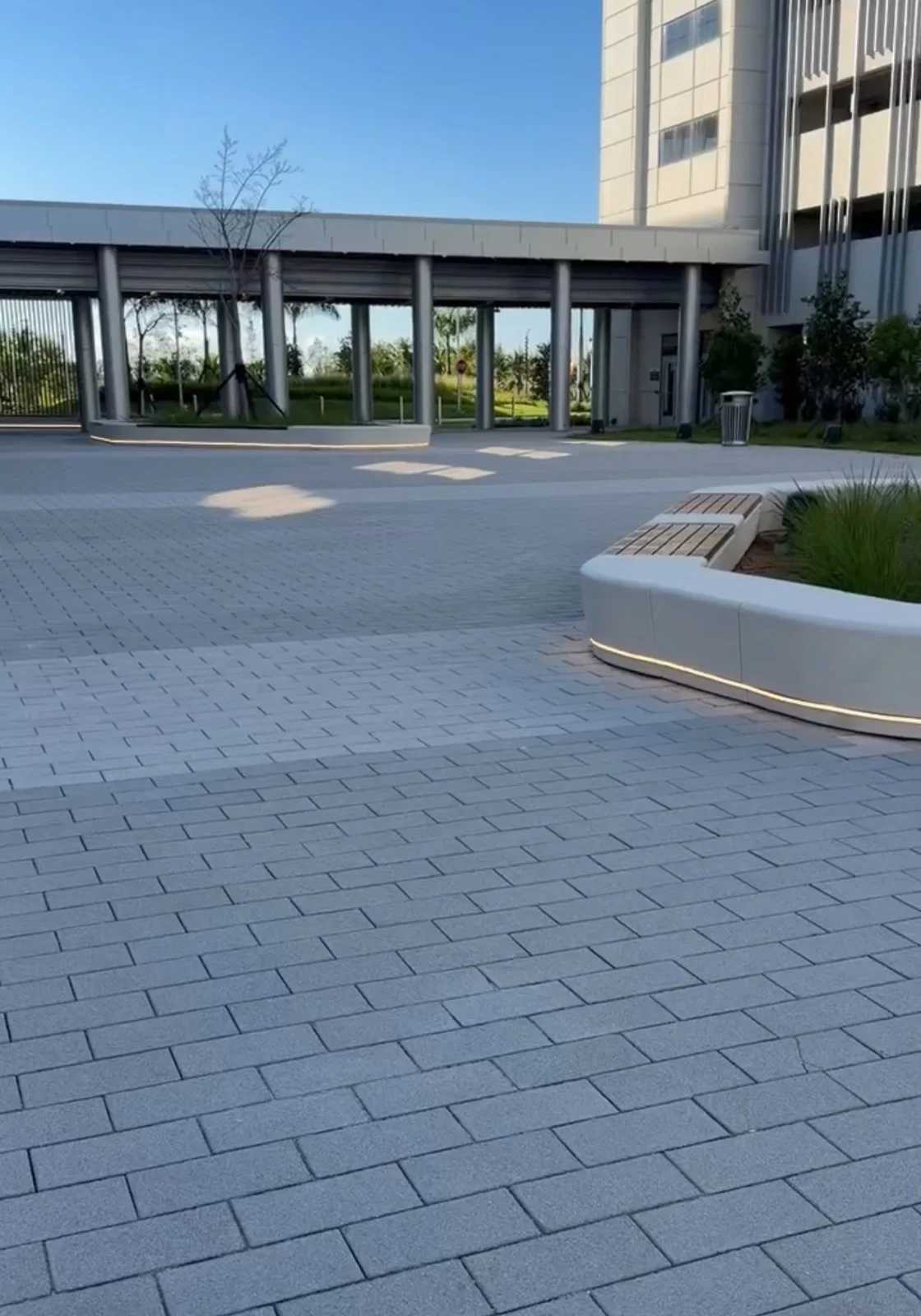
What actually goes wrong
When a paver surface goes wrong in Florida, the pavers are rarely the thing that failed. Water got into the base, the base moved, and the surface followed it down. Fix the surface only and you are back in two years.
Water wants to go down, and across a lot of the coast it cannot go far. The water table is high, so it moves sideways through the ground. That sideways flow is what washes sand from under the edge of a driveway.
Roots are the other big reason pavers lift around here. Ficus and black olive trees, and plenty of older shade trees, spread their roots shallow and wide, and those roots chase the moisture that collects under a walkway.
None of this is visible in a finished photo, which is why the cheap version and the right version look identical on day one. They stop looking identical around year two.
How we run this job
We come look at it
Somebody from the crew comes out, stands on the problem, and tells you what is actually going on underneath it. No sales visit, just a look and an honest read.
You get the plan in writing
Everything in writing up front: what we are doing, what it is made of, how long it takes, and what it costs. Nothing changes without you signing off on it.
We build the base first
Dig to depth, compact the aggregate in layers, screed the bedding. Nobody ever sees this part again, which is exactly why most failures start here.
Pavers go down and get cut in
Laying the field is the fast part. The care is in the cuts at the edges and the restraint that locks the whole field in place.
Joints get filled and the site gets cleaned
Sand swept in and compacted, surface washed, debris hauled by us. You get the property back the way we found it, minus the problem.
What changes on a commercial property
Commercial work is a sequencing problem as much as a construction one. The property has to keep operating, which means phasing, temporary routing, and being honest about which days a given area is genuinely unusable.
Load cases are different too. Delivery vehicles, dumpster trucks and fire apparatus all cross surfaces that look residential, and a base built for cars fails quickly under them. The dumpster pad is almost always the first thing to go.
Accessibility is not optional on commercial property. Slopes, transitions and detectable warnings are code, and a resurfacing job that quietly changes a slope can put a compliant property out of compliance.
If nobody talks to you about drainage, they are quoting a different job.
The rain that falls on your pavers is the least of it. A well-jointed surface sheds most of that. The water that undermines a base is water delivered to one spot again and again, from a gutter downspout, an irrigation head, or the slope of the property next door. We look for those sources on every walk.
The grade under a patio or walkway has one job: get water off and away from the building. The pitch that does it is roughly an eighth to a quarter inch per foot. Underfoot it feels level. In a downpour you can watch the water move. Lose that fall and you get puddles, or worse, water running back toward the foundation.
Where the water goes once it leaves the surface is a real design question. On a tight lot with no fall available, that can mean a channel drain across the low edge, a permeable section that lets water through into a stone reservoir, or a regrade of the adjacent planting bed. All of those are cheaper to build now than to retrofit.
Separation
Geotextile between subgrade and base stops fine soil migrating up and destroying the aggregate structure.
Base depth
Set by what the surface carries, not by habit. A walkway and a truck-bearing drive are not the same excavation.
Compaction
Done in lifts, layer by layer. Dump it all at once and a quick pass leaves a hard crust sitting on loose material that settles later.
More commercial work
This service runs across our whole region. Some of the areas where we do the most of it:
What it asks of you afterwards
Keep an eye on paver edges. A lip of roughly a quarter inch is where a surface stops being uneven and starts tripping people. At home that means a stubbed toe. On a commercial property it also means a liability question, so a lifted edge there should not wait for the next maintenance round.
Pavers that went down on a proper base do not ask for much. Every so often, look at the joints. If the sand is low, refill it, and if leaves or dirt are packed in, clear them out. Watch for settling and deal with it while it is small.
Whether to seal is your call. A good sealer brings the color up a shade and makes an oil drip or a spill easier to clean off. The tradeoff is upkeep, since it wears and has to be reapplied every few years, and the wrong product can leave a plastic shine or trap moisture underneath. We will tell you which way we would go on yours.
If budget is tight, clay brick is usually not where we start, since it costs more and comes in fewer shapes. If the priority is a surface that looks the same in twenty years, it is the answer. Its color is the fired clay, and that does not fade.
Two things to know about travertine. It is natural stone, so expect differences in tone between units. And it stays cooler than concrete underfoot in direct sun, which makes it the usual pick around a pool. If the spot gets oil or heavy staining, add a sealer to the plan.
Porcelain is hard on a sloppy installer. It will not forgive a slightly uneven bed, so the base and bedding have to be dead accurate. Cutting it takes the right blade and time. Do that and you get a dense surface that barely absorbs anything and holds up well against stains.
The failures we get called out to fix
None of these are visible on the day the work finishes, which is exactly why they keep happening.
Laying over the old surface
When someone asks us to pave over what they have, we look at the old surface first. If the base is why it failed, an overlay keeps that problem and puts a nicer face on it for a season. Quick and cheap, and still broken underneath.
Skipping the geotextile
Fine soil moves. Water carries it and traffic pumps it, and without a barrier it ends up in the aggregate base. A layer of separation fabric under the base stops that. Skip it and the base gradually turns soft, and the settlement it causes sits below anything a surface repair can reach.
Using the wrong sand in the bedding
The grains matter. Sharp, angular concrete sand interlocks and holds a paver’s position. Rounded sand, such as mason or beach sand, keeps shifting under weight and lets the pavers wander.
Sealing too early
Of all the shortcuts, early sealing is one of the hardest to undo. A new concrete paver has to cure and let its efflorescence come out before sealing. Seal it in the first month and that white haze can stay under the sealer permanently.
The pavers are a wearing surface. The base is the building.
Common questions
Do I need to be home while you work
Most owners are at work while we are. What we need from you is access to the area and a water source. If the gate locks or there is a pet in the yard, tell us ahead of time. Should we run into a surprise, we will call you the same day.
Will the new pavers match what I already have
New pavers start out looking newer than the ones already down, because concrete pavers change color a little with sun and age. Sometimes the match is exact and sometimes it is close. When a line is discontinued or the difference is too obvious, we walk you through the options before anything gets ordered.
What happens to the old surface
We break it out and haul it off. Concrete and old pavers go to a recycler where one is available. That is included in the scope, not added on after.
How do you keep it from settling again
Most of the time it comes down to the base. If it was laid too thin or compacted in one pass, we dig it out and rebuild it in lifts, then check that water is leaving the area the way it should. Fixing the surface without the base just repeats the problem.
Do you work with HOAs and property managers
We put together submittals for HOA boards and property managers regularly. Tell us what your approval process requires and we will work inside it, including phasing so residents keep access.
Do you cover Miami, FL
Yes. Miami is where Paverson is based, and we work across the city regularly. Reach us by phone or at info@paverson.com and we will tell you honestly how soon we could get there.
Let us walk the property
A real answer comes from being there. We will walk the property, follow where the water goes, and give you a written account of what we see, so you are not guessing from a phone call.
Quality you can stand on