Marble Pavers without the part that fails later
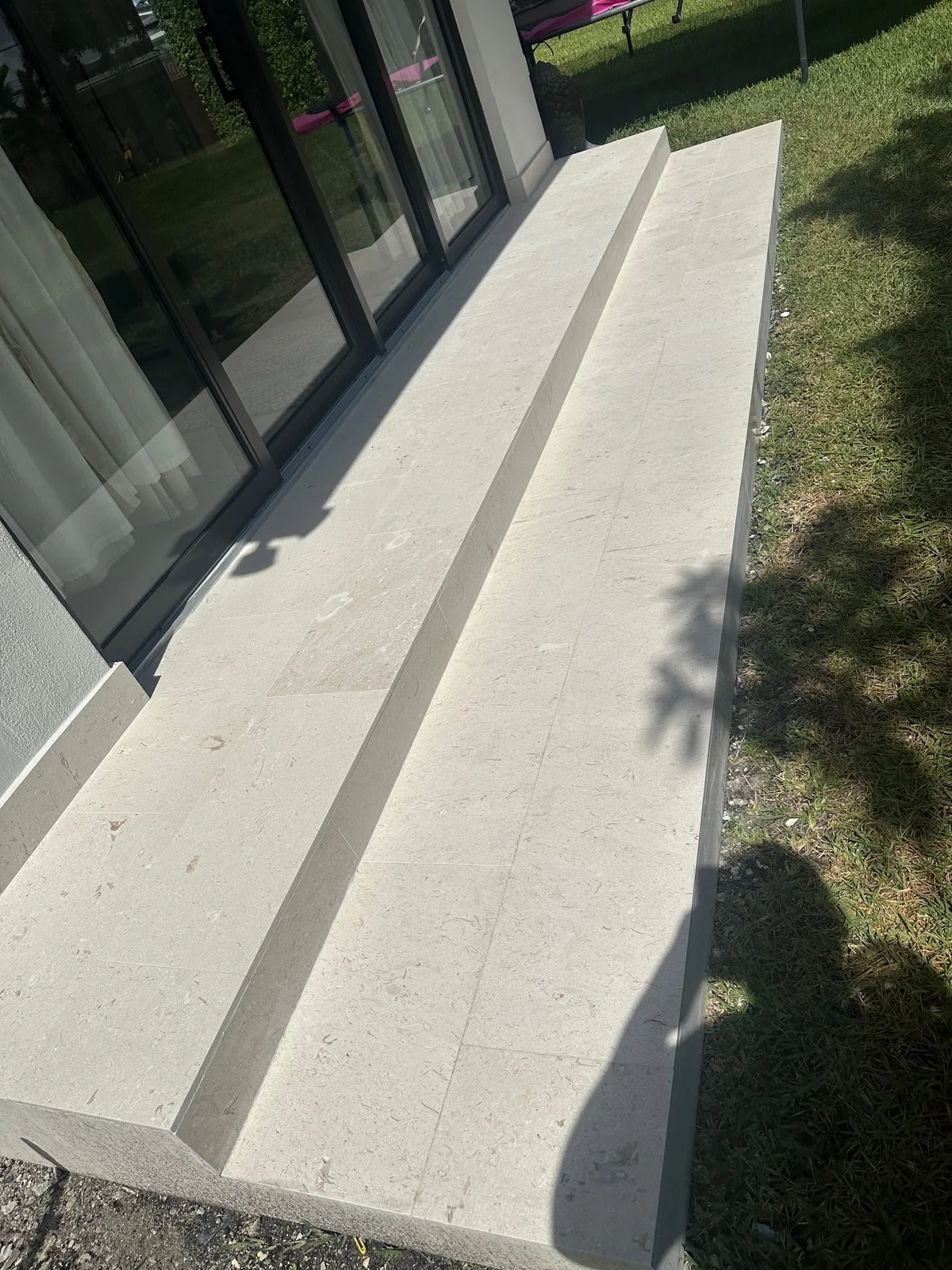
Marble where the property calls for it and the exposure allows it.
What actually goes wrong
When a paver surface goes wrong in Florida, the pavers are rarely the thing that failed. Water got into the base, the base moved, and the surface followed it down. Fix the surface only and you are back in two years.
Watch what one heavy afternoon storm does to a South Florida yard: a lot of water arrives at once, and it moves through sand that shifts as it goes. That is the load a paver base here has to survive every summer. Up north the same base would get an easier life.
The second common cause is roots. Shallow, wide root systems on ficus, black olive and older shade trees head toward moisture, and the ground under a walkway holds plenty of it.
We would rather lose a bid than skip the base work, because the base work is the job. Everything above it is finish.
How we run this job
We come look at it
We start in person. Someone from the crew comes out, looks at the problem and follows the water across the property. You get our honest read on the spot, and if the fix is small, we say it is small.
You get the plan in writing
Everything in writing up front: what we are doing, what it is made of, how long it takes, and what it costs. Nothing changes without you signing off on it.
We build the base first
Excavation to the depth the job needs, compacted aggregate in lifts, and a screeded bedding layer. This is the part nobody sees and the part that decides whether the surface is still flat in ten years.
Pavers go down and get cut in
The field goes down to the pattern, edge cuts happen on site, and the perimeter gets a restraint so nothing creeps.
Joints get filled and the site gets cleaned
Sand swept in and compacted, the surface washed down, and the property left the way we found it. We haul our own debris.
How the material changes the outcome
Material choice changes four things at once: what it costs, how it feels underfoot, how it ages, and how easy it is to match in five years when something needs replacing.
Availability is worth thinking about up front. Manufacturers discontinue lines. Buying a small overage of the same production run and keeping it somewhere dry is the cheapest insurance in this whole trade.
Absorption drives most of the durability difference. A dense, low-absorption unit takes less water in, so it stains less and is less affected by salt. That is most of why porcelain behaves the way it does.
A sunken paver is a symptom. The base under it is the disease.
Ask what goes in the joints. On most patios now the answer is polymeric sand, which binds when it is wetted and holds up to washout much better than plain sand does. It is also easy to get wrong. It has to be installed dry, swept off the surface completely before any water, and watered in per the manufacturer’s directions. Hurry any of that and you get a hazy film.
The cheapest material on a patio may be the one that holds it together. Joint sand transfers load between pavers, and that transfer is what makes a field of loose units act as a surface. When joints wash out, each paver is left carrying its own load. That is exactly when they begin to rock, and rocking pavers crack.
Separation
Geotextile between subgrade and base stops fine soil migrating up and destroying the aggregate structure.
Base depth
Set by what the surface carries, not by habit. A walkway and a truck-bearing drive are not the same excavation.
Compaction
Each lift of aggregate gets compacted before the next one goes down. The shortcut, one dump and a quick pass, compacts the surface and leaves the rest loose.
Other materials we lay
We cover this across the region. A few of the areas we work most:
What it asks of you afterwards
It does not take much. An edge lifted a little more than a quarter inch looks minor and still catches toes. That makes it the item to act on quickly once an install has settled in. If the pavers serve a commercial property, the stakes include liability, beyond keeping the surface in shape.
Owners are often surprised how little a properly built paver surface needs from them. The joints are where most of the attention goes: keep them full of sand and free of leaves that would otherwise rot in place. Beyond that, keep an eye out for any area that starts to sink.
Sealing really is a preference, which is why you hear different opinions on it. Our view: it is worth it where the surface takes oil, food or heavy staining, and less worth it on a walkway that only sees foot traffic. A poorly chosen sealer can leave a glossy sheen or trap moisture underneath, so product choice matters as much as the decision itself.
Clay brick ages without changing color. The color is the fired clay, so sun has nothing to bleach out. It is more expensive and the shape options are narrower, and for a surface you want looking the same in twenty years, it is hard to beat.
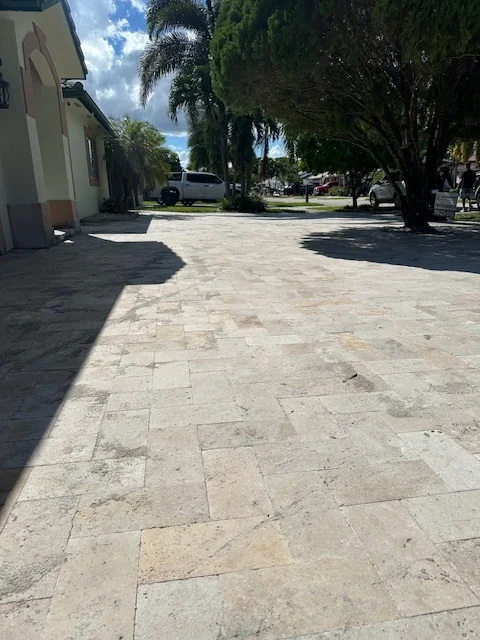
Travertine is the one people ask for around pools, and for a good reason: it stays noticeably cooler underfoot than concrete in direct sun. It is a natural stone, so there is variation between units, and it wants a sealer if it is somewhere that gets oil or heavy staining.
Of everything we install for homeowners, porcelain is the newest. What it brings is density: it soaks up almost no water and resists staining better than nearly anything else. What it demands is precision, both in the base, which has to be truly even, and in the cutting.
The shortcuts that surface two years later
Each of these hides under a clean new surface. Since the owner cannot see them at the end, they keep getting done.
Sealing too early
Fresh concrete pavers push a white residue to the surface as they cure. That is efflorescence, and it needs to finish before any sealer goes on. Seal in the first month and the haze can end up permanently under the coat.
Laying over the old surface
Paving over an old surface is a lot like painting over rust. It goes quickly and costs little, and the problem underneath keeps working. If the base caused the first failure, the new surface will show it again within a season or so.
Skipping the geotextile
A separation fabric between the subgrade and the base stops the two from mixing. Without it, fine soil migrates up into the aggregate, the base loses its structure, and you get settlement that no amount of surface work will fix.
Using the wrong sand in the bedding
If pavers are wandering out of line, check the bedding. It should be angular concrete sand with sharp grains. Rounded mason or beach sand rolls under load and lets them move.
The edge restraint is the piece nobody thinks about and the reason the field holds.
Common questions
What happens to the old surface
Breaking out the old surface is the first stage of the job. It gets loaded and hauled off, and we recycle the concrete and old pavers when a recycler is in reach. That work is written into the scope.
How do you keep it from settling again
A releveling that only lifts and resets the pavers will settle again, because whatever caused the dip is still there. Our fix starts underneath: rebuild the base in compacted layers, then sort out where the water is coming from, whether that is a downspout, a low grade or irrigation.
Do you work with HOAs and property managers
Yes. Property managers usually want clear communication and no surprises, and that is how we like to work too. Tell us what your approval process requires and we will work inside it.
Do you cover Miami, FL
Absolutely. We are headquartered in Miami, FL and work there regularly. The quickest way to find out how soon we could start is a phone call to 786-717-9244.
Is there a warranty
Yes, in writing, covering our workmanship. Manufacturer coverage on the pavers themselves comes from the manufacturer and we will hand you that paperwork too. We will also tell you plainly what a warranty does not cover, like a new root or a changed drainage condition.
Can you work around my pool being open
Usually. Pool deck work gets staged so you keep a safe path and the water stays covered while we cut. If there is a stretch where the pool has to be off limits we tell you which days up front.
Have somebody come look at it
Give us a look at it in person. We walk the whole property, pay attention to drainage, and write up what we found, which is quicker than trading descriptions over the phone.
Quality you can stand on