Custom Paver Installation done so it stays flat
Layouts drawn for your property instead of a pattern off a sheet.

What actually goes wrong
Almost every paver problem we get called out to is a base problem wearing a surface disguise. The pavers themselves are fine. They are concrete or stone, and they will outlast most of us. What moves is what is underneath them.
The water table sits high across a lot of the coast, so there is less room for water to go down and more reason for it to move sideways. That is what takes the sand out from under a driveway edge.
Tree roots lift more pavers than people expect. They chase water and the base holds water, so once a root grows into that layer it keeps raising the surface above it.
We would rather lose a bid than skip the base work, because the base work is the job. Everything above it is finish.
How we run this job
We come look at it
Somebody from the crew comes out, stands on the problem, and tells you what is actually going on underneath it. No sales visit, just a look and an honest read.
You get the plan in writing
Everything in writing up front: what we are doing, what it is made of, how long it takes, and what it costs. Nothing changes without you signing off on it.
We build the base first
Dig to depth, compact the aggregate in layers, screed the bedding. Nobody ever sees this part again, which is exactly why most failures start here.
Pavers go down and get cut in
Field laid to the pattern, edges cut on site, and a restraint set around the perimeter so the field cannot creep.
Joints get filled and the site gets cleaned
Sand swept in and compacted, surface washed, debris hauled by us. You get the property back the way we found it, minus the problem.
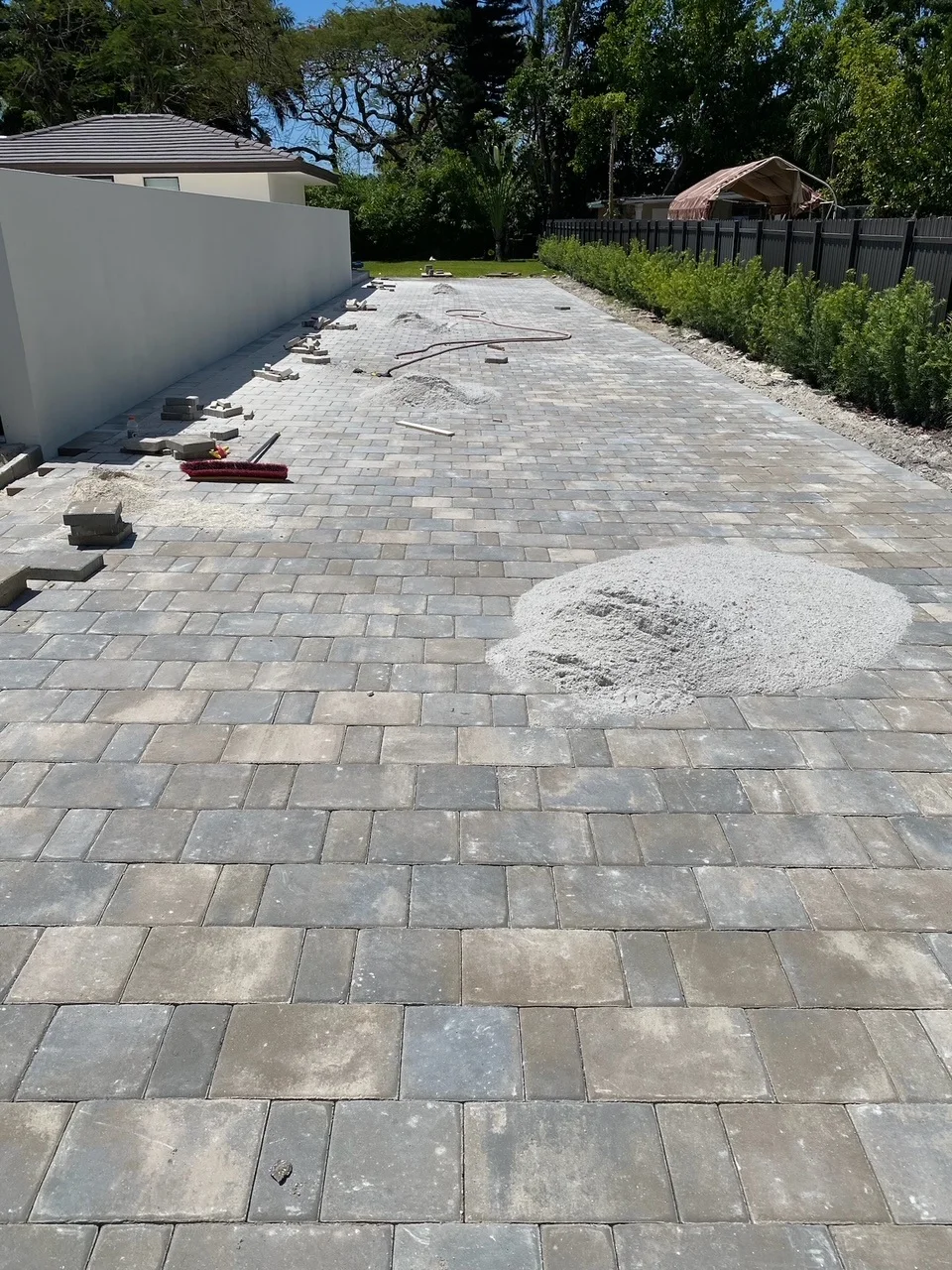
What a proper installation actually involves
Short version: the base gets as deep as the load needs. Foot traffic is light, so a walkway sits on a shallower base. A driveway is a different job the moment a loaded pickup parks on it every day, and a commercial drive taking delivery trucks is a bigger one again. We measure for the heaviest of those your surface will see. A contractor who quotes a garden path and a driveway at the same depth skipped that step.
The base is a stack of thin layers, each one compacted on its own. That is what building in lifts means. The shortcut is to spread all the aggregate in one go and compact the surface, which leaves a firm top over material that never got pressed down. For a while you cannot tell the difference. Then, about a year in, the surface starts settling in uneven spots.
A field of loose pavers only works because of what is under it. The pavers spread a load out sideways. The bedding course, a thin layer of sharp sand screeded perfectly flat, gives each one an even seat. Below that the compacted crushed aggregate base takes the weight and passes it down over a wider area, so the subgrade, your own soil, never feels the full point load of a tire. Take out the base and the pavers are just a pile of blocks.
The edge restraint is the piece nobody thinks about and the reason the field holds.
Most of the damage we see comes from water that was aimed at the pavers by accident. The downspout that dumps at the edge is the classic one. Irrigation is close behind, since a head spraying one spot twice a day keeps the base wet all year. A neighbor’s grade can do it too. Rain landing on the surface is rarely the culprit.
The grade under a patio or walkway has one job: get water off and away from the building. The pitch that does it is roughly an eighth to a quarter inch per foot. Underfoot it feels level. In a downpour you can watch the water move. Lose that fall and you get puddles, or worse, water running back toward the foundation.
Where the water goes once it leaves the surface is a real design question. On a tight lot with no fall available, that can mean a channel drain across the low edge, a permeable section that lets water through into a stone reservoir, or a regrade of the adjacent planting bed. All of those are cheaper to build now than to retrofit.
Fall
Built into the base at roughly an eighth to a quarter inch per foot, away from the building. Too slight to see, enough to move water.
Restraint
A perimeter edge restraint is what stops the field creeping outward and the joints opening from the outside in.
Joint sand
Structural, not cosmetic. It transfers load between units, which is the whole reason a field of loose pavers behaves like a surface.
More installation work
Our crews handle this across the region, and these are some of the areas we see most:
What it asks of you afterwards
Debris in the joints is the thing to stay ahead of. Leaves and grass clippings break down into soil, and soil in a joint is where weeds start. Sweep it out, keep the sand topped up, and a well-built surface will ask very little else of you.
Think of sealer as a coat you can choose to put on, and then have to keep putting on. It helps the joint sand stay put and gives stains less grip. Pick the wrong product and you get a shiny, plastic look you will not like, or a film that holds water under it. We tell people plainly when theirs is better left alone.
A lifted edge is the one problem worth fixing the week you notice it. Past about a quarter inch it becomes a trip hazard. Catching it early usually means resetting a few pavers. On a commercial property, waiting also means carrying a liability question until it is done.
Porcelain looks clean and stays clean, because it is dense enough that almost nothing soaks in. It is newer to residential work than the other materials, and it is less forgiving. An uneven bed under it shows, so we spend extra time on the base, and the cuts are slow work with the correct blade.
Concrete pavers cover the biggest share of what gets installed. They are pigmented through the body of the unit, so the sun fades them gently and evenly over time. New ones look a touch different from how they will look after a year or two, since the color settles as they cure out. Shapes and colors run wider than any other paver.
Concrete pavers shift in color as the sun works on them. Clay brick holds steady, because its color is the fired clay itself. Brick costs more and comes in fewer shapes, and it is the material to choose when the look has to hold for twenty years.
The shortcuts that surface two years later
None of these are visible on the day the work finishes, which is exactly why they keep happening.
Using the wrong sand in the bedding
Bedding wants sharp, angular concrete sand. Rounded mason sand or beach sand behaves like ball bearings under load and lets the pavers wander.
Sealing too early
Give new concrete pavers time before sealing. They have to cure and let efflorescence work its way out. Sealing during the first month risks catching that white bloom under the sealer, where it stays for good.
Laying over the old surface
A new surface laid over an old one usually looks fine for about a season. After that, the base that ruined the first surface starts ruining the second. Speed and price are the only things the shortcut buys you.
Skipping the geotextile
Geotextile fabric is a thin layer that does a big job. It sits on the subgrade and keeps the native soil out of the aggregate base. Leave it out and the fines work their way up over time until the base is half dirt, and then the surface starts to sink.
A sunken paver is a symptom. The base under it is the disease.
Common questions
How long does the job take
A typical custom paver installation job runs two to five working days once we start. Base work is the slow part; laying the field goes quickly. Weather moves things, and in summer we plan around the afternoon storms rather than pretending they will not happen.
Do I need to be home while you work
No. Many of our customers come home to a finished section after work. Just make sure we can reach the area and have a water source. Surprises get a same-day call.
Will the new pavers match what I already have
It depends mostly on whether the line is still made. If it is, we can usually get close, though sun and age shift the color of concrete pavers a little over time. If it has been discontinued, we show you the options before ordering, and that can include borrowing units from a less visible spot.
What happens to the old surface
We take it out and take it away. Old concrete and pavers get recycled where a facility is available, and hauling is built into the scope from the start, so there is no surprise charge at the end.
How do you keep it from settling again
We start with a question: where is the water going? That answer usually explains the settling. From there it is a matter of correcting the drainage and putting a proper base back in, plus handling any root or downspout feeding the problem.
Do you cover Miami, FL
Yes. Miami is where we are based, so it is about as close to home as our work gets. Give us a call and we will tell you when we can come out.
Start with a conversation
The quickest route to a straight answer is a visit. One of us comes out, walks it with you, watches where water heads, and writes it all down for you to keep.
Quality you can stand on