Paver Porch Installation, from the subgrade up
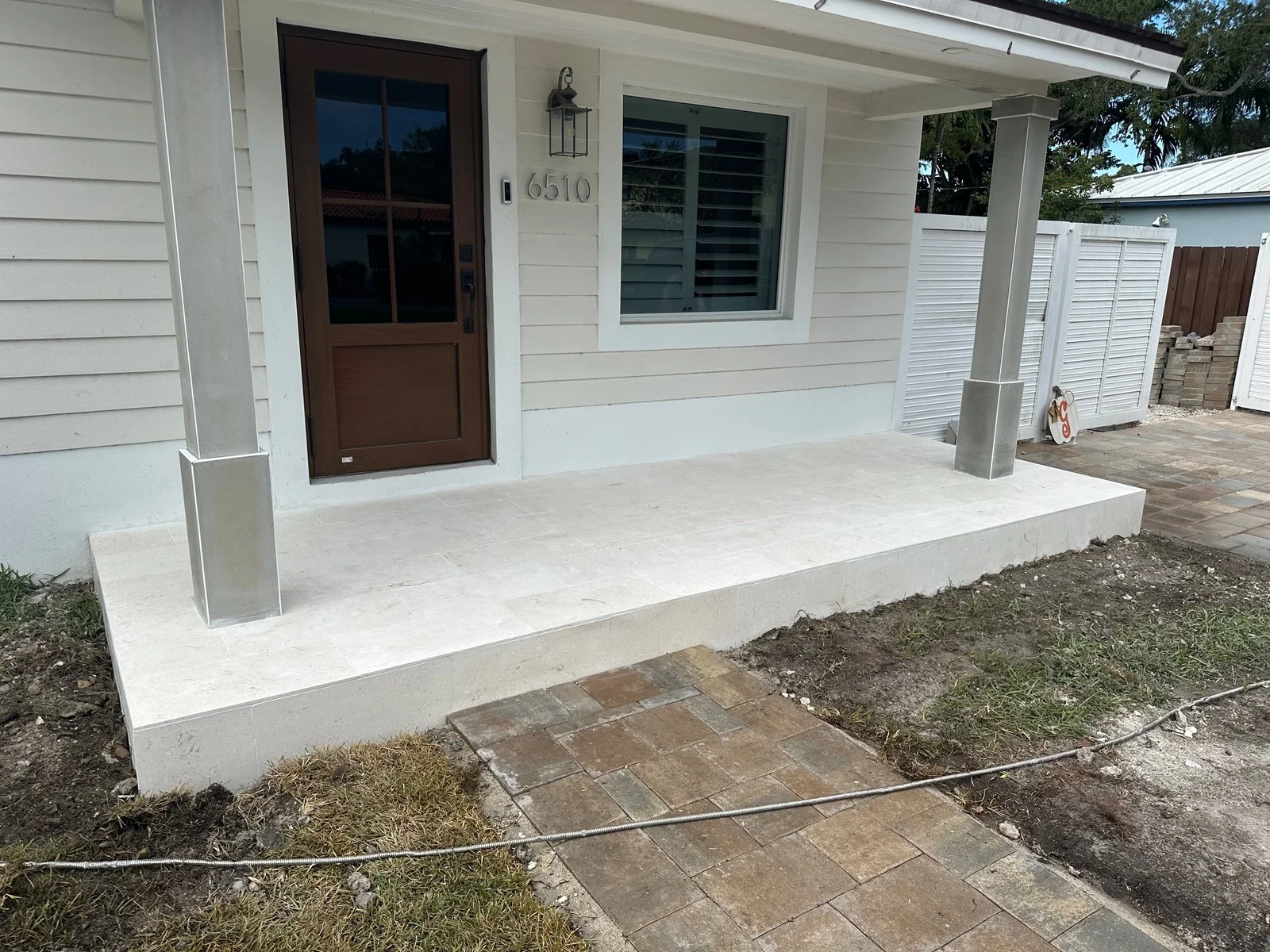
Porch floors set flat and drained away from the threshold.
What actually goes wrong
Here is the honest version: a sunken paver is a symptom. The base under it lost material, usually to water, and the surface settled into the gap. Resetting the pavers without correcting the base just buys you a season.
Water wants to go down, and across a lot of the coast it cannot go far. The water table is high, so it moves sideways through the ground. That sideways flow is what washes sand from under the edge of a driveway.
Tree roots lift more pavers than people expect. They chase water and the base holds water, so once a root grows into that layer it keeps raising the surface above it.
So the real question to ask anybody bidding this work is not what pavers they use. It is how deep they excavate, how they compact, and where they think your water goes. The answers tell you everything about how long the job will last.
How we run this job
We come look at it
We come out and see it with you. The walk covers the surface and where the water goes after it leaves. You get a plain answer, and if the fix is smaller than you feared, we tell you that first.
You get the plan in writing
Scope, materials, schedule, and cost on paper before a shovel moves. The number you approve is the number, not an opening position.
We build the base first
Excavation to the depth this job actually needs, aggregate compacted lift by lift, bedding screeded flat. The slow part, and the part that decides whether the surface is still flat in ten years.
Pavers go down and get cut in
Laying the field is the fast part. The care is in the cuts at the edges and the restraint that locks the whole field in place.
Joints get filled and the site gets cleaned
Sand swept in and compacted, the surface washed down, and the property left the way we found it. We haul our own debris.
What a proper installation actually involves
We work out depth by asking about the traffic. Mostly we want to know what parks on it and whether a truck ever backs onto it. A walkway carrying people gets a shallower base. A driveway with a loaded pickup on it daily gets more, and a commercial drive with deliveries gets more again. That number comes from your property, so it changes from job to job. When it never changes, it was a guess.
Loose aggregate under a hard crust is the failure nobody sees coming. It happens when a base is dumped in at full depth and compacted only at the surface. The top tightens up and the bottom never does, and once traffic and water work on it, the loose part shifts and the pavers above it sink in patches. Laying the base in lifts of a few inches, compacting each one, prevents it.
Most of the work on a paver job is buried by the end of it. You see the pavers. You do not see the compacted crushed aggregate base under them, which is the part carrying the load, or the screeded layer of sharp sand they sit in, or the subgrade at the bottom, which is just whatever soil the property came with. The pavers spread weight and take the wear. Holding the surface up is the base’s job, and that is where we spend our time.
Compaction in lifts is the difference between ten years and two.
A paver that rocks under your foot usually has an empty joint beside it. The sand between pavers is what passes load from one unit to its neighbors, so a step on one is shared across several. Once that sand washes out, each paver carries its own weight alone. That is when they start to move, and once they move, they start to crack.
If your patio has a cloudy film that will not rinse off, look at the joint sand. Polymeric sand binds when water hits it, which is great inside a joint because it resists washout far better than plain sand. On the paver face it is a problem. It must go in dry, be swept off the surface thoroughly before wetting, and be watered in as the manufacturer specifies. Rushing those steps leaves the haze.
Compaction
Loose stone under a firm crust is what a single dump and quick pass produces. Placing aggregate in lifts and compacting each one is how the base gets dense all the way through.
Fall
Set at roughly an eighth to a quarter inch per foot, away from the structure. Subtle to walk on, and the reason water leaves instead of standing.
Restraint
A perimeter edge restraint is what stops the field creeping outward and the joints opening from the outside in.
More installation work
We cover the whole region for this. Areas we work in regularly include:
What it asks of you afterwards
Pavers that went down on a proper base do not ask for much. Every so often, look at the joints. If the sand is low, refill it, and if leaves or dirt are packed in, clear them out. Watch for settling and deal with it while it is small.
Think of sealer as a coat you can choose to put on, and then have to keep putting on. It helps the joint sand stay put and gives stains less grip. Pick the wrong product and you get a shiny, plastic look you will not like, or a film that holds water under it. We tell people plainly when theirs is better left alone.
Our rule of thumb is a quarter inch. A paver edge lifted more than about that much is a trip hazard waiting for someone, and it should move to the top of the list. On commercial sites, add liability to the reasons, since a fall there is more than a maintenance problem.
Porcelain looks clean and stays clean, because it is dense enough that almost nothing soaks in. It is newer to residential work than the other materials, and it is less forgiving. An uneven bed under it shows, so we spend extra time on the base, and the cuts are slow work with the correct blade.
Concrete pavers are what most jobs end up using. Our crews lay them more than anything else, and a predictable unit means a cleaner layout with fewer surprises. Color comes from pigment mixed through the paver, so fading is gradual and even. Give it a year or two to settle into its final shade as it cures.
Clay brick keeps its color essentially forever because the color is the fired clay itself. It costs more, comes in fewer shapes, and it is the right answer when you want a surface that looks the same in twenty years.
How this gets done badly
Nothing on this list shows when the work is new. Each one waits a while before it surfaces, which is how it keeps getting repeated.
Using the wrong sand in the bedding
Pavers only hold their line if the bedding grips them. That takes sharp, angular concrete sand. Rounded mason or beach sand behaves like ball bearings once there is weight on it.
Sealing too early
Of all the shortcuts, early sealing is one of the hardest to undo. A new concrete paver has to cure and let its efflorescence come out before sealing. Seal it in the first month and that white haze can stay under the sealer permanently.
Laying over the old surface
A new surface laid over an old one usually looks fine for about a season. After that, the base that ruined the first surface starts ruining the second. Speed and price are the only things the shortcut buys you.
Skipping the geotextile
Fabric between the ground and the base is a small step that keeps the base doing its job. Sandy soil especially wants to wash up into the stone layer above it. When it does, the base loses its strength and you get low spots that come back no matter how often they are reset.
If nobody talks to you about drainage, they are quoting a different job.
Common questions
What happens to the old surface
Gone before the new base goes in. We demolish it, haul it, and recycle the concrete and pavers if a recycler is available locally. You will see it listed in the scope from the start.
How do you keep it from settling again
Settling is a symptom. The cause is almost always water or a weak base, and occasionally a tree root. We correct whichever one it is, rebuild the base where it failed, and then relay the pavers, so the spot has no reason to drop again.
Do you work with HOAs and property managers
We put together submittals for HOA boards and property managers regularly. Tell us what your approval process requires and we will work inside it, including phasing so residents keep access.
Do you cover Miami, FL
Yes. Miami is where we are based, so it is about as close to home as our work gets. Give us a call and we will tell you when we can come out.
Is there a warranty
We warranty our workmanship in writing. That is the part we control, and we stand behind it. Material coverage on the pavers is the manufacturer’s, and we hand that documentation over at the end. We are also straightforward about exclusions, such as new roots or drainage conditions that change after the install.
Can you work around my pool being open
Usually. Pool deck work gets staged so you keep a safe path and the water stays covered while we cut. If there is a stretch where the pool has to be off limits we tell you which days up front.
Let us walk the property
The quickest start is a call. Describe what is sinking or lifting, or send a couple of pictures, and we will tell you straight what we think it is and what it takes. Honest answers include ‘this can wait.’
Quality you can stand on