What large paver patios should actually involve
Big patios where drainage and jointing decide whether it lasts.
What actually goes wrong
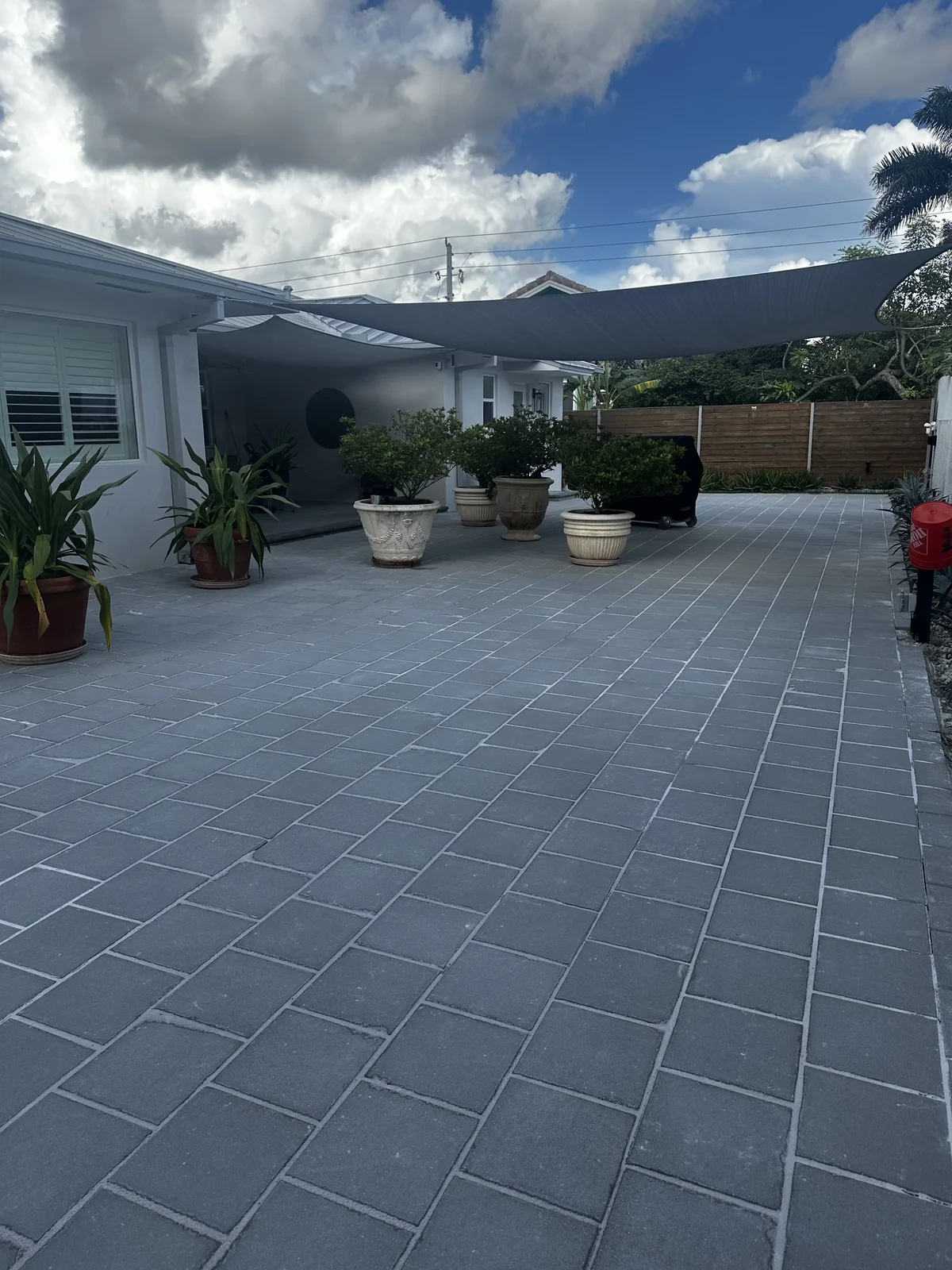
Here is the honest version: a sunken paver is a symptom. The base under it lost material, usually to water, and the surface settled into the gap. Resetting the pavers without correcting the base just buys you a season.
On the coast we design for water that moves sideways. The water table sits high in a lot of places, which leaves rain little room to soak downward. It travels across instead, and that is the movement that strips sand from under a driveway’s edge.
Some lifted pavers have nothing to do with water running off. Ficus, black olive and many older shade trees run roots shallow and wide, and a damp walkway base is exactly what they go looking for.
So the real question to ask anybody bidding this work is not what pavers they use. It is how deep they excavate, how they compact, and where they think your water goes. The answers tell you everything about how long the job will last.
How we run this job
We come look at it
Somebody from the crew comes out, stands on the problem, and tells you what is actually going on underneath it. No sales visit, just a look and an honest read.
You get the plan in writing
Scope, materials, schedule, and cost on paper before a shovel moves. The number you approve is the number, not an opening position.
We build the base first
Ten years from now, the surface is either flat or it is not, and the base decides which. That is why we start there: digging to the right depth, compacting aggregate in lifts, and screeding the bedding layer.
Pavers go down and get cut in
Laying the field is the fast part. The care is in the cuts at the edges and the restraint that locks the whole field in place.
Joints get filled and the site gets cleaned
Joints filled and set, everything washed down, our own debris on our own truck. The site is yours again the same day we finish.
What makes a patio last
Furniture is the quiet load. Table and chair legs concentrate weight on a tiny footprint and will dish an under-compacted patio in a season. Sun umbrellas with heavy bases are the usual culprit.
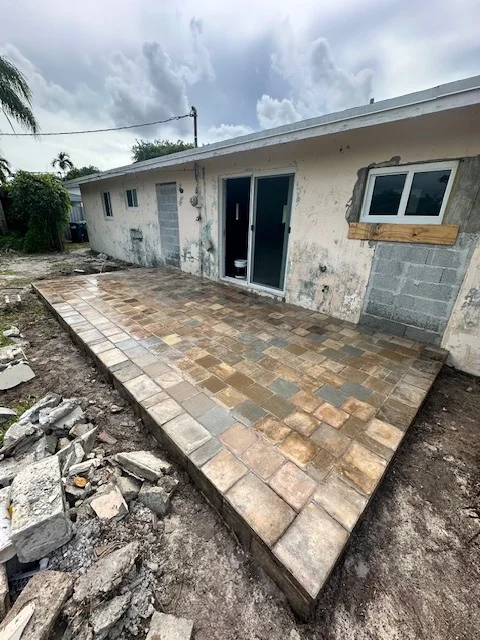
A patio carries people and furniture rather than vehicles, so the base can be shallower than a driveway. What it cannot be is badly drained. A patio that holds water grows algae, gets slick, and pushes moisture back at the house.
Fall away from the building is the whole game. A patio wants a gentle slope carrying water into the yard, never toward a slab or a door threshold. On a tight lot with no fall available that means a channel drain or a permeable section built in from the start.
Compaction in lifts is the difference between ten years and two.
Before we design anything, we find out where the water on the site comes from. The usual sources are a downspout discharging at the edge, an irrigation head spraying the same patch twice a day, and a neighboring grade sending runoff across a corner. Rain falling evenly on jointed pavers matters far less.
When water stands on pavers, the slope is usually the reason. A paver surface should fall about an eighth to a quarter inch per foot away from the building, a pitch you cannot feel underfoot that still moves water off. Flatten it and puddles form. Tip it the wrong way and runoff ends up at the foundation.
Water that leaves a paved area still has to go somewhere, and on a commercial property it tends to head for a doorway or the planting bed next to it. When the lot is tight and there is no fall to work with, we plan for it: a channel drain across the low edge, a permeable section into a stone reservoir, or a regrade of the bed alongside. Each is far cheaper during construction.
Base depth
Set by what the surface carries, not by habit. A walkway and a truck-bearing drive are not the same excavation.
Compaction
Each lift of aggregate gets compacted before the next one goes down. The shortcut, one dump and a quick pass, compacts the surface and leaves the rest loose.
Fall
Away from the building, always, at about an eighth to a quarter inch per foot. That small slope decides where every storm ends up.
More patio work
We are on jobs like this across the region. A handful of the places we work most:
What it asks of you afterwards
A well-laid surface mostly looks after itself. What it does need is joints that stay full, so add sand when you see it dropping, and attention to any low spot before it spreads. Catching settling early keeps the repair small.
Most sealing problems come down to the product. A sealer that is wrong for the material can leave a plastic-looking shine or hold moisture under it, and that is hard to undo. The right one, applied at the right time, deepens the color and keeps joint sand in place. Sealing stays optional, and we give you a straight answer on whether it is worth it here.
People walking across pavers are rarely looking at their feet, which is why a raised edge matters. More than about a quarter inch of lift is enough to catch a toe. Deal with that one quickly, especially on commercial property, where it is a liability concern along with a maintenance one.
Most of what we put down is concrete pavers. They come in more shapes and colors than any other option and lay up predictably. Years later, when you want to add on or patch, they are also the easiest to match. The pigment runs all the way through each unit, so sun softens the color over time and there is no surface coat to wear through.
Clay brick ages without changing color. The color is the fired clay, so sun has nothing to bleach out. It is more expensive and the shape options are narrower, and for a surface you want looking the same in twenty years, it is hard to beat.
Travertine is the one people ask for around pools, and for a good reason: it stays noticeably cooler underfoot than concrete in direct sun. It is a natural stone, so there is variation between units, and it wants a sealer if it is somewhere that gets oil or heavy staining.
Where these jobs go wrong
These shortcuts all pass a walk-through on day one. The problems arrive later, and that delay is why they stay common.
Sealing too early
Sealing is a timing job on new concrete pavers. They have to cure, and their efflorescence has to work out to the surface, before the sealer goes on. Rush it into the first month and the white haze gets sealed in.
Laying over the old surface
An overlay inherits everything beneath it. Settled spots and a soft base stay exactly where they were. If the base is what sank the old surface, the new layer just hides it for a season before the same failure comes back.
Skipping the geotextile
We put a geotextile down on the subgrade before any base goes in. Its whole purpose is separation. Soil stays below, aggregate stays above, and the base keeps the structure it was compacted into. Leave it out and the mixing happens slowly and does not reverse.
Using the wrong sand in the bedding
Cheap, rounded sand in the bedding layer is how pavers end up drifting. Mason sand and beach sand roll under load. Bedding should be sharp, angular concrete sand.
Water is what ends most paver surfaces, and it rarely arrives from the sky.
Common questions
Do I need to be home while you work
No. We need access and a water source. Most people go to work and come home to a finished section. If we hit something unexpected we call you that day, not at the end.
Will the new pavers match what I already have
Concrete pavers drift a little in color as the sun and the years work on them, so a fresh unit next to one that has been down a while can stand out. Sometimes we match exactly and sometimes closely. If we cannot get close enough, you see the options before we order.
What happens to the old surface
Removal and disposal are included. We break out whatever is there now and take it off the property. Where we can get it to a recycler, the old concrete and pavers go there.
How do you keep it from settling again
The answer depends on what made it settle, which is why we look before we price it. Drainage problems get corrected and a failed base gets dug out and rebuilt, and if a root is pushing, it gets dealt with too. Then the pavers go back down on a base with a reason to stay put.
Do you work with HOAs and property managers
HOA, condo and multifamily properties are a regular part of our work. We are used to board timelines and submittals, and we schedule in phases so residents can still get around. Tell us how your approvals work.
Do you cover Miami, FL
Miami, FL is squarely in our regular area. We work there most weeks. If you send a few photos of the job, we can usually tell you a lot before anyone even comes out.
Tell us what you are looking at
Send a couple of photos or just call. We will tell you what we think is going on, what it would take to fix, and whether it needs doing now or can wait.
Quality you can stand on