Paver Driveway Repair without the part that fails later
Fixing the sunken, shifted, or broken sections without redoing the whole drive.
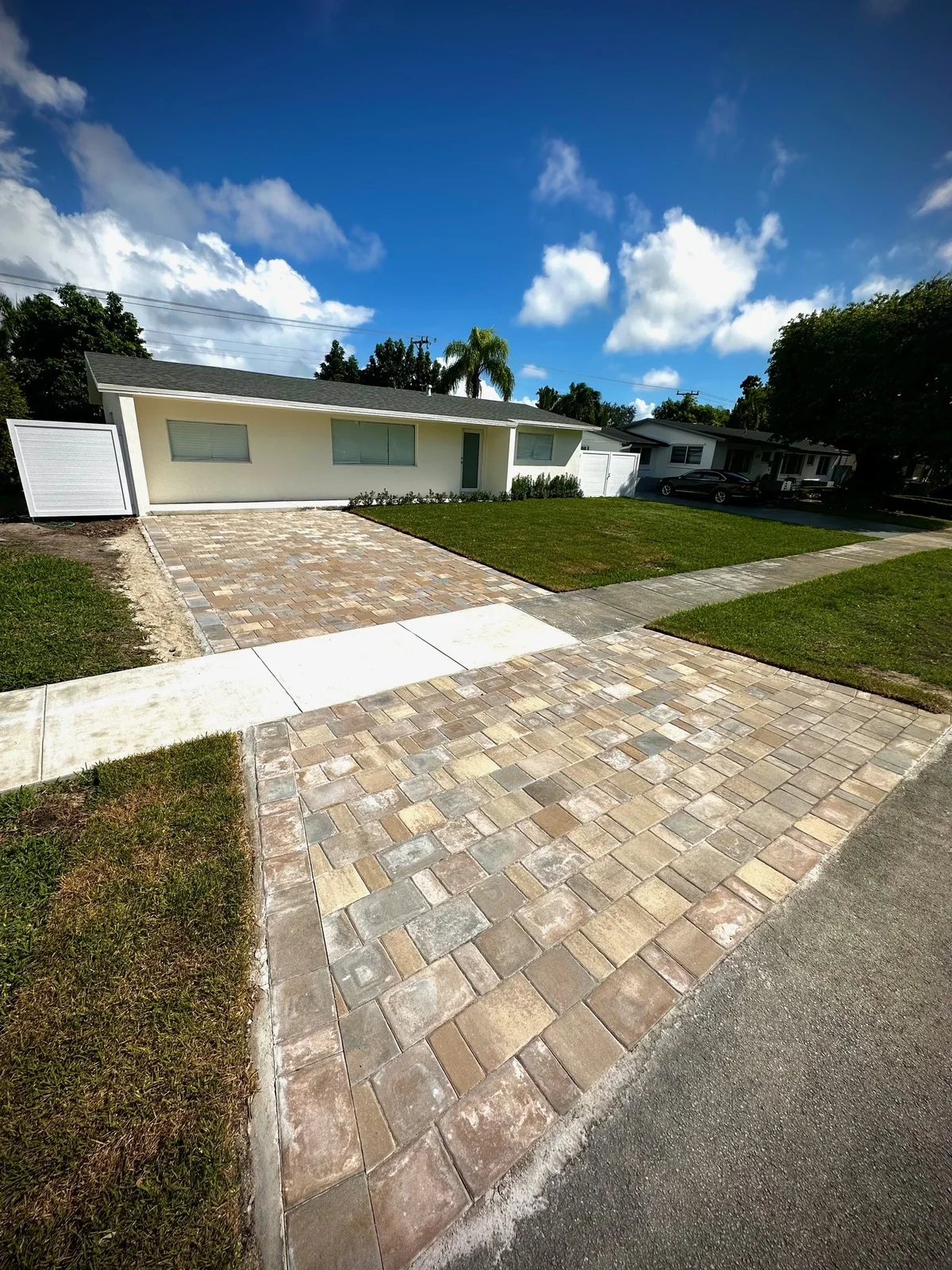
What actually goes wrong
Here is the honest version: a sunken paver is a symptom. The base under it lost material, usually to water, and the surface settled into the gap. Resetting the pavers without correcting the base just buys you a season.
The water table sits high across a lot of the coast, so there is less room for water to go down and more reason for it to move sideways. That is what takes the sand out from under a driveway edge.
Shade is nice until the roots arrive. Older trees like ficus and black olive spread their roots near the surface and a long way out, and they will follow moisture under a walkway and lift it.
We would rather lose a bid than skip the base work, because the base work is the job. Everything above it is finish.
How we run this job
We come look at it
We come out and see it with you. The walk covers the surface and where the water goes after it leaves. You get a plain answer, and if the fix is smaller than you feared, we tell you that first.
You get the plan in writing
Everything in writing up front: what we are doing, what it is made of, how long it takes, and what it costs. Nothing changes without you signing off on it.
We build the base first
Before a single paver goes down, we dig to the depth your job calls for and build the base up in compacted lifts. A screeded bedding layer goes on last. That buried work decides whether the surface is still flat ten years from now.
Pavers go down and get cut in
Field laid to the pattern, edges cut on site, and a restraint set around the perimeter so the field cannot creep.
Joints get filled and the site gets cleaned
Joints filled and set, everything washed down, our own debris on our own truck. The site is yours again the same day we finish.
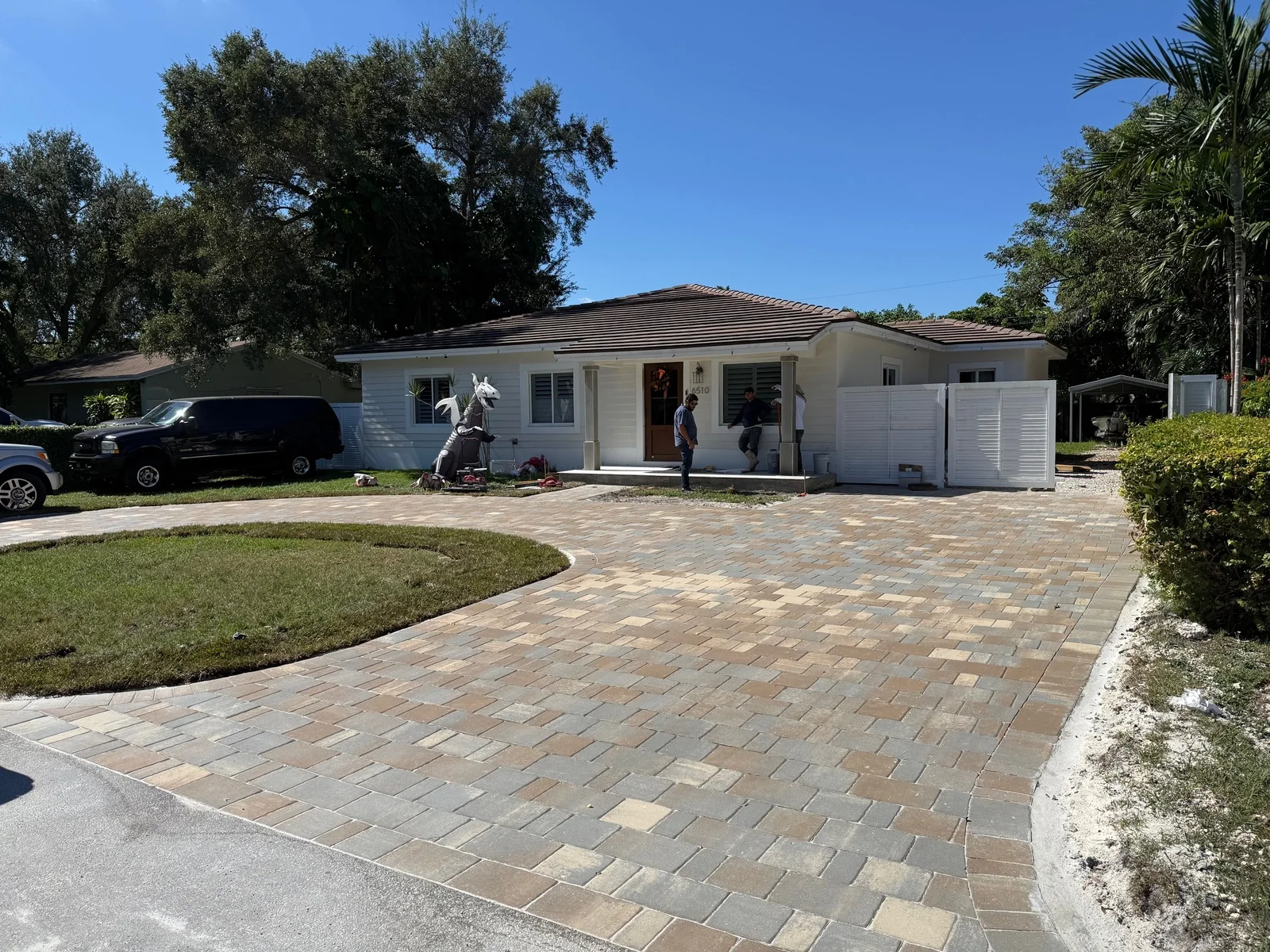
What a driveway asks of the ground under it
Width matters more than people expect. A drive built to the minimum feels fine until somebody steps out of a car onto wet grass every time it rains, and the edge course starts breaking down from being driven over.
A driveway is the only paver surface on most properties that carries a vehicle, and that changes everything under it. Passenger cars are not the design case; the design case is the delivery truck, the moving van, and the day somebody parks a loaded trailer on the apron.
The apron, where the drive meets the street, takes the worst of it. Vehicles turn there under load, which grinds and shoves the surface sideways rather than just pressing down. That is why aprons need the deepest base on the job and the most serious edge restraint.
A sunken paver is a symptom. The base under it is the disease.
If your patio has a cloudy film that will not rinse off, look at the joint sand. Polymeric sand binds when water hits it, which is great inside a joint because it resists washout far better than plain sand. On the paver face it is a problem. It must go in dry, be swept off the surface thoroughly before wetting, and be watered in as the manufacturer specifies. Rushing those steps leaves the haze.
Joints should be filled all the way, and kept that way. The sand in there is structural: it shares load from one paver to the next, and that sharing is what makes a set of loose units work like a surface. Half-full joints wash out faster, and once they do, every paver is carrying its own load. Rocking comes next, then cracking.
Compaction
Done in lifts, layer by layer. Dump it all at once and a quick pass leaves a hard crust sitting on loose material that settles later.
Fall
Roughly an eighth to a quarter inch per foot. Flat surfaces hold puddles and backward ones send water at the foundation, so the slope always runs away from the building.
Restraint
A perimeter edge restraint is what stops the field creeping outward and the joints opening from the outside in.
More driveway work
We take this work all over the region. Some of the places we are in most often:
What it asks of you afterwards
The main job is the joints. When the sand drops below the edge of the pavers, add more. When leaves collect in them, sweep them out before they rot and start growing weeds. A properly built surface really does not need much beyond that.
Whether to seal is your call. A good sealer brings the color up a shade and makes an oil drip or a spill easier to clean off. The tradeoff is upkeep, since it wears and has to be reapplied every few years, and the wrong product can leave a plastic shine or trap moisture underneath. We will tell you which way we would go on yours.
A lifted edge is the one problem worth fixing the week you notice it. Past about a quarter inch it becomes a trip hazard. Catching it early usually means resetting a few pavers. On a commercial property, waiting also means carrying a liability question until it is done.
Pool decks are where travertine earns its place. Bare feet notice the difference right away: in direct sun it runs cooler than concrete. Keep in mind that every unit is a little different, since it is quarried stone, and that areas exposed to oil or heavy staining should be sealed.
Porcelain is hard on a sloppy installer. It will not forgive a slightly uneven bed, so the base and bedding have to be dead accurate. Cutting it takes the right blade and time. Do that and you get a dense surface that barely absorbs anything and holds up well against stains.
Concrete pavers cover the biggest share of what gets installed. They are pigmented through the body of the unit, so the sun fades them gently and evenly over time. New ones look a touch different from how they will look after a year or two, since the color settles as they cure out. Shapes and colors run wider than any other paver.
How this gets done badly
Nothing on this list shows when the work is new. Each one waits a while before it surfaces, which is how it keeps getting repeated.
Laying over the old surface
It is the shortcut that costs the most later. A new surface on top of a failed one goes down fast and cheap, and it still sits on the same ground. If the base caused the original failure, the overlay hides it for one season.
Skipping the geotextile
Geotextile fabric is a thin layer that does a big job. It sits on the subgrade and keeps the native soil out of the aggregate base. Leave it out and the fines work their way up over time until the base is half dirt, and then the surface starts to sink.
Using the wrong sand in the bedding
Pavers only hold their line if the bedding grips them. That takes sharp, angular concrete sand. Rounded mason or beach sand behaves like ball bearings once there is weight on it.
Sealing too early
Give new concrete pavers time before sealing. They have to cure and let efflorescence work its way out. Sealing during the first month risks catching that white bloom under the sealer, where it stays for good.
Compaction in lifts is the difference between ten years and two.
Common questions
Do I need to be home while you work
No. We just need a way in and a water source to hook up to. If you want to check in, call us anytime, and if we hit something we did not plan for, we will be the ones calling you that day.
Will the new pavers match what I already have
It depends mostly on whether the line is still made. If it is, we can usually get close, though sun and age shift the color of concrete pavers a little over time. If it has been discontinued, we show you the options before ordering, and that can include borrowing units from a less visible spot.
What happens to the old surface
We take it out and take it away. Old concrete and pavers get recycled where a facility is available, and hauling is built into the scope from the start, so there is no surprise charge at the end.
How do you keep it from settling again
By fixing the reason it settled. That usually means correcting drainage and rebuilding the base properly, and sometimes it means dealing with a root or a downspout that is dumping water in the wrong place.
Do you work with HOAs and property managers
Yes, HOA and condo work is part of what we do. We prepare submittals for the board and phase the job so residents still get in and out. Tell us your approval steps and we follow them.
Do you cover Miami, FL
Yes. Being Miami-based means we are in and around Miami, FL almost every week. Ask us about scheduling when you call and you will get a clear answer.
Start with a conversation
The water usually explains the problem, so that is what we look at first. We come out, walk the property, trace where the water goes, and write up what we find. It is the fastest way to a real answer.
Quality you can stand on