Paver Driveway Replacement without the part that fails later
Tearing out a failed driveway and rebuilding it properly from the subgrade up.

What actually goes wrong
Almost every paver problem we get called out to is a base problem wearing a surface disguise. The pavers themselves are fine. They are concrete or stone, and they will outlast most of us. What moves is what is underneath them.
Summer rain in South Florida tends to show up all at once, and it lands on sandy ground that shifts when water runs through it. That combination puts more pressure on a paver base than a drier climate ever would. A base that would pass up north gets tested here every year.
Tree roots lift more pavers than people expect. They chase water and the base holds water, so once a root grows into that layer it keeps raising the surface above it.
That is why the schedule on our jobs is mostly spent on the part you will never see again. The surface takes a day or two. The ground it sits on takes the rest, and the ground is what you are actually paying for.
How we run this job
We come look at it
We look at it in person, with you there if you can be. The crew member who comes out checks the surface and the drainage around it and tells you straight what is happening. A smaller fix, when that is the truth, is what we recommend.
You get the plan in writing
Scope, materials, how long it takes, and what it costs, written down before anybody starts. No verbal numbers that change later.
We build the base first
Before a single paver goes down, we dig to the depth your job calls for and build the base up in compacted lifts. A screeded bedding layer goes on last. That buried work decides whether the surface is still flat ten years from now.
Pavers go down and get cut in
The field goes down to the pattern, edge cuts happen on site, and the perimeter gets a restraint so nothing creeps.
Joints get filled and the site gets cleaned
Sand swept in and compacted, surface washed, debris hauled by us. You get the property back the way we found it, minus the problem.
What a driveway asks of the ground under it
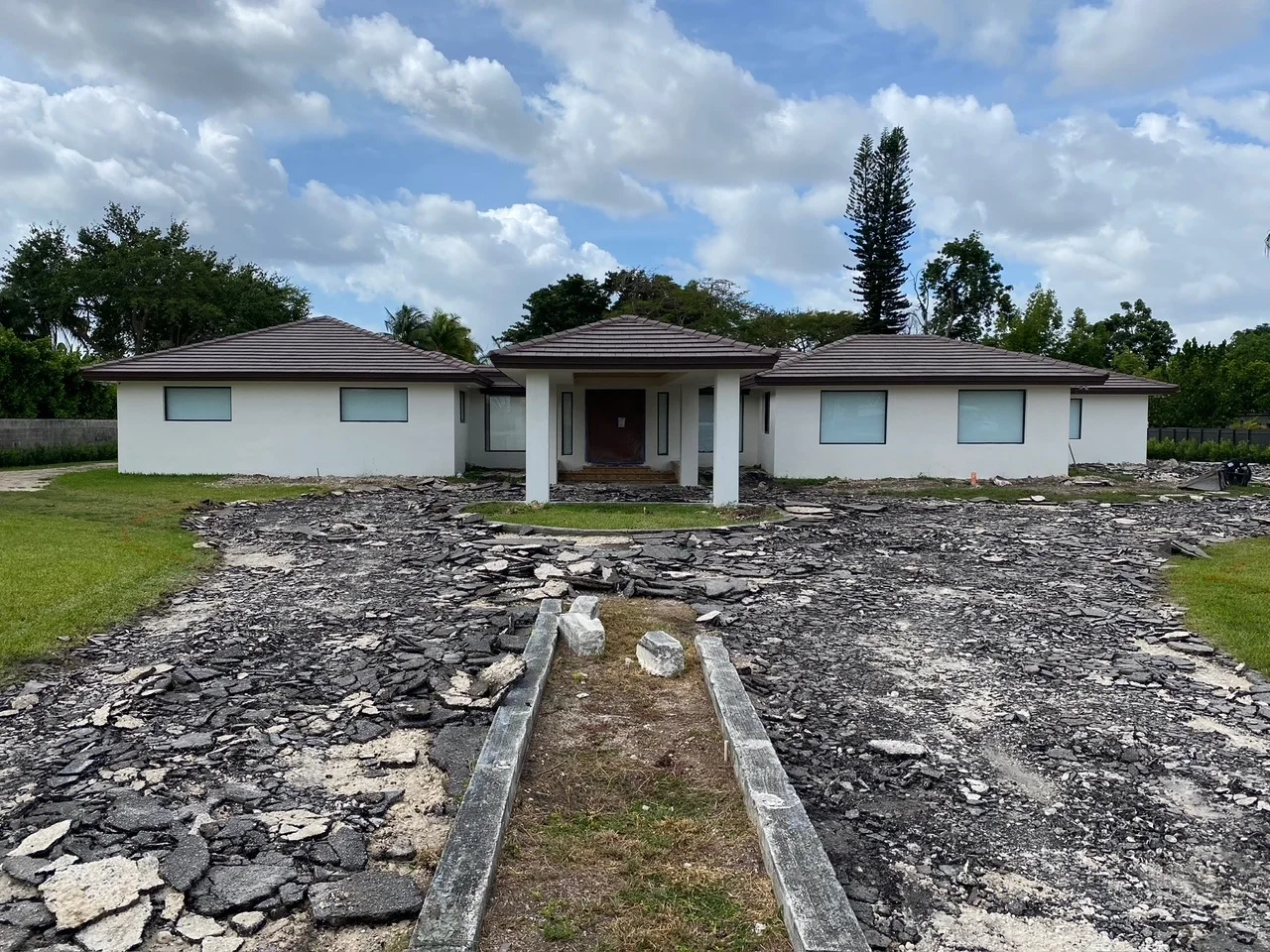
A driveway is the only paver surface on most properties that carries a vehicle, and that changes everything under it. Passenger cars are not the design case; the design case is the delivery truck, the moving van, and the day somebody parks a loaded trailer on the apron.
The apron, where the drive meets the street, takes the worst of it. Vehicles turn there under load, which grinds and shoves the surface sideways rather than just pressing down. That is why aprons need the deepest base on the job and the most serious edge restraint.
Width matters more than people expect. A drive built to the minimum feels fine until somebody steps out of a car onto wet grass every time it rains, and the edge course starts breaking down from being driven over.
If nobody talks to you about drainage, they are quoting a different job.
Most of the damage we see comes from water that was aimed at the pavers by accident. The downspout that dumps at the edge is the classic one. Irrigation is close behind, since a head spraying one spot twice a day keeps the base wet all year. A neighbor’s grade can do it too. Rain landing on the surface is rarely the culprit.
Every paver surface we build is pitched away from the building at roughly an eighth to a quarter inch per foot. You will never feel that slope when you walk across it. Water does feel it, and it runs off the edge instead of sitting in puddles or heading back toward your foundation, which are the two ways a bad grade shows itself.
On a flat commercial lot, a channel drain across the low edge is often the cleanest answer. It catches sheet flow before it reaches a doorway or a parking stall. Where there is no fall to send water anywhere, a permeable section can let it soak through into a stone reservoir underneath, and sometimes the right move is regrading the planting bed alongside. We decide that during design, while it is still easy.
Base depth
Set by what the surface carries, not by habit. A walkway and a truck-bearing drive are not the same excavation.
Compaction
Firm from top to bottom, which takes lifts. Aggregate goes down a layer at a time and each layer is compacted. A single dump gets a crust and little else.
Fall
About an eighth to a quarter inch of drop per foot, heading away from the building. You will never feel it. The water will.
More driveway work
Our crews handle this across the region, and these are some of the areas we see most:
What it asks of you afterwards
Whether to seal is your call. A good sealer brings the color up a shade and makes an oil drip or a spill easier to clean off. The tradeoff is upkeep, since it wears and has to be reapplied every few years, and the wrong product can leave a plastic shine or trap moisture underneath. We will tell you which way we would go on yours.
Our rule of thumb is a quarter inch. A paver edge lifted more than about that much is a trip hazard waiting for someone, and it should move to the top of the list. On commercial sites, add liability to the reasons, since a fall there is more than a maintenance problem.
A paver surface that was built properly asks for very little. Keep the joints topped up, keep organic debris from composting in them, and deal with a settled area while it is small. That is genuinely most of it.
Concrete pavers carry their color through the whole unit. Sun will mellow it slowly over the years, and there is no surface layer to wear off. Expect some shift in the first year or two while the paver finishes curing, which is normal. This is the material behind most of the driveways, patios and walkways we build, because it is predictable to lay and easy to match later.
Concrete pavers shift in color as the sun works on them. Clay brick holds steady, because its color is the fired clay itself. Brick costs more and comes in fewer shapes, and it is the material to choose when the look has to hold for twenty years.
Travertine gets requested for pool decks because it stays noticeably cooler than concrete under bare feet in the sun. It does want a sealer if the area sees oil or heavy staining, and as a natural stone, expect variation from one unit to the next.
What we see when somebody else did it
None of these leave a mark you could spot at the final walk. That is the whole reason they keep coming back.
Sealing too early
Everybody wants the new pavers sealed right away. That is the mistake. Concrete pavers need to cure and clear their efflorescence first, and sealing in the first month can lock a white haze under the sealer permanently.
Laying over the old surface
Skipping the tear-out saves time and some money. It also keeps every defect in the ground below. If a weak base is what wrecked the old surface, the new one hides that failure briefly and then repeats it.
Skipping the geotextile
Fine soil moves. Water carries it and traffic pumps it, and without a barrier it ends up in the aggregate base. A layer of separation fabric under the base stops that. Skip it and the base gradually turns soft, and the settlement it causes sits below anything a surface repair can reach.
Using the wrong sand in the bedding
Sand looks like sand until a truck rolls over it. Sharp, angular concrete sand grips. Rounded sand, the mason or beach kind, rolls under the load and lets pavers slide out of place.
The pavers are a wearing surface. The base is the building.
Common questions
Do I need to be home while you work
You can go to work as usual. We need to be able to reach the work area and use your water. If anything changes the plan, like what we find once the old surface is up, we call you that day.
Will the new pavers match what I already have
It depends mostly on whether the line is still made. If it is, we can usually get close, though sun and age shift the color of concrete pavers a little over time. If it has been discontinued, we show you the options before ordering, and that can include borrowing units from a less visible spot.
What happens to the old surface
Gone before the new base goes in. We demolish it, haul it, and recycle the concrete and pavers if a recycler is available locally. You will see it listed in the scope from the start.
How do you keep it from settling again
Most of the time it comes down to the base. If it was laid too thin or compacted in one pass, we dig it out and rebuild it in lifts, then check that water is leaving the area the way it should. Fixing the surface without the base just repeats the problem.
Do you work with HOAs and property managers
Regularly. We phase the work so residents can still reach their doors and parking while each section is rebuilt, and we fit into whatever approval process your board runs.
Do you cover Miami, FL
Yes. Miami is where Paverson is based, and we work across the city regularly. Reach us by phone or at info@paverson.com and we will tell you honestly how soon we could get there.
Let us walk the property
The quickest start is a call. Describe what is sinking or lifting, or send a couple of pictures, and we will tell you straight what we think it is and what it takes. Honest answers include ‘this can wait.’
Quality you can stand on