What paver area drain installation should actually involve
Area drains for the low corner that never dries out.
What actually goes wrong
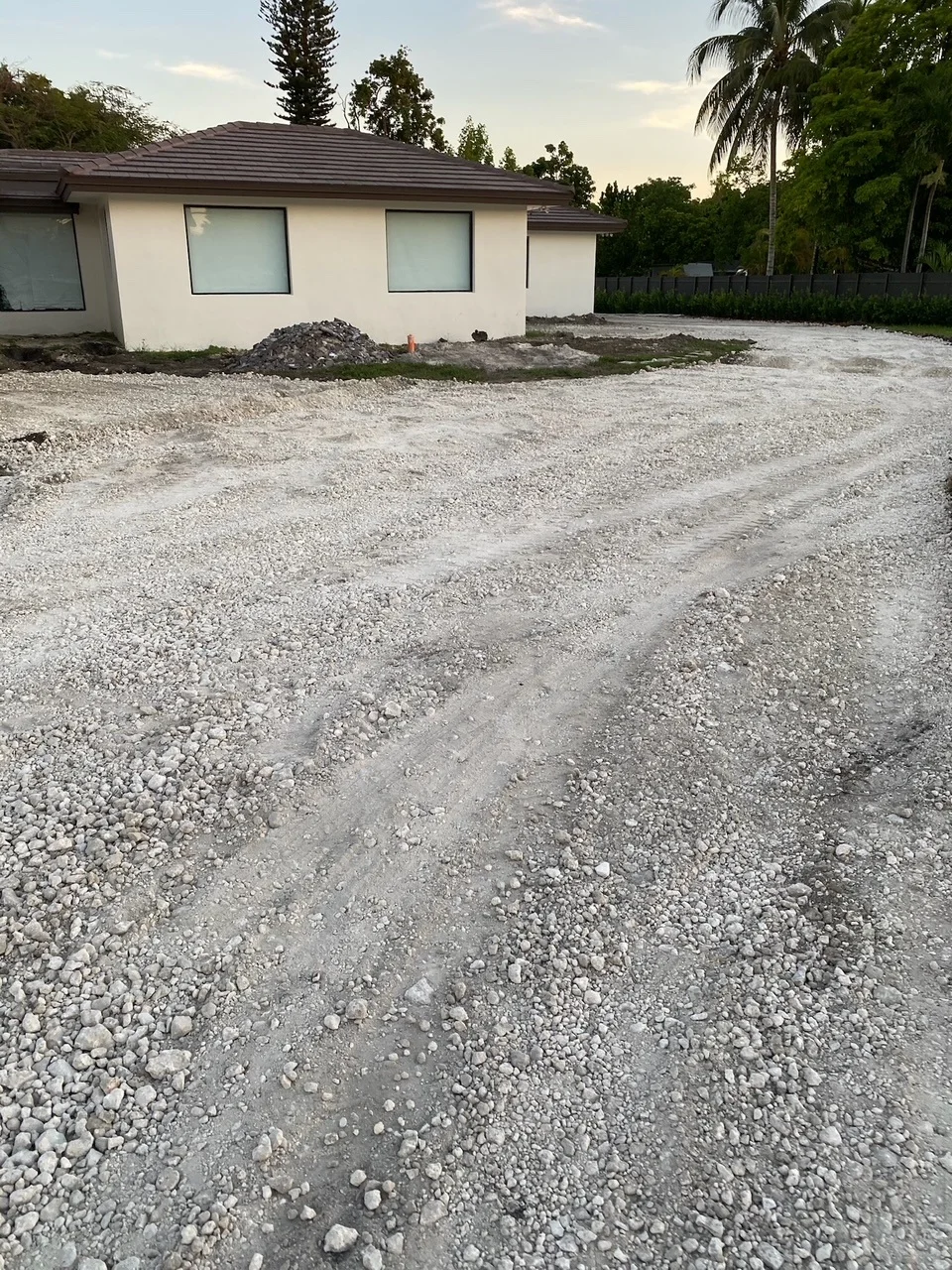
The failure is almost always below the pavers. Sand washes out of the joints, water gets down into the bedding, the bedding migrates, and the surface drops. Everything you can see is downstream of that.
Our ground is sand over limestone in most of the region, and sand drains fast right up until it does not. Add an afternoon storm that drops two inches in an hour and the base either handles it or it starts washing.
Large trees near a paver surface cause a lot of lifting. Their roots follow moisture, and the base under pavers holds plenty of it. Over the years they push in and raise the surface.
None of this is visible in a finished photo, which is why the cheap version and the right version look identical on day one. They stop looking identical around year two.
How we run this job
We come look at it
The first step is a walk-through. A crew member looks at the surface and where water drains on your property, then talks it through with you on site. If less work will solve it, that is what we recommend.
You get the plan in writing
Everything in writing up front: what we are doing, what it is made of, how long it takes, and what it costs. Nothing changes without you signing off on it.
We build the base first
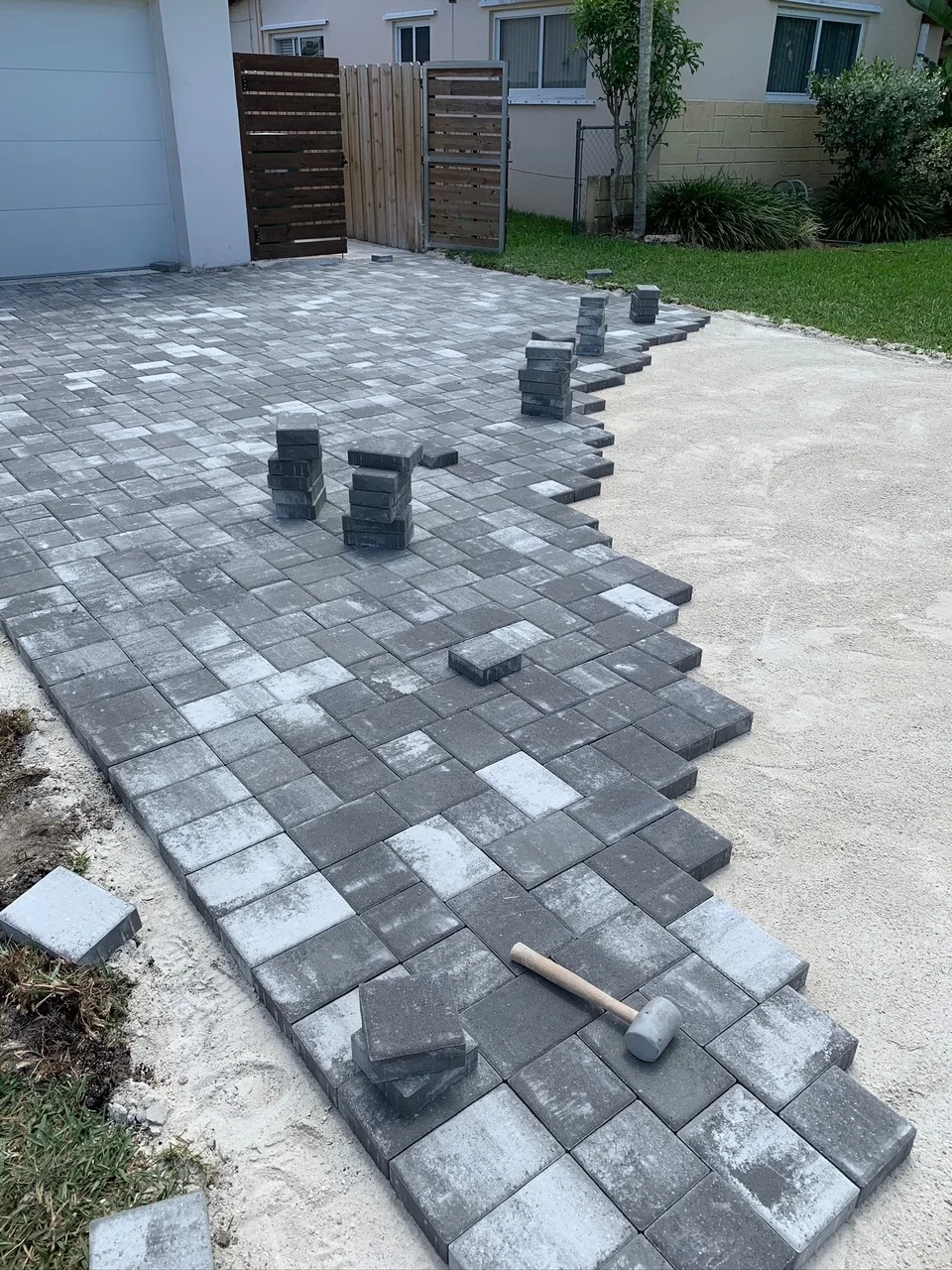
The base comes first and gets most of our attention. Excavation goes as deep as the load requires. Aggregate is compacted layer by layer, then the bedding is screeded flat. You will not see any of it once the pavers are in.
Pavers go down and get cut in
The field goes down to the pattern, edge cuts happen on site, and the perimeter gets a restraint so nothing creeps.
Joints get filled and the site gets cleaned
Joints filled and set, everything washed down, our own debris on our own truck. The site is yours again the same day we finish.
Where the water goes when it rains here
A paver surface is really four layers and only one of them is visible. Under the pavers there is a thin bedding course of sharp sand, screeded dead flat. Under that is the base, which is compacted crushed aggregate and does the actual structural work. Under that is the subgrade, which is whatever your property is made of. The pavers on top are a wearing surface. They spread load and they look good, but they are not what holds the thing up.
The same paver can go on a garden path or a delivery drive. What changes is everything under it. People on foot put very little load on a base, so a walkway can sit shallow. A driveway with a loaded pickup on it every day needs more depth, and a commercial drive that takes delivery trucks needs the most. Picking the paver is the easy decision. Sizing the base is the one that gets measured.
Compaction has to happen in lifts. That means putting the aggregate down in layers of a few inches and compacting each one before the next goes on. Dump the whole depth in at once and run a plate over the top and you get a hard crust over loose material, which behaves fine for a year and then starts settling in patches. This is the single most common corner cut in the trade and it is invisible on day one.
Water is what ends most paver surfaces, and it rarely arrives from the sky.
The rain that falls on your pavers is the least of it. A well-jointed surface sheds most of that. The water that undermines a base is water delivered to one spot again and again, from a gutter downspout, an irrigation head, or the slope of the property next door. We look for those sources on every walk.
Ask whoever is pricing your job what fall they are building in. The answer should be around an eighth to a quarter inch per foot, away from the building. That is enough for water to leave the surface and gentle enough that it feels flat underfoot. Flat surfaces puddle, and surfaces graded the wrong way push water at the foundation.
Sometimes the fix for commercial drainage is in the planting next to the pavers. Regrading the adjacent bed can give water somewhere to go when the paved area itself has no fall. Where that is not enough, a channel drain along the low edge or a permeable section over a stone reservoir does the job. Whichever it is, we build it with the paving, which costs a lot less than a retrofit.
Compaction
Done in lifts, layer by layer. Dump it all at once and a quick pass leaves a hard crust sitting on loose material that settles later.
Fall
Built into the base at roughly an eighth to a quarter inch per foot, away from the building. Too slight to see, enough to move water.
Restraint
A perimeter edge restraint is what stops the field creeping outward and the joints opening from the outside in.
More drainage work
This service runs across our whole region. Some of the areas where we do the most of it:
What it asks of you afterwards
If you like the look of freshly wet pavers, sealing gets you close to that all the time. It also makes stains easier to lift and helps hold the joint sand. What it asks of you is a recoat every few years and some care in choosing a product, since the wrong one can look plasticky or trap moisture. We will be straight with you about whether yours needs it.
On a commercial property, a lifted paver is a liability item before it is a repair item. An edge that rises more than about a quarter inch above the surface around it is enough to catch a toe, so it deserves a quick response rather than a spot on next year’s list.
A paver surface that was built properly asks for very little. Keep the joints topped up, keep organic debris from composting in them, and deal with a settled area while it is small. That is genuinely most of it.
Concrete pavers are the easiest material to live with over the long run. If one cracks or a section needs resetting, matching it is usually straightforward. The color is part of the paver itself, so it softens gradually in the sun. It also changes a little in the first year or two as the units cure, which surprises some owners, so we mention it up front.
Concrete pavers shift in color as the sun works on them. Clay brick holds steady, because its color is the fired clay itself. Brick costs more and comes in fewer shapes, and it is the material to choose when the look has to hold for twenty years.
Pool decks are where travertine earns its place. Bare feet notice the difference right away: in direct sun it runs cooler than concrete. Keep in mind that every unit is a little different, since it is quarried stone, and that areas exposed to oil or heavy staining should be sealed.
Where these jobs go wrong
These are the mistakes you cannot catch by looking at a fresh install. That is exactly what keeps them in circulation.
Skipping the geotextile
Without a separation layer, the subgrade and the base slowly trade places. Soil particles ride water up into the stone while the stone presses down into the soil, and the base gets thinner every year. Surface repairs do nothing for that kind of settlement.
Using the wrong sand in the bedding
Using whatever sand is on the truck is a common shortcut. Bedding has to be sharp, angular concrete sand, because rounded mason or beach sand lets pavers drift once weight goes on them.
Sealing too early
A new concrete paver needs to cure and let its efflorescence work out before it gets sealed. Seal it in the first month and you can lock a white haze under the sealer permanently.
Laying over the old surface
Skipping the tear-out saves time and some money. It also keeps every defect in the ground below. If a weak base is what wrecked the old surface, the new one hides that failure briefly and then repeats it.
The pavers are a wearing surface. The base is the building.
Common questions
How long does the job take
A typical paver area drain installation job runs two to five working days once we start. Base work is the slow part; laying the field goes quickly. Weather moves things, and in summer we plan around the afternoon storms rather than pretending they will not happen.
Do I need to be home while you work
You do not. As long as we can get to the work area and hook up to an outside spigot, the crew can work while you are out. If something unexpected turns up, you hear from us that same day.
Will the new pavers match what I already have
New pavers start out looking newer than the ones already down, because concrete pavers change color a little with sun and age. Sometimes the match is exact and sometimes it is close. When a line is discontinued or the difference is too obvious, we walk you through the options before anything gets ordered.
What happens to the old surface
We remove it. Breaking out and hauling the old concrete or pavers is a normal part of our scope, and where a recycler is available, that material gets recycled instead of landfilled.
How do you keep it from settling again
By fixing the reason it settled. That usually means correcting drainage and rebuilding the base properly, and sometimes it means dealing with a root or a downspout that is dumping water in the wrong place.
Do you cover Miami, FL
Yes. We are based in Miami, and our working area reaches about 100 miles out from there, so Miami itself is never a stretch. Call and ask what our schedule looks like.
Start with a conversation
A real answer comes from being there. We will walk the property, follow where the water goes, and give you a written account of what we see, so you are not guessing from a phone call.
Quality you can stand on