Outdoor Pavers done so it stays flat
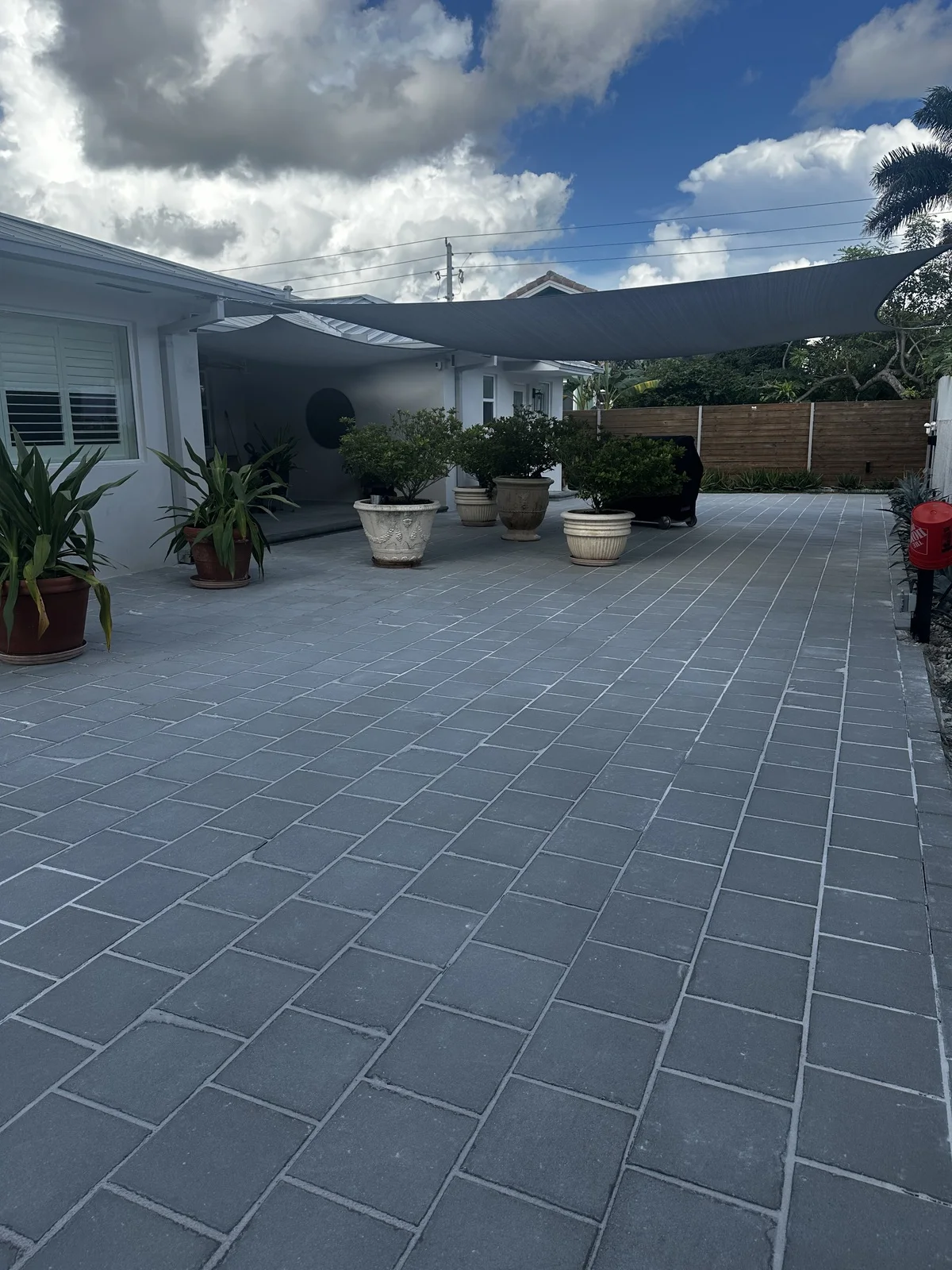
Floors for outdoor rooms: kitchens, fire pits, courtyards, lanais.
What actually goes wrong
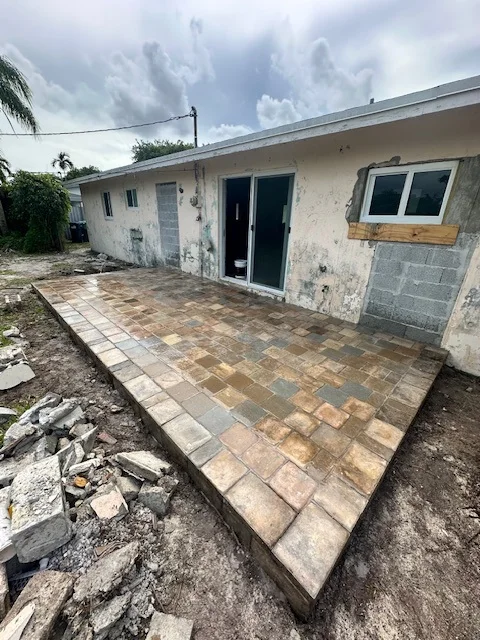
Almost every paver problem we get called out to is a base problem wearing a surface disguise. The pavers themselves are fine. They are concrete or stone, and they will outlast most of us. What moves is what is underneath them.
South Florida gives us two things that make base work matter more than it does up north: sand that moves when water runs through it, and rain that arrives all at once. A base that would be fine in a dry climate gets tested here every summer.
Mature trees are the second cause. Roots go where the water is, and a paver base holds moisture, so they grow straight into it and push the surface up.
None of this is visible in a finished photo, which is why the cheap version and the right version look identical on day one. They stop looking identical around year two.
How we run this job
We come look at it
One of us walks the property with you, looks at where the water goes, and gives you a straight read on what we see. If it is smaller than you feared, we say so.
You get the plan in writing
Scope, materials, schedule, and cost on paper before a shovel moves. The number you approve is the number, not an opening position.
We build the base first
Dig to depth, compact the aggregate in layers, screed the bedding. Nobody ever sees this part again, which is exactly why most failures start here.
Pavers go down and get cut in
Laying the field is the fast part. The care is in the cuts at the edges and the restraint that locks the whole field in place.
Joints get filled and the site gets cleaned
Sand swept in and compacted, surface washed, debris hauled by us. You get the property back the way we found it, minus the problem.
What outdoor rooms do to a surface
Heat is a real material constraint around fire features. Some units spall when they take repeated direct heat, so the ring immediately around a fire pit gets specified differently from the field around it.
Outdoor living surfaces get treated as furniture rather than pavement, which is exactly how they fail. A kitchen run takes grease and heat; a fire feature takes heat and foot traffic in the dark; a lanai floor lives under a cage that concentrates runoff.
Under a screen enclosure the cuts have to be clean to the track and the drainage has to work with the cage rather than against it. Water coming off a cage lands in a line, not spread out, so it concentrates in one place.
If nobody talks to you about drainage, they are quoting a different job.
Water is the thing that ends most paver surfaces, and it almost never arrives from where people expect. It is rarely the rain landing on the pavers, because a properly jointed field sheds most of that. It is the downspout discharging at the edge, the irrigation head spraying the same spot twice a day, or the neighboring grade sending runoff across the corner.
Fall matters more than people think. A paver surface wants a slope of roughly an eighth to a quarter inch per foot away from the building. That is subtle enough that you will not notice it walking on it and steep enough that water leaves instead of standing. Get it flat and you get puddles; get it backwards and you send water at the foundation.
Where the water goes once it leaves the surface is a real design question. On a tight lot with no fall available, that can mean a channel drain across the low edge, a permeable section that lets water through into a stone reservoir, or a regrade of the adjacent planting bed. All of those are cheaper to build now than to retrofit.
Restraint
A perimeter edge restraint is what stops the field creeping outward and the joints opening from the outside in.
Joint sand
Structural, not cosmetic. It transfers load between units, which is the whole reason a field of loose pavers behaves like a surface.
Separation
Geotextile between subgrade and base stops fine soil migrating up and destroying the aggregate structure.
More outdoor work
We cover this across the region. A few of the areas we work most:
What it asks of you afterwards
A paver surface that was built properly asks for very little. Keep the joints topped up, keep organic debris from composting in them, and deal with a settled area while it is small. That is genuinely most of it.
Sealing is optional and it is a preference rather than a requirement. It deepens the color, makes stains easier to lift, and helps hold joint sand. It also needs redoing every few years and a bad sealer choice can leave a plastic-looking sheen or trap moisture. We will tell you honestly whether your surface benefits.
The thing worth acting on quickly is a trip hazard. A lifted edge of more than about a quarter inch is something somebody will catch a toe on, and on a commercial property that is a liability question as well as a maintenance one.
Porcelain is the newest of these in residential work. It is dense, absorbs almost nothing, and is close to stain-proof. It needs precise base work because it is unforgiving of an uneven bed, and cutting it takes the right blade and patience.
Concrete pavers are the workhorse and cover most of what gets installed. Widest range of shapes and colors, most predictable to lay, and the easiest to match later. Color is pigment through the unit, so it fades gently with sun rather than wearing off, though it does shift over the first year or two as it cures out.
Clay brick keeps its color essentially forever because the color is the fired clay itself. It costs more, comes in fewer shapes, and it is the right answer when you want a surface that looks the same in twenty years.
The failures we get called out to fix
None of these are visible on the day the work finishes, which is exactly why they keep happening.
Using the wrong sand in the bedding
Bedding wants sharp, angular concrete sand. Rounded mason sand or beach sand behaves like ball bearings under load and lets the pavers wander.
Sealing too early
A new concrete paver needs to cure and let its efflorescence work out before it gets sealed. Seal it in the first month and you can lock a white haze under the sealer permanently.
Laying over the old surface
It is quick, it is cheap, and it inherits every problem underneath. If the base was the reason the old surface failed, putting a new one on top of it just hides the failure for a season.
Skipping the geotextile
A separation fabric between the subgrade and the base stops the two from mixing. Without it, fine soil migrates up into the aggregate, the base loses its structure, and you get settlement that no amount of surface work will fix.
A sunken paver is a symptom. The base under it is the disease.
Common questions
Will the new pavers match what I already have
Sometimes exactly, sometimes closely. Concrete pavers change color a little with sun and age, and older lines get discontinued. If we cannot match, we will show you the options before we order anything, including pulling units from a less visible area to patch a visible one.
What happens to the old surface
We break it out and haul it off. Concrete and old pavers go to a recycler where one is available. That is included in the scope, not added on after.
How do you keep it from settling again
By fixing the reason it settled. That usually means correcting drainage and rebuilding the base properly, and sometimes it means dealing with a root or a downspout that is dumping water in the wrong place.
Do you work with HOAs and property managers
Regularly. We are used to submittals, board timelines, and phasing work so residents keep access. Tell us what your approval process looks like and we will work inside it.
Do you cover Miami, FL
Yes. Miami, FL is inside our regular working area and we are out that way most weeks. Call and we will tell you honestly when we could get to you.
Is there a warranty
Yes, in writing, covering our workmanship. Manufacturer coverage on the pavers themselves comes from the manufacturer and we will hand you that paperwork too. We will also tell you plainly what a warranty does not cover, like a new root or a changed drainage condition.
Start with a conversation
The fastest way to get a real answer is to have one of us stand on it. We will walk the property, look at where the water goes, and write up what we find.
Quality you can stand on