Paver Seating Area Installation, from the subgrade up
Defined seating zones that read as a room instead of leftover space.
What actually goes wrong
The failure is almost always below the pavers. Sand washes out of the joints, water gets down into the bedding, the bedding migrates, and the surface drops. Everything you can see is downstream of that.
We pay extra attention to driveway edges on the coast. A high water table means rain cannot sink very far, so it moves sideways through the ground, and the edge is where that flow pulls sand out first.
The second common cause is roots. Shallow, wide root systems on ficus, black olive and older shade trees head toward moisture, and the ground under a walkway holds plenty of it.
That is why the schedule on our jobs is mostly spent on the part you will never see again. The surface takes a day or two. The ground it sits on takes the rest, and the ground is what you are actually paying for.
How we run this job
We come look at it
Somebody from the crew comes out, stands on the problem, and tells you what is actually going on underneath it. No sales visit, just a look and an honest read.
You get the plan in writing
Scope, materials, schedule, and cost on paper before a shovel moves. The number you approve is the number, not an opening position.
We build the base first
Excavation to the depth this job actually needs, aggregate compacted lift by lift, bedding screeded flat. The slow part, and the part that decides whether the surface is still flat in ten years.
Pavers go down and get cut in
Laying the field is the fast part. The care is in the cuts at the edges and the restraint that locks the whole field in place.
Joints get filled and the site gets cleaned
Sand swept in and compacted, the surface washed down, and the property left the way we found it. We haul our own debris.
What a proper installation actually involves
If you are comparing contractors, ask them about the three layers you will never see. A paver surface has four. The pavers on top are the wearing surface. Under them sits a thin bedding course of sharp sand, screeded flat. Under that is the base of compacted crushed aggregate, the layer that does the structural work. Under that is the subgrade, your native soil. A contractor who only wants to talk about paver colors is skipping the part that holds the thing up.
The heaviest thing that ever crosses the surface sets the depth, even if it only comes once a week. A walkway for people can sit on a shallow base. A home driveway that sees a loaded pickup needs a deeper one. A commercial drive where delivery trucks pull in needs deeper still. If somebody hands you the same base depth for a garden path and a driveway, they did not measure anything.
Settling that shows up a year after an install usually has the same cause. The base was compacted once, at full depth, so only the top few inches got tight. The rest stayed loose and slowly packed down under traffic and rain. We build bases in lifts, a few inches at a time, compacting each layer before the next goes on, so the whole depth is firm.
Compaction in lifts is the difference between ten years and two.
Pavers are separate pieces, and the joint sand is what lets them act like one surface. It locks each unit against its neighbors so weight spreads across the field. With full joints, a load gets shared. Once the joints wash out, every paver is on its own, which is where rocking starts and cracked corners follow.
That hazy film you sometimes see on a newer patio is usually polymeric sand that was rushed. The sand binds when it gets wet, so it has to go into the joints dry and be swept completely off the paver faces before any water touches it. Then it gets watered in exactly the way the manufacturer says. Skip the sweeping and the binder sets on the surface instead of in the joint.
Joint sand
Structural, not cosmetic. It transfers load between units, which is the whole reason a field of loose pavers behaves like a surface.
Separation
Geotextile between subgrade and base stops fine soil migrating up and destroying the aggregate structure.
Base depth
Set by what the surface carries, not by habit. A walkway and a truck-bearing drive are not the same excavation.
More installation work
We bring this work to properties across the region. A few places that keep us busy:
What it asks of you afterwards
If one thing gets a phone call right away, make it a raised edge. Once a paver sits more than about a quarter inch above its neighbors, somebody is going to catch a toe on it. On a commercial property that is a liability issue, and it is a maintenance one too.
Most of the maintenance happens before the pavers go down. Get the base and joints right and the owner’s part is short: keep organic debris out of the joints, refill sand as needed, and address any settled patch early.
Sealing is optional and it is a preference rather than a requirement. It deepens the color, makes stains easier to lift, and helps hold joint sand. It also needs redoing every few years and a bad sealer choice can leave a plastic-looking sheen or trap moisture. We will tell you honestly whether your surface benefits.
Travertine is quarried stone, so no two pieces look quite alike. Some people love that variation and some find it busy, so it is worth seeing a few units side by side before you commit. Its big practical advantage is temperature: in direct sun it stays cooler underfoot than concrete, which is why it shows up around so many pools.
If staining is your main worry, porcelain is close to stain-proof. It absorbs almost nothing. It asks more of the installer than most materials, though: an uneven bed shows through, so base work has to be precise, and cutting it cleanly takes the proper blade and some patience.
Most of what we put down is concrete pavers. They come in more shapes and colors than any other option and lay up predictably. Years later, when you want to add on or patch, they are also the easiest to match. The pigment runs all the way through each unit, so sun softens the color over time and there is no surface coat to wear through.
Where these jobs go wrong
On the day the job wraps, all of these look like good work. The damage comes later, so the habits never get corrected.
Laying over the old surface
An overlay inherits everything beneath it. Settled spots and a soft base stay exactly where they were. If the base is what sank the old surface, the new layer just hides it for a season before the same failure comes back.
Skipping the geotextile
We put a geotextile down on the subgrade before any base goes in. Its whole purpose is separation. Soil stays below, aggregate stays above, and the base keeps the structure it was compacted into. Leave it out and the mixing happens slowly and does not reverse.
Using the wrong sand in the bedding
Concrete sand goes in the bedding for a reason: its grains are sharp and angular, so they lock. Mason sand and beach sand are rounded and let pavers wander under load.
Sealing too early
Leave new concrete pavers unsealed through their first month. They are still curing, and efflorescence is still working out of them. Seal over that and the white haze can be locked under the sealer permanently.
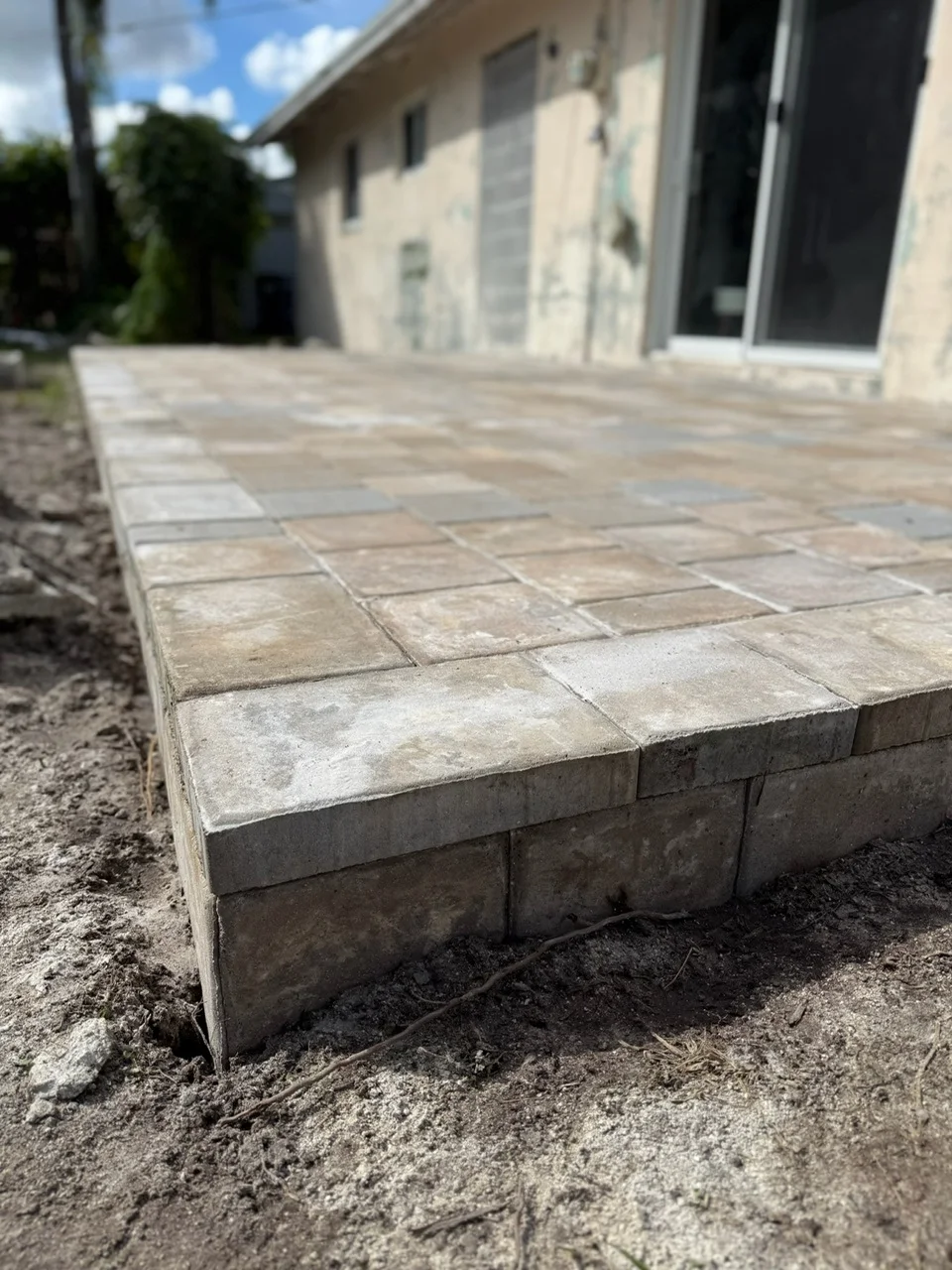
The edge restraint is the piece nobody thinks about and the reason the field holds.
Common questions
What happens to the old surface
Breaking out the old surface is the first stage of the job. It gets loaded and hauled off, and we recycle the concrete and old pavers when a recycler is in reach. That work is written into the scope.
How do you keep it from settling again
A releveling that only lifts and resets the pavers will settle again, because whatever caused the dip is still there. Our fix starts underneath: rebuild the base in compacted layers, then sort out where the water is coming from, whether that is a downspout, a low grade or irrigation.
Do you work with HOAs and property managers
HOA, condo and multifamily properties are a regular part of our work. We are used to board timelines and submittals, and we schedule in phases so residents can still get around. Tell us how your approvals work.
Do you cover Miami, FL
Absolutely. We are headquartered in Miami, FL and work there regularly. The quickest way to find out how soon we could start is a phone call to 786-717-9244.
Is there a warranty
We do offer one, in writing, on the workmanship. The manufacturer handles the warranty on the pavers, and that documentation comes to you from us. We also tell you now what is not covered, things like roots or drainage that change after we finish, so it never comes as a surprise.
Can you work around my pool being open
Usually. Pool deck work gets staged so you keep a safe path and the water stays covered while we cut. If there is a stretch where the pool has to be off limits we tell you which days up front.
Start with a conversation
A few photos tell us a lot. Email them, or just call and describe it, and you will get a straightforward answer about the problem and the fix. If waiting a year is the sensible move, that is what we will recommend.
Quality you can stand on