Paver Medallion Installation, from the subgrade up
A medallion set true, which is a cutting job before it is a laying job.
What actually goes wrong
Almost every paver problem we get called out to is a base problem wearing a surface disguise. The pavers themselves are fine. They are concrete or stone, and they will outlast most of us. What moves is what is underneath them.
Driveway edges usually go first, and the high water table across much of the coast is a big reason. Less room for water to drain down means more of it moving sideways through the base. Over time that flow carries the sand away from under the edge.
Look at what is planted nearby. A ficus, a black olive or an older shade tree can lift a walkway from a surprising distance, since their roots run shallow and wide and follow moisture underneath.
We would rather lose a bid than skip the base work, because the base work is the job. Everything above it is finish.
How we run this job
We come look at it
A straight read starts on site. We come out, walk the whole property with you, trace the water, and tell you what we see without dressing it up. Small problems get called small.
You get the plan in writing
Scope, materials, how long it takes, and what it costs, written down before anybody starts. No verbal numbers that change later.
We build the base first
Dig to depth, compact the aggregate in layers, screed the bedding. Nobody ever sees this part again, which is exactly why most failures start here.
Pavers go down and get cut in
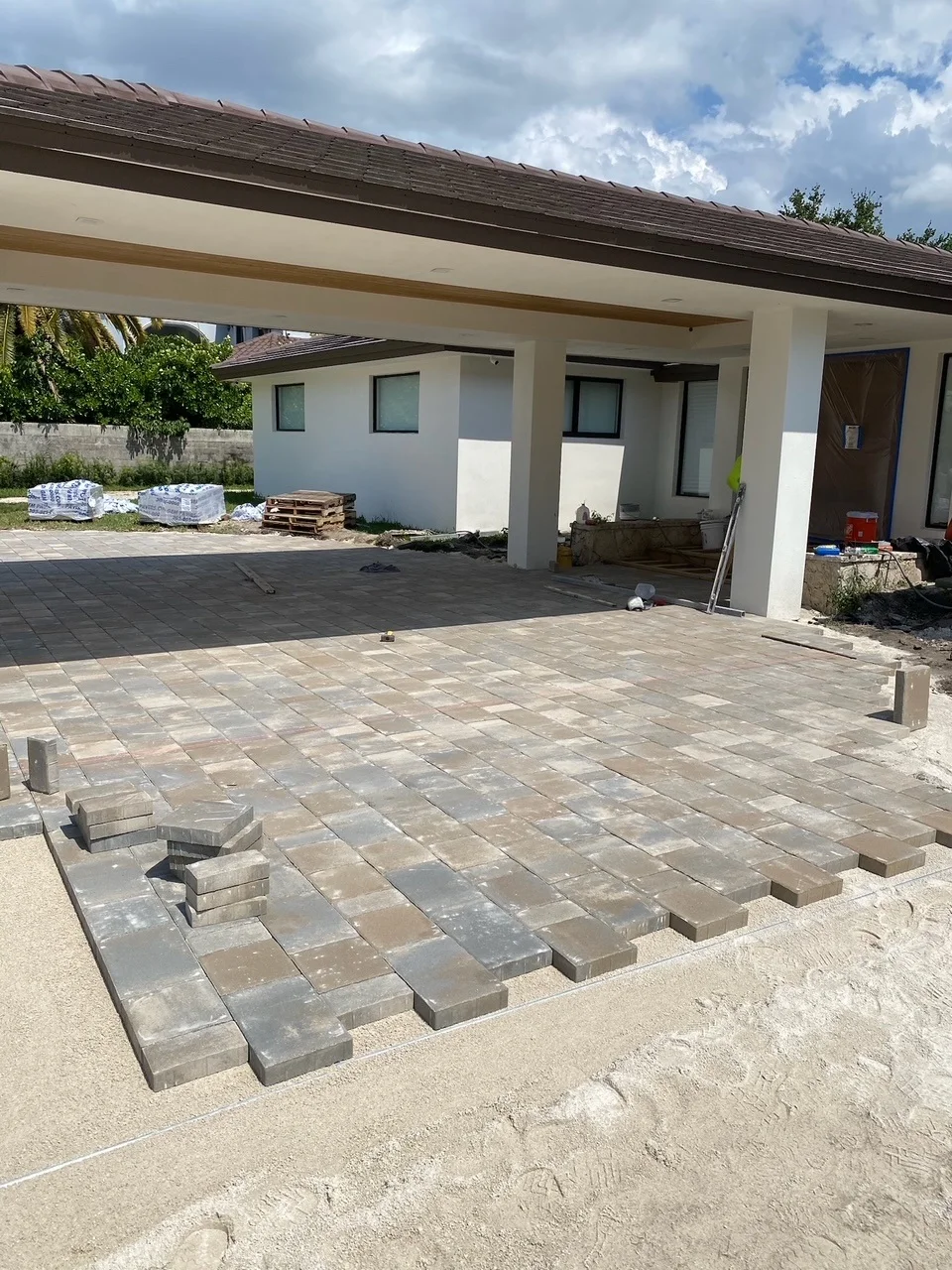
The field goes down to the pattern, edge cuts happen on site, and the perimeter gets a restraint so nothing creeps.
Joints get filled and the site gets cleaned
Joints filled and set, everything washed down, our own debris on our own truck. The site is yours again the same day we finish.
How the layout gets decided before anything is cut
Compaction in lifts is the most commonly skipped step in paver work, and it is easy to see why. Nobody can tell from the finished surface. A single thick layer compacted from the top gives you a hard skin over loose aggregate, and that holds up just long enough for the job to be paid and forgotten. Building in layers of a few inches, each compacted before the next, is what keeps it flat.
A paver surface is really four layers and only one of them is visible. Under the pavers there is a thin bedding course of sharp sand, screeded dead flat. Under that is the base, which is compacted crushed aggregate and does the actual structural work. Under that is the subgrade, which is whatever your property is made of. The pavers on top are a wearing surface. They spread load and they look good, but they are not what holds the thing up.
Base depth works both ways. Digging a garden path out like a truck drive spends your money on stone nobody needs. Laying a driveway on a path’s base saves money for about a season. People on foot need the least, a pickup parked every day needs more, and a commercial drive taking delivery trucks needs the most. Matching the depth to the load is the measurement, and it is the part guessers skip.
Compaction in lifts is the difference between ten years and two.
The grade under a patio or walkway has one job: get water off and away from the building. The pitch that does it is roughly an eighth to a quarter inch per foot. Underfoot it feels level. In a downpour you can watch the water move. Lose that fall and you get puddles, or worse, water running back toward the foundation.
The question to ask is where the water ends up after it leaves the pavers. On a commercial site that answer drives part of the design. A tight lot with no fall available might need a channel drain at the low edge, a permeable section draining into a stone reservoir, or a regraded planting bed. Building any of them during the install beats cutting the job back open later.
The rain that falls on your pavers is the least of it. A well-jointed surface sheds most of that. The water that undermines a base is water delivered to one spot again and again, from a gutter downspout, an irrigation head, or the slope of the property next door. We look for those sources on every walk.
Restraint
A perimeter edge restraint is what stops the field creeping outward and the joints opening from the outside in.
Joint sand
Structural, not cosmetic. It transfers load between units, which is the whole reason a field of loose pavers behaves like a surface.
Separation
Geotextile between subgrade and base stops fine soil migrating up and destroying the aggregate structure.
More design work
We cover the whole region for this. Areas we work in regularly include:
What it asks of you afterwards
Whether to seal is your call. A good sealer brings the color up a shade and makes an oil drip or a spill easier to clean off. The tradeoff is upkeep, since it wears and has to be reapplied every few years, and the wrong product can leave a plastic shine or trap moisture underneath. We will tell you which way we would go on yours.
Our rule of thumb is a quarter inch. A paver edge lifted more than about that much is a trip hazard waiting for someone, and it should move to the top of the list. On commercial sites, add liability to the reasons, since a fall there is more than a maintenance problem.
A paver surface that was built properly asks for very little. Keep the joints topped up, keep organic debris from composting in them, and deal with a settled area while it is small. That is genuinely most of it.
Concrete pavers carry their color through the whole unit. Sun will mellow it slowly over the years, and there is no surface layer to wear off. Expect some shift in the first year or two while the paver finishes curing, which is normal. This is the material behind most of the driveways, patios and walkways we build, because it is predictable to lay and easy to match later.
If budget is tight, clay brick is usually not where we start, since it costs more and comes in fewer shapes. If the priority is a surface that looks the same in twenty years, it is the answer. Its color is the fired clay, and that does not fade.
Travertine gets requested for pool decks because it stays noticeably cooler than concrete under bare feet in the sun. It does want a sealer if the area sees oil or heavy staining, and as a natural stone, expect variation from one unit to the next.
The failures we get called out to fix
You cannot see any of these when the crew packs up. They show up later, which is why they keep happening.
Laying over the old surface
It is the shortcut that costs the most later. A new surface on top of a failed one goes down fast and cheap, and it still sits on the same ground. If the base caused the original failure, the overlay hides it for one season.
Skipping the geotextile
Fabric between the ground and the base is a small step that keeps the base doing its job. Sandy soil especially wants to wash up into the stone layer above it. When it does, the base loses its strength and you get low spots that come back no matter how often they are reset.
Using the wrong sand in the bedding
Using whatever sand is on the truck is a common shortcut. Bedding has to be sharp, angular concrete sand, because rounded mason or beach sand lets pavers drift once weight goes on them.
Sealing too early
If a newly sealed paver job looks cloudy white under the shine, it was probably sealed too early. Concrete pavers need to cure and release their efflorescence first. Sealed in the first month, that haze stays locked beneath the sealer.
Water is what ends most paver surfaces, and it rarely arrives from the sky.
Common questions
Do I need to be home while you work
You can go to work as usual. We need to be able to reach the work area and use your water. If anything changes the plan, like what we find once the old surface is up, we call you that day.
Will the new pavers match what I already have
First we find out whether your paver line is still made. Older lines get discontinued, and even a current one can look a little different from units that have sat in the sun for years. If we can match, exactly or closely, we order. If not, we show you the options first, like pulling pavers from a less visible area.
What happens to the old surface
Gone before the new base goes in. We demolish it, haul it, and recycle the concrete and pavers if a recycler is available locally. You will see it listed in the scope from the start.
How do you keep it from settling again
Most of the time it comes down to the base. If it was laid too thin or compacted in one pass, we dig it out and rebuild it in lifts, then check that water is leaving the area the way it should. Fixing the surface without the base just repeats the problem.
Do you work with HOAs and property managers
Regularly. We phase the work so residents can still reach their doors and parking while each section is rebuilt, and we fit into whatever approval process your board runs.
Do you cover Miami, FL
Yes, Miami is our home area. Tell us where the property is and what you are thinking about, and we will give you a realistic idea of when we could be there.
Tell us what you are looking at
Pictures and a short description are usually enough for a first answer. We will tell you what we think is wrong and what putting it right involves, and we will be honest when it can sit for a year.
Quality you can stand on