Backyard Pavers, from the subgrade up
Whatever the back of the property needs, from a pad to a full floor.
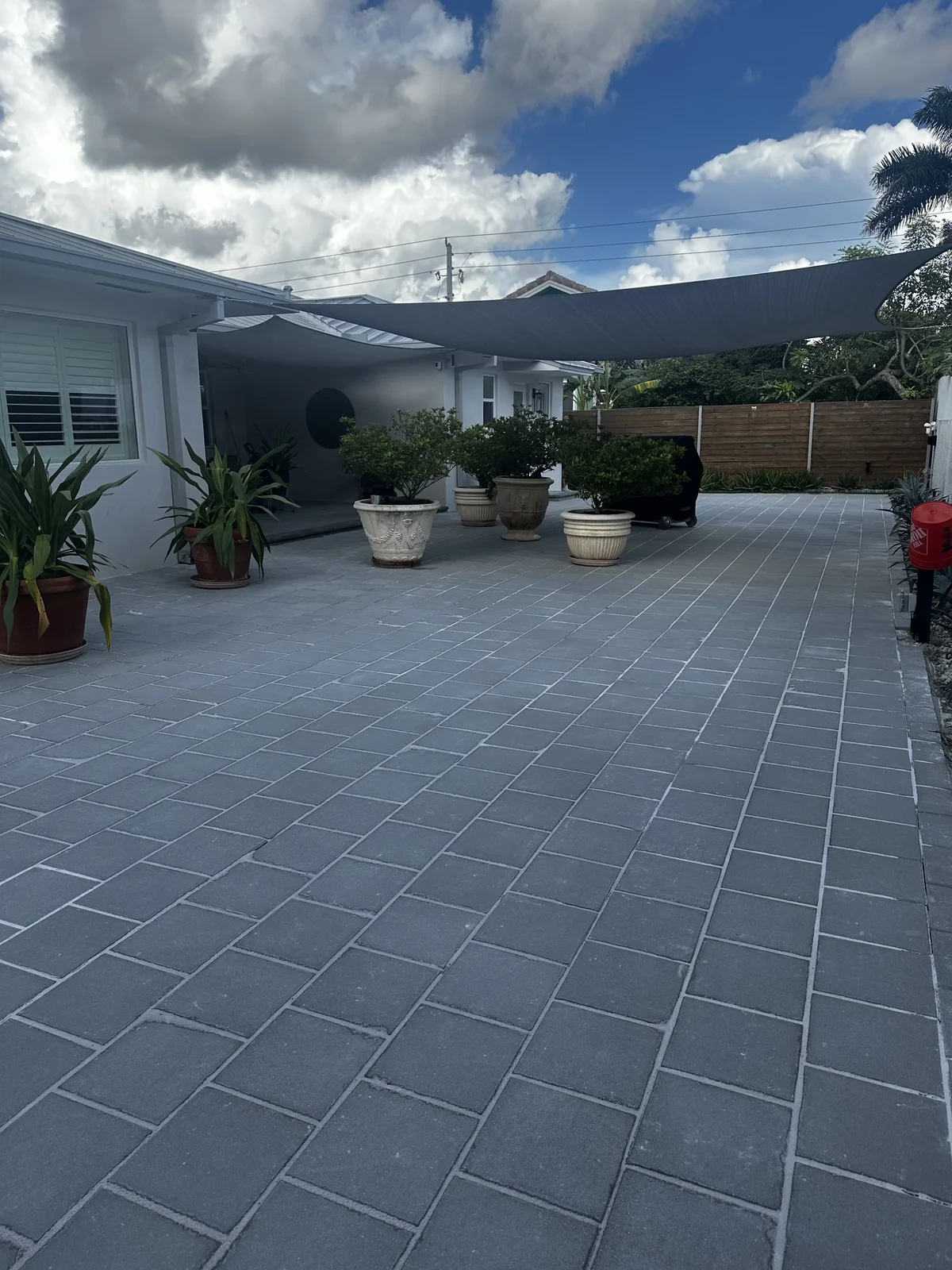
What actually goes wrong
Almost every paver problem we get called out to is a base problem wearing a surface disguise. The pavers themselves are fine. They are concrete or stone, and they will outlast most of us. What moves is what is underneath them.
Two inches of rain in an hour is the kind of afternoon storm we plan for, and our soil is mostly sand over limestone. Fast-draining sand handles light rain without complaint. Under that kind of downpour it reaches its limit, and the base above either holds together or begins to wash.
Trees are the other common culprit. A paver base stays damp underneath, which is exactly what roots are looking for, so they grow into it and lift the pavers from below.
None of this is visible in a finished photo, which is why the cheap version and the right version look identical on day one. They stop looking identical around year two.
How we run this job
We come look at it
We come to you and look at the surface in person. The water path gets as much attention as the pavers themselves. You will get a plain account of what we see, and we will not inflate a small problem into a big job.
You get the plan in writing
Everything in writing up front: what we are doing, what it is made of, how long it takes, and what it costs. Nothing changes without you signing off on it.
We build the base first
Dig to depth, compact the aggregate in layers, screed the bedding. Nobody ever sees this part again, which is exactly why most failures start here.
Pavers go down and get cut in
The field goes down to the pattern, edge cuts happen on site, and the perimeter gets a restraint so nothing creeps.
Joints get filled and the site gets cleaned
Sand swept in and compacted, surface washed, debris hauled by us. You get the property back the way we found it, minus the problem.
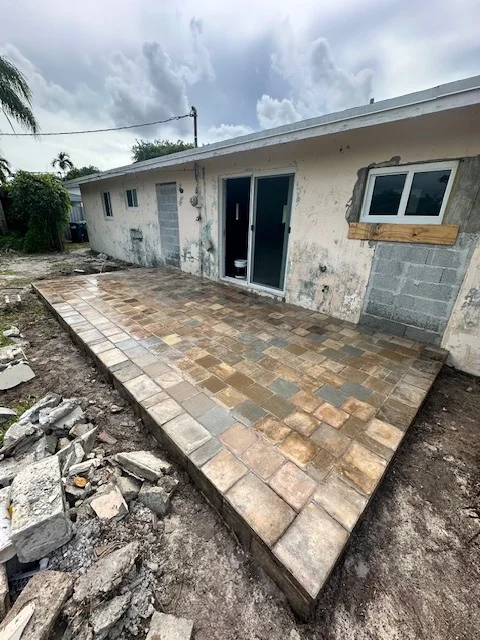
What outdoor rooms do to a surface
Outdoor living surfaces get treated as furniture rather than pavement, which is exactly how they fail. A kitchen run takes grease and heat; a fire feature takes heat and foot traffic in the dark; a lanai floor lives under a cage that concentrates runoff.
Under a screen enclosure the cuts have to be clean to the track and the drainage has to work with the cage rather than against it. Water coming off a cage lands in a line, not spread out, so it concentrates in one place.
Heat is a real material constraint around fire features. Some units spall when they take repeated direct heat, so the ring immediately around a fire pit gets specified differently from the field around it.
Water is what ends most paver surfaces, and it rarely arrives from the sky.
Puddles that sit on a patio for hours after a storm are a grading problem. So is water that runs toward the building. Both come from getting the fall wrong. The target is about an eighth to a quarter inch of drop per foot, heading away from the structure, which is too gentle to notice underfoot and enough to move the water off.
Sometimes the best place for the water is straight down. A permeable paver section lets rain pass through the joints into a stone reservoir below, which helps on a tight lot where the surface has no fall to give. Other sites call for a channel drain on the low edge or a regrade of the planting bed beside the paving. Any of those costs less to build now than to add after the fact.
When a paver surface fails, look at the edges before you blame the rain. A downspout emptying right against the border, a sprinkler that wets the same corner every day, runoff from the lot next door: those are the usual suspects. Rain falling on a properly jointed field mostly runs off. Concentrated water from one source is what washes the base out.
Restraint
A perimeter edge restraint is what stops the field creeping outward and the joints opening from the outside in.
Joint sand
Structural, not cosmetic. It transfers load between units, which is the whole reason a field of loose pavers behaves like a surface.
Separation
Geotextile between subgrade and base stops fine soil migrating up and destroying the aggregate structure.
More outdoor work
We cover this across the region. A few of the areas we work most:
What it asks of you afterwards
Walk your pavers now and then and look along the edges. If any paver has lifted more than about a quarter inch, treat it as urgent, because that is the height where people start catching their toes. For anyone managing a commercial property, it is a liability matter as much as upkeep.
Upkeep on a well-built paver surface is light. Sweep leaves and debris off before they break down in the joints, top up the joint sand when it gets low, and call about any dip while it is still small. Most owners do little else.
Plenty of good paver jobs are never sealed. Unsealed concrete pavers weather to a softer color and the joints still do their job if they are kept topped up. Sealing earns its keep where stains are likely, around a grill or under a parked car, and where you want a darker, richer color. Ask us and we will give you a straight read on your surface.
Travertine is quarried stone, so no two pieces look quite alike. Some people love that variation and some find it busy, so it is worth seeing a few units side by side before you commit. Its big practical advantage is temperature: in direct sun it stays cooler underfoot than concrete, which is why it shows up around so many pools.
Where it fits, porcelain is a very low-fuss surface to own. Spills sit on top instead of soaking in, because the material absorbs almost nothing. The work is all on the install side: precise base preparation, a perfectly even bedding course and careful cutting with the right blade.
Concrete pavers win on choice: they come in more shapes and colors than any other material we install. They also lay up consistently, which makes for a predictable job. The color runs through the whole unit, so it fades slowly and gently in the sun. Expect it to shift a bit in the first year or two as it cures out.
The failures we get called out to fix
A finished job hides all of these. Because nobody can spot them at handover, they keep showing up on paver work.
Laying over the old surface
It is quick, it is cheap, and it inherits every problem underneath. If the base was the reason the old surface failed, putting a new one on top of it just hides the failure for a season.
Skipping the geotextile
When we tear out a failed paver job, a muddy base with no fabric under it is a common sight. The soil and the stone have blended into one weak layer. That is exactly what separation fabric is there to prevent, and why resetting pavers on top of that mess never holds.
Using the wrong sand in the bedding
Cheap, rounded sand in the bedding layer is how pavers end up drifting. Mason sand and beach sand roll under load. Bedding should be sharp, angular concrete sand.
Sealing too early
Fresh concrete pavers push a white residue to the surface as they cure. That is efflorescence, and it needs to finish before any sealer goes on. Seal in the first month and the haze can end up permanently under the coat.
If nobody talks to you about drainage, they are quoting a different job.
Common questions
Do I need to be home while you work
No need. Leave us access and water, and go about your day. Plenty of customers head out in the morning and come back to a finished section. Anything we did not expect gets a phone call that day.
Will the new pavers match what I already have
You will know before we order anything. Plenty of repairs match exactly. Others come close, since concrete pavers shift color a little with sun and age and older lines get discontinued. When close is not good enough, we can move units from a less visible area onto the visible patch.
What happens to the old surface
Removal and disposal are included. We break out whatever is there now and take it off the property. Where we can get it to a recycler, the old concrete and pavers go there.
How do you keep it from settling again
The answer depends on what made it settle, which is why we look before we price it. Drainage problems get corrected and a failed base gets dug out and rebuilt, and if a root is pushing, it gets dealt with too. Then the pavers go back down on a base with a reason to stay put.
Do you work with HOAs and property managers
Yes. Property managers usually want clear communication and no surprises, and that is how we like to work too. Tell us what your approval process requires and we will work inside it.
Do you cover Miami, FL
Miami, FL is squarely in our regular area. We work there most weeks. If you send a few photos of the job, we can usually tell you a lot before anyone even comes out.
Have somebody come look at it
Give us a look at it in person. We walk the whole property, pay attention to drainage, and write up what we found, which is quicker than trading descriptions over the phone.
Quality you can stand on