Permeable Pavers done so it stays flat
Surfaces that let stormwater through instead of shedding it to the street.
What actually goes wrong
When a paver surface goes wrong in Florida, the pavers are rarely the thing that failed. Water got into the base, the base moved, and the surface followed it down. Fix the surface only and you are back in two years.
We pay extra attention to driveway edges on the coast. A high water table means rain cannot sink very far, so it moves sideways through the ground, and the edge is where that flow pulls sand out first.
If a big tree is close by, its roots are a likely cause. The damp aggregate under a paver surface draws them in, and as they grow they push the pavers up out of line.
That is why the schedule on our jobs is mostly spent on the part you will never see again. The surface takes a day or two. The ground it sits on takes the rest, and the ground is what you are actually paying for.
How we run this job
We come look at it
Somebody from the crew comes out, stands on the problem, and tells you what is actually going on underneath it. No sales visit, just a look and an honest read.
You get the plan in writing
Scope, materials, schedule, and cost on paper before a shovel moves. The number you approve is the number, not an opening position.
We build the base first
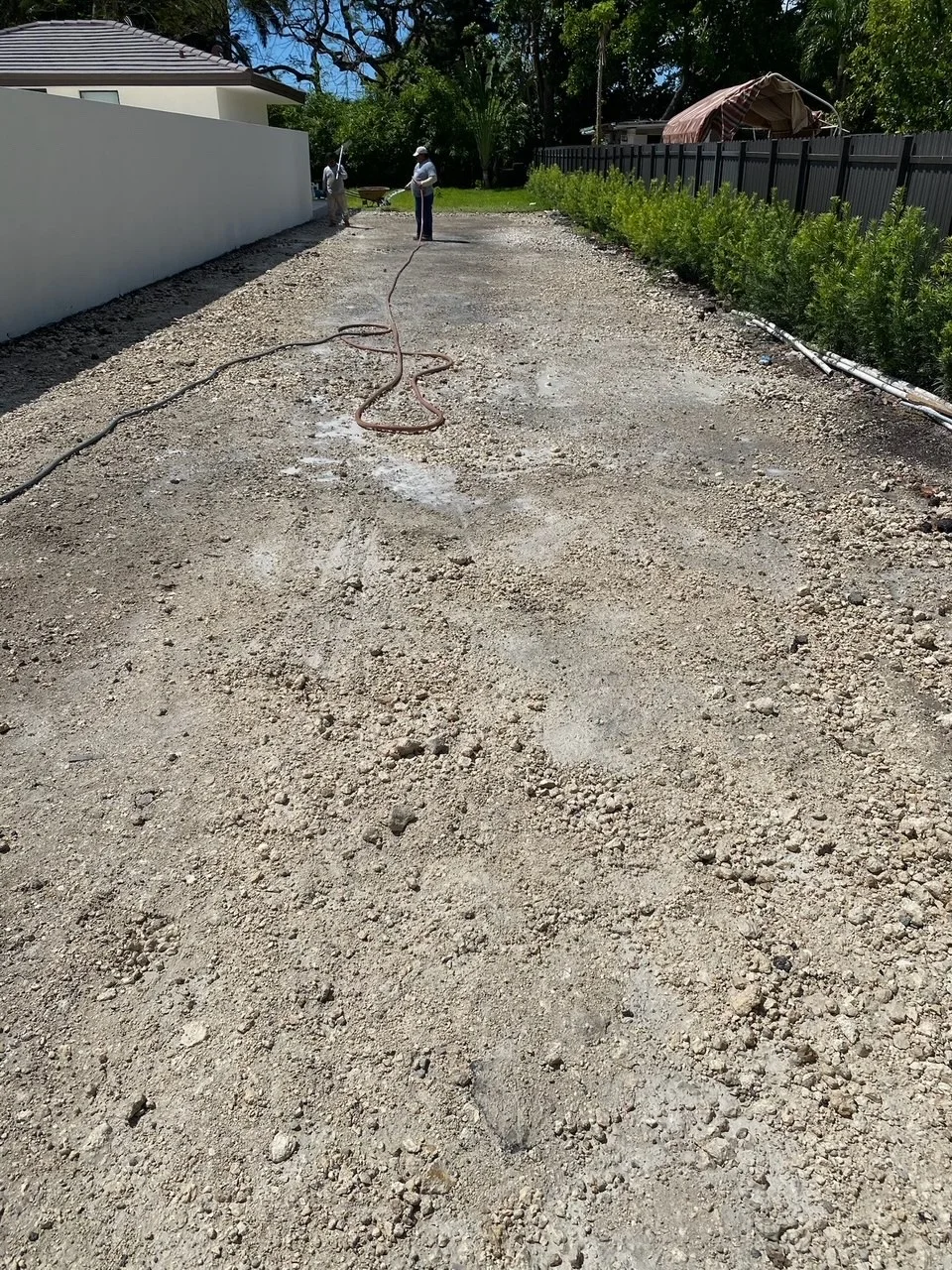
Excavation to the depth this job actually needs, aggregate compacted lift by lift, bedding screeded flat. The slow part, and the part that decides whether the surface is still flat in ten years.
Pavers go down and get cut in
The field goes down to the pattern, edge cuts happen on site, and the perimeter gets a restraint so nothing creeps.
Joints get filled and the site gets cleaned
Joints filled and set, everything washed down, our own debris on our own truck. The site is yours again the same day we finish.
How the material changes the outcome
Availability is worth thinking about up front. Manufacturers discontinue lines. Buying a small overage of the same production run and keeping it somewhere dry is the cheapest insurance in this whole trade.
Absorption drives most of the durability difference. A dense, low-absorption unit takes less water in, so it stains less and is less affected by salt. That is most of why porcelain behaves the way it does.
Material choice changes four things at once: what it costs, how it feels underfoot, how it ages, and how easy it is to match in five years when something needs replacing.
The edge restraint is the piece nobody thinks about and the reason the field holds.
Ask what goes in the joints. On most patios now the answer is polymeric sand, which binds when it is wetted and holds up to washout much better than plain sand does. It is also easy to get wrong. It has to be installed dry, swept off the surface completely before any water, and watered in per the manufacturer’s directions. Hurry any of that and you get a hazy film.
Pavers are separate pieces, and the joint sand is what lets them act like one surface. It locks each unit against its neighbors so weight spreads across the field. With full joints, a load gets shared. Once the joints wash out, every paver is on its own, which is where rocking starts and cracked corners follow.
Joint sand
Structural, not cosmetic. It transfers load between units, which is the whole reason a field of loose pavers behaves like a surface.
Separation
Geotextile between subgrade and base stops fine soil migrating up and destroying the aggregate structure.
Base depth
Set by what the surface carries, not by habit. A walkway and a truck-bearing drive are not the same excavation.
Other materials we lay
We bring this work to properties across the region. A few places that keep us busy:
What it asks of you afterwards
Owners are often surprised how little a properly built paver surface needs from them. The joints are where most of the attention goes: keep them full of sand and free of leaves that would otherwise rot in place. Beyond that, keep an eye out for any area that starts to sink.
Most sealing problems come down to the product. A sealer that is wrong for the material can leave a plastic-looking shine or hold moisture under it, and that is hard to undo. The right one, applied at the right time, deepens the color and keeps joint sand in place. Sealing stays optional, and we give you a straight answer on whether it is worth it here.
People walking across pavers are rarely looking at their feet, which is why a raised edge matters. More than about a quarter inch of lift is enough to catch a toe. Deal with that one quickly, especially on commercial property, where it is a liability concern along with a maintenance one.
If staining is your main worry, porcelain is close to stain-proof. It absorbs almost nothing. It asks more of the installer than most materials, though: an uneven bed shows through, so base work has to be precise, and cutting it cleanly takes the proper blade and some patience.
If you are unsure which material to choose, concrete pavers are the safe default. The range of shapes and colors is the widest of anything we install, and matching them for a repair or an addition down the road is easier than with any other paver. Know going in that the color moves a little during the first year or two as they cure out.
Clay brick ages without changing color. The color is the fired clay, so sun has nothing to bleach out. It is more expensive and the shape options are narrower, and for a surface you want looking the same in twenty years, it is hard to beat.
How this gets done badly
Each of these hides under a clean new surface. Since the owner cannot see them at the end, they keep getting done.
Skipping the geotextile
This one cannot be checked after the fact. Once the pavers are down, nobody can see whether there is fabric under the base. If there is not, fine soil gradually moves up into the aggregate and weakens it, and the settling that follows takes a full rebuild to fix.
Using the wrong sand in the bedding
If pavers are wandering out of line, check the bedding. It should be angular concrete sand with sharp grains. Rounded mason or beach sand rolls under load and lets them move.
Sealing too early
Leave new concrete pavers unsealed through their first month. They are still curing, and efflorescence is still working out of them. Seal over that and the white haze can be locked under the sealer permanently.
Laying over the old surface
Paving over an old surface is a lot like painting over rust. It goes quickly and costs little, and the problem underneath keeps working. If the base caused the first failure, the new surface will show it again within a season or so.
Compaction in lifts is the difference between ten years and two.
Common questions
Will the new pavers match what I already have
Often the best match is already on your property. When a new paver will not blend, we can pull units from a less visible area, use them on the visible patch, and put the new ones where nobody looks. Otherwise matches range from exact to close, because concrete pavers shift color a bit with sun and age.
What happens to the old surface
Removal and disposal are included. We break out whatever is there now and take it off the property. Where we can get it to a recycler, the old concrete and pavers go there.
How do you keep it from settling again
Settled pavers almost always point to something underneath. We trace it, whether it is drainage, a soft base or a root moving in, and fix that first. Pavers go back down only once the reason for the dip is gone.
Do you work with HOAs and property managers
HOA, condo and multifamily properties are a regular part of our work. We are used to board timelines and submittals, and we schedule in phases so residents can still get around. Tell us how your approvals work.
Do you cover Miami, FL
It is our home turf. We are based in Miami, FL and out on jobs around it most weeks, so getting to you is rarely the hard part. Call and we will give you a real answer on dates.
Is there a warranty
Yes, in writing, covering our workmanship. Manufacturer coverage on the pavers themselves comes from the manufacturer and we will hand you that paperwork too. We will also tell you plainly what a warranty does not cover, like a new root or a changed drainage condition.
Tell us what you are looking at
You will get what we find in writing. One of us walks the property with you, checks where the water goes, and writes it up, which beats any answer we could give without seeing it.
Quality you can stand on