Travertine Paver Installation done so it stays flat
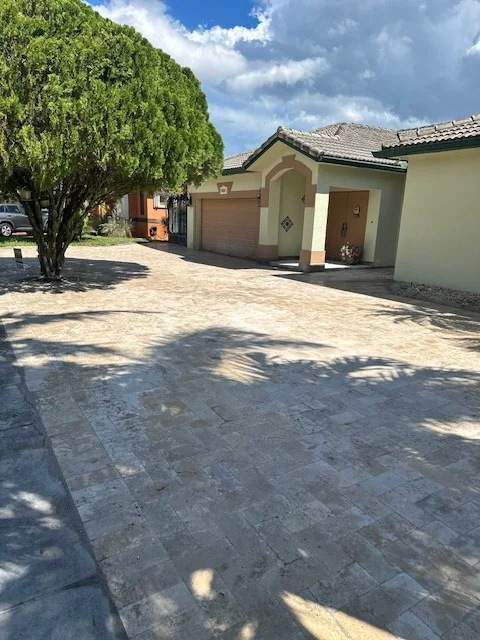
Natural stone that stays cool underfoot and reads high end.
What actually goes wrong
Almost every paver problem we get called out to is a base problem wearing a surface disguise. The pavers themselves are fine. They are concrete or stone, and they will outlast most of us. What moves is what is underneath them.
Summer rain in South Florida tends to show up all at once, and it lands on sandy ground that shifts when water runs through it. That combination puts more pressure on a paver base than a drier climate ever would. A base that would pass up north gets tested here every year.
Look at what is planted nearby. A ficus, a black olive or an older shade tree can lift a walkway from a surprising distance, since their roots run shallow and wide and follow moisture underneath.
So the real question to ask anybody bidding this work is not what pavers they use. It is how deep they excavate, how they compact, and where they think your water goes. The answers tell you everything about how long the job will last.
How we run this job
We come look at it
Somebody from the crew comes out, stands on the problem, and tells you what is actually going on underneath it. No sales visit, just a look and an honest read.
You get the plan in writing
Scope, materials, how long it takes, and what it costs, written down before anybody starts. No verbal numbers that change later.
We build the base first
Excavation to the depth this job actually needs, aggregate compacted lift by lift, bedding screeded flat. The slow part, and the part that decides whether the surface is still flat in ten years.
Pavers go down and get cut in
The field goes down to the pattern, edge cuts happen on site, and the perimeter gets a restraint so nothing creeps.
Joints get filled and the site gets cleaned
Sand swept in and compacted, surface washed, debris hauled by us. You get the property back the way we found it, minus the problem.
How the layout gets decided before anything is cut
Most of the work on a paver job is buried by the end of it. You see the pavers. You do not see the compacted crushed aggregate base under them, which is the part carrying the load, or the screeded layer of sharp sand they sit in, or the subgrade at the bottom, which is just whatever soil the property came with. The pavers spread weight and take the wear. Holding the surface up is the base’s job, and that is where we spend our time.
We work out depth by asking about the traffic. Mostly we want to know what parks on it and whether a truck ever backs onto it. A walkway carrying people gets a shallower base. A driveway with a loaded pickup on it daily gets more, and a commercial drive with deliveries gets more again. That number comes from your property, so it changes from job to job. When it never changes, it was a guess.
The base is a stack of thin layers, each one compacted on its own. That is what building in lifts means. The shortcut is to spread all the aggregate in one go and compact the surface, which leaves a firm top over material that never got pressed down. For a while you cannot tell the difference. Then, about a year in, the surface starts settling in uneven spots.
Water is what ends most paver surfaces, and it rarely arrives from the sky.
Plain sand in the joints works until the first few hard rains start carrying it away. Polymeric sand binds when wetted, so it stays in the joint, and that is why it is now the standard choice. The binding is also the risk. Any of it left on the paver faces when the water goes on will set there, so we install it dry, sweep it clean, and water it in to the manufacturer’s spec.
Joints should be filled all the way, and kept that way. The sand in there is structural: it shares load from one paver to the next, and that sharing is what makes a set of loose units work like a surface. Half-full joints wash out faster, and once they do, every paver is carrying its own load. Rocking comes next, then cracking.
Separation
Geotextile between subgrade and base stops fine soil migrating up and destroying the aggregate structure.
Base depth
Set by what the surface carries, not by habit. A walkway and a truck-bearing drive are not the same excavation.
Compaction
Done in lifts, layer by layer. Dump it all at once and a quick pass leaves a hard crust sitting on loose material that settles later.
More design work
This service runs across our whole region. Some of the areas where we do the most of it:
What it asks of you afterwards
Whether to seal is your call. A good sealer brings the color up a shade and makes an oil drip or a spill easier to clean off. The tradeoff is upkeep, since it wears and has to be reapplied every few years, and the wrong product can leave a plastic shine or trap moisture underneath. We will tell you which way we would go on yours.
The thing worth acting on quickly is a trip hazard. A lifted edge of more than about a quarter inch is something somebody will catch a toe on, and on a commercial property that is a liability question as well as a maintenance one.
A paver surface that was built properly asks for very little. Keep the joints topped up, keep organic debris from composting in them, and deal with a settled area while it is small. That is genuinely most of it.
Concrete pavers are what most jobs end up using. Our crews lay them more than anything else, and a predictable unit means a cleaner layout with fewer surprises. Color comes from pigment mixed through the paver, so fading is gradual and even. Give it a year or two to settle into its final shade as it cures.
With clay brick there is no pigment to fade. The color comes from the clay as it is fired, so the paver looks essentially the same for as long as it lasts. The trade is a higher price and a smaller choice of shapes.
Two things to know about travertine. It is natural stone, so expect differences in tone between units. And it stays cooler than concrete underfoot in direct sun, which makes it the usual pick around a pool. If the spot gets oil or heavy staining, add a sealer to the plan.
The failures we get called out to fix
None of these are visible on the day the work finishes, which is exactly why they keep happening.
Laying over the old surface
It is the shortcut that costs the most later. A new surface on top of a failed one goes down fast and cheap, and it still sits on the same ground. If the base caused the original failure, the overlay hides it for one season.
Skipping the geotextile
Fine soil moves. Water carries it and traffic pumps it, and without a barrier it ends up in the aggregate base. A layer of separation fabric under the base stops that. Skip it and the base gradually turns soft, and the settlement it causes sits below anything a surface repair can reach.
Using the wrong sand in the bedding
The grains matter. Sharp, angular concrete sand interlocks and holds a paver’s position. Rounded sand, such as mason or beach sand, keeps shifting under weight and lets the pavers wander.
Sealing too early
Give new concrete pavers time before sealing. They have to cure and let efflorescence work its way out. Sealing during the first month risks catching that white bloom under the sealer, where it stays for good.
The pavers are a wearing surface. The base is the building.
Common questions
What happens to the old surface
We take it out and take it away. Old concrete and pavers get recycled where a facility is available, and hauling is built into the scope from the start, so there is no surprise charge at the end.
How do you keep it from settling again
By fixing the reason it settled. That usually means correcting drainage and rebuilding the base properly, and sometimes it means dealing with a root or a downspout that is dumping water in the wrong place.
Do you work with HOAs and property managers
Regularly. We phase the work so residents can still reach their doors and parking while each section is rebuilt, and we fit into whatever approval process your board runs.
Do you cover Miami, FL
Yes. Miami is where we are based, so it is about as close to home as our work gets. Give us a call and we will tell you when we can come out.
Is there a warranty
You get a written warranty from us covering the installation work. On top of that, the pavers come with the manufacturer’s own coverage, and we make sure that paperwork reaches you. What changes later, a new tree root or altered drainage, is outside our warranty, and we say so before the job starts.
Can you work around my pool being open
Usually. Pool deck work gets staged so you keep a safe path and the water stays covered while we cut. If there is a stretch where the pool has to be off limits we tell you which days up front.
Start with a conversation
The quickest start is a call. Describe what is sinking or lifting, or send a couple of pictures, and we will tell you straight what we think it is and what it takes. Honest answers include ‘this can wait.’
Quality you can stand on