What florida outdoor kitchen pavers should actually involve
Kitchen floors that take grease, heat and a summer downpour.
What actually goes wrong
Here is the honest version: a sunken paver is a symptom. The base under it lost material, usually to water, and the surface settled into the gap. Resetting the pavers without correcting the base just buys you a season.
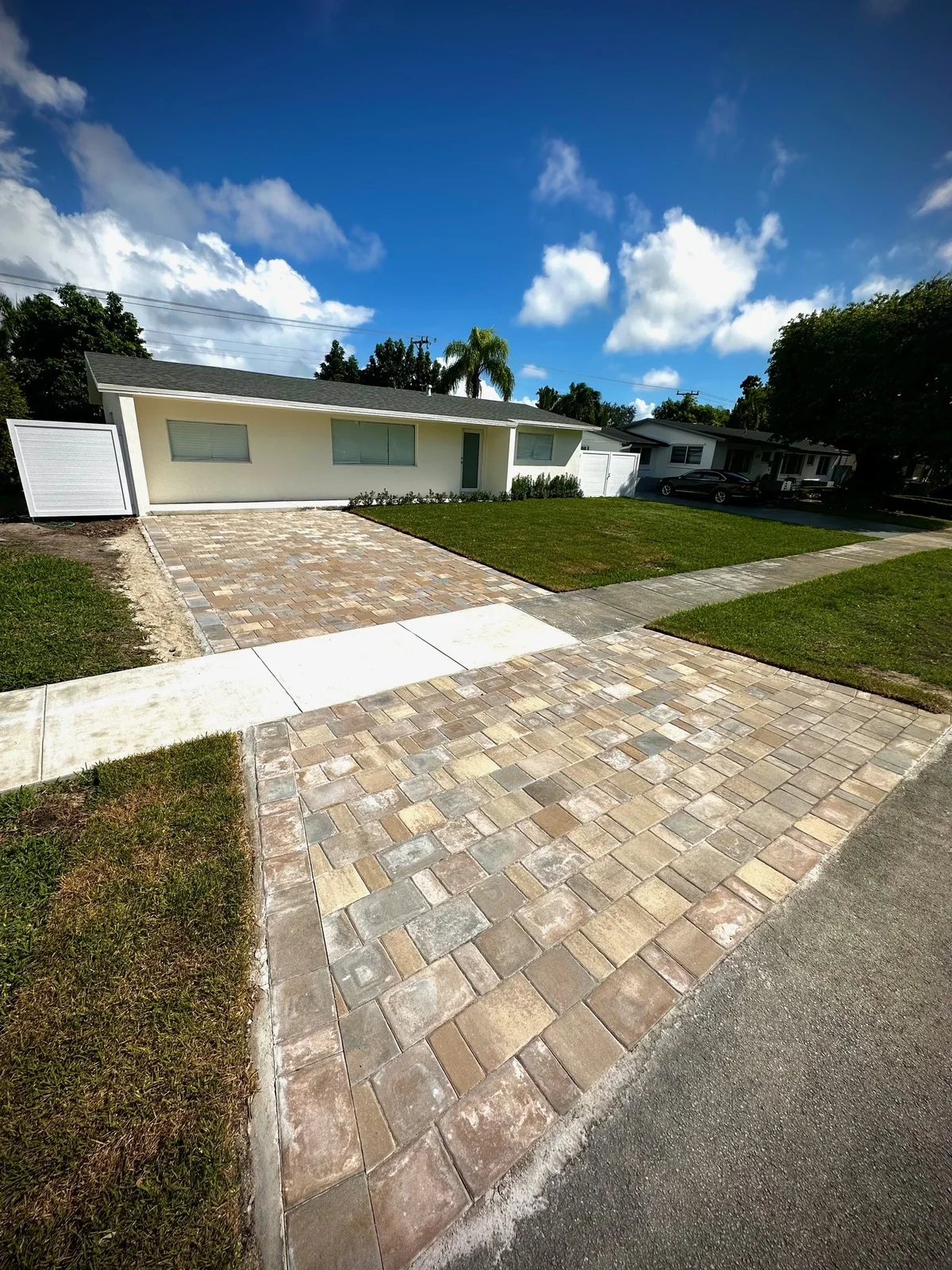
We pay extra attention to driveway edges on the coast. A high water table means rain cannot sink very far, so it moves sideways through the ground, and the edge is where that flow pulls sand out first.
The second common cause is roots. Shallow, wide root systems on ficus, black olive and older shade trees head toward moisture, and the ground under a walkway holds plenty of it.
That is why the schedule on our jobs is mostly spent on the part you will never see again. The surface takes a day or two. The ground it sits on takes the rest, and the ground is what you are actually paying for.
How we run this job
We come look at it
Somebody from the crew comes out, stands on the problem, and tells you what is actually going on underneath it. No sales visit, just a look and an honest read.
You get the plan in writing
Scope, materials, schedule, and cost on paper before a shovel moves. The number you approve is the number, not an opening position.
We build the base first
Most of the job is buried before you see a paver. We excavate to the depth the work calls for and compact the aggregate base in lifts, then screed the bedding layer. That hidden part is what holds the surface flat for years.
Pavers go down and get cut in
Field laid to the pattern, edges cut on site, and a restraint set around the perimeter so the field cannot creep.
Joints get filled and the site gets cleaned
Sand swept in and compacted, surface washed, debris hauled by us. You get the property back the way we found it, minus the problem.
What salt air and a high water table do to a surface
Depth is decided by what the surface has to carry. A walkway that only ever sees people can sit on a shallower base than a driveway that takes a loaded pickup every day, and a commercial drive that takes delivery trucks needs more again. Anybody who quotes the same base depth for a garden path and a driveway is not measuring, they are guessing.
A plate compactor only reaches so deep. That is why the base goes in as a series of lifts, each a few inches thick and compacted before the next one lands on top. Put the full depth down at once and the plate firms up the top and leaves the bottom loose. It feels solid when you walk it. Then over the first year or two, the loose layer underneath consolidates unevenly and the surface settles in patches.
Each layer has one job. The pavers take foot traffic and tires and spread that weight across a wider area. The sand bedding under them, sharp sand screeded dead flat, sets their height and keeps them level with each other. The compacted aggregate base below does the real structural work. The subgrade at the bottom is your native soil, and our job there is mostly to keep water from softening it. When a surface fails, it is almost always one of the hidden three.
Water is what ends most paver surfaces, and it rarely arrives from the sky.
We draw the water’s route before we draw the paver pattern. On a commercial job, once rain runs off the surface, the design has to say where it goes next. With a tight lot and no fall available, that might be a channel drain along the low side or a permeable section feeding a stone reservoir. Sometimes it is a regrade of the planting bed beside it. All of them are cheaper now than later.
Irrigation is the one people overlook. A sprinkler head that hits the same few feet of paver twice a day keeps that part of the base saturated, and over time the sand underneath washes. Downspouts discharging at the edge and runoff coming off a neighboring grade do the same. The rain itself, landing on a well-jointed surface, is rarely the problem.
An eighth to a quarter inch per foot does not sound like much, and walking on it you would swear the surface is level. That small, steady drop away from the building is what carries water off. A flat surface holds puddles. A surface sloped the wrong way delivers runoff to the foundation, which is a far bigger problem.
Compaction
Layered, then compacted, then layered again. One load spread and run over once looks finished and leaves loose material below the crust.
Fall
Away from the building, always, at about an eighth to a quarter inch per foot. That small slope decides where every storm ends up.
Restraint
A perimeter edge restraint is what stops the field creeping outward and the joints opening from the outside in.
More coastal work
We bring this work to properties across the region. A few places that keep us busy:
What it asks of you afterwards
It does not take much. An edge lifted a little more than a quarter inch looks minor and still catches toes. That makes it the item to act on quickly once an install has settled in. If the pavers serve a commercial property, the stakes include liability, beyond keeping the surface in shape.
Most of the maintenance happens before the pavers go down. Get the base and joints right and the owner’s part is short: keep organic debris out of the joints, refill sand as needed, and address any settled patch early.
Sealing really is a preference, which is why you hear different opinions on it. Our view: it is worth it where the surface takes oil, food or heavy staining, and less worth it on a walkway that only sees foot traffic. A poorly chosen sealer can leave a glossy sheen or trap moisture underneath, so product choice matters as much as the decision itself.
Travertine is the one people ask for around pools, and for a good reason: it stays noticeably cooler underfoot than concrete in direct sun. It is a natural stone, so there is variation between units, and it wants a sealer if it is somewhere that gets oil or heavy staining.
Of everything we install for homeowners, porcelain is the newest. What it brings is density: it soaks up almost no water and resists staining better than nearly anything else. What it demands is precision, both in the base, which has to be truly even, and in the cutting.
One practical reason we steer a lot of people toward concrete pavers is the future. Lines change, and a material that is easy to match makes a later extension or repair look like it was always there. They also offer the widest choice of shape and color. Plan on the color shifting slightly over the first year or two while they cure.
The failures we get called out to fix
A finished job hides all of these. Because nobody can spot them at handover, they keep showing up on paver work.
Using the wrong sand in the bedding
Concrete sand goes in the bedding for a reason: its grains are sharp and angular, so they lock. Mason sand and beach sand are rounded and let pavers wander under load.
Sealing too early
Leave new concrete pavers unsealed through their first month. They are still curing, and efflorescence is still working out of them. Seal over that and the white haze can be locked under the sealer permanently.
Laying over the old surface
Before paving over anything, ask why the old surface failed. If the answer is the base, a new surface on top of it is borrowing time. It goes down fast and cheap, and the same problem comes back through it.
Skipping the geotextile
A separation fabric between the subgrade and the base stops the two from mixing. Without it, fine soil migrates up into the aggregate, the base loses its structure, and you get settlement that no amount of surface work will fix.
Compaction in lifts is the difference between ten years and two.
Common questions
What happens to the old surface
Breaking out the old surface is the first stage of the job. It gets loaded and hauled off, and we recycle the concrete and old pavers when a recycler is in reach. That work is written into the scope.
How do you keep it from settling again
We find out why it sank before we touch it. Resetting pavers on the same weak base or over the same wet spot only buys you a little time. Usually the cure is better drainage and a properly rebuilt base, and sometimes it means dealing with a root or a downspout.
Do you work with HOAs and property managers
Regularly. We are used to submittals, board timelines, and phasing work so residents keep access. Tell us what your approval process looks like and we will work inside it.
Do you cover Miami, FL
It is our home turf. We are based in Miami, FL and out on jobs around it most weeks, so getting to you is rarely the hard part. Call and we will give you a real answer on dates.
Is there a warranty
Yes. We put our workmanship warranty in writing. Before you sign, we also walk you through what falls outside it, like damage from new roots or from drainage that changes after we leave, so nobody is surprised later. Coverage for the pavers themselves comes from the manufacturer, and you get that paperwork from us.
Can you work around my pool being open
Usually. Pool deck work gets staged so you keep a safe path and the water stays covered while we cut. If there is a stretch where the pool has to be off limits we tell you which days up front.
Tell us what you are looking at
A few photos tell us a lot. Email them, or just call and describe it, and you will get a straightforward answer about the problem and the fix. If waiting a year is the sensible move, that is what we will recommend.
Quality you can stand on