Paver work across Collier County
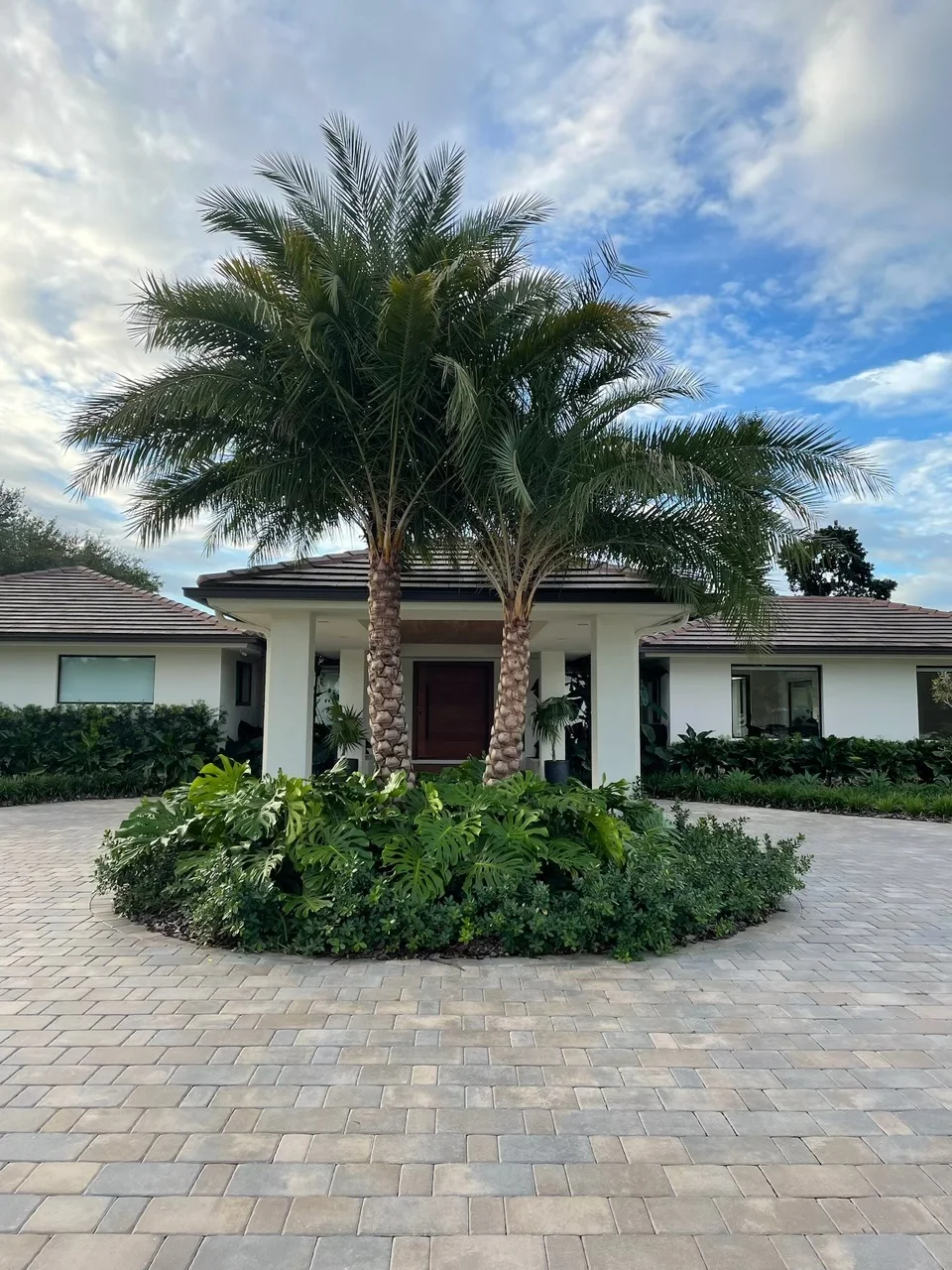
Naples and Marco Island work, where finish tolerance is the whole job and travertine is the default expectation.
What this county does to a paver base
Naples and Marco Island work, where finish tolerance is the whole job and travertine is the default expectation.
We build bases for the conditions South Florida actually has. Sand that moves when water runs through it is one. Rain that comes all at once is the other. A base that would be fine somewhere drier gets checked by both of those every summer here.
The failure is almost always below the pavers. Sand washes out of the joints, water gets down into the bedding, the bedding migrates, and the surface drops. Everything you can see is downstream of that.
Mature trees are the second cause. Roots go where the water is, and a paver base holds moisture, so they grow straight into it and push the surface up.
What we are actually doing down there
The base is a stack of thin layers, each one compacted on its own. That is what building in lifts means. The shortcut is to spread all the aggregate in one go and compact the surface, which leaves a firm top over material that never got pressed down. For a while you cannot tell the difference. Then, about a year in, the surface starts settling in uneven spots.
A paver surface is really four layers and only one of them is visible. Under the pavers there is a thin bedding course of sharp sand, screeded dead flat. Under that is the base, which is compacted crushed aggregate and does the actual structural work. Under that is the subgrade, which is whatever your property is made of. The pavers on top are a wearing surface. They spread load and they look good, but they are not what holds the thing up.
We work out depth by asking about the traffic. Mostly we want to know what parks on it and whether a truck ever backs onto it. A walkway carrying people gets a shallower base. A driveway with a loaded pickup on it daily gets more, and a commercial drive with deliveries gets more again. That number comes from your property, so it changes from job to job. When it never changes, it was a guess.
The edge restraint is the piece nobody thinks about and the reason the field holds.
We think about where water will run before we think about pattern or color. Every paver surface needs a gentle fall, roughly an eighth to a quarter inch per foot, pointed away from the house or building. It is subtle enough to go unnoticed and steep enough to work. A flat or backward pitch shows up in the first heavy rain.
Where the water goes once it leaves the surface is a real design question. On a tight lot with no fall available, that can mean a channel drain across the low edge, a permeable section that lets water through into a stone reservoir, or a regrade of the adjacent planting bed. All of those are cheaper to build now than to retrofit.
Most of the damage we see comes from water that was aimed at the pavers by accident. The downspout that dumps at the edge is the classic one. Irrigation is close behind, since a head spraying one spot twice a day keeps the base wet all year. A neighbor’s grade can do it too. Rain landing on the surface is rarely the culprit.
Compaction
Thin layers, each one compacted before the next goes on. A thick dump with one pass of the plate leaves loose stone hiding under a firm skin.
Fall
Roughly an eighth to a quarter inch per foot. Flat surfaces hold puddles and backward ones send water at the foundation, so the slope always runs away from the building.
Restraint
A perimeter edge restraint is what stops the field creeping outward and the joints opening from the outside in.
Where we work in Collier County
Each of these has its own page with what we see locally.
Choosing material for this part of the state
Concrete in the midday sun can get uncomfortable on bare feet. Travertine stays noticeably cooler, which is the main reason it is the paver people ask for around pools. The tradeoffs are that natural stone varies from piece to piece and that it should be sealed anywhere it is likely to get oil or heavy staining.
Porcelain looks clean and stays clean, because it is dense enough that almost nothing soaks in. It is newer to residential work than the other materials, and it is less forgiving. An uneven bed under it shows, so we spend extra time on the base, and the cuts are slow work with the correct blade.
Concrete pavers carry their color through the whole unit. Sun will mellow it slowly over the years, and there is no surface layer to wear off. Expect some shift in the first year or two while the paver finishes curing, which is normal. This is the material behind most of the driveways, patios and walkways we build, because it is predictable to lay and easy to match later.
The main job is the joints. When the sand drops below the edge of the pavers, add more. When leaves collect in them, sweep them out before they rot and start growing weeds. A properly built surface really does not need much beyond that.
If you like the look of freshly wet pavers, sealing gets you close to that all the time. It also makes stains easier to lift and helps hold the joint sand. What it asks of you is a recoat every few years and some care in choosing a product, since the wrong one can look plasticky or trap moisture. We will be straight with you about whether yours needs it.
On a commercial property, a lifted paver is a liability item before it is a repair item. An edge that rises more than about a quarter inch above the surface around it is enough to catch a toe, so it deserves a quick response rather than a spot on next year’s list.
Collier County on the map
Where these jobs go wrong
None of these leave a mark you could spot at the final walk. That is the whole reason they keep coming back.
Sealing too early
Of all the shortcuts, early sealing is one of the hardest to undo. A new concrete paver has to cure and let its efflorescence come out before sealing. Seal it in the first month and that white haze can stay under the sealer permanently.
Laying over the old surface
It is the shortcut that costs the most later. A new surface on top of a failed one goes down fast and cheap, and it still sits on the same ground. If the base caused the original failure, the overlay hides it for one season.
Skipping the geotextile
Between the native soil and the base, there should be a geotextile fabric. It keeps the two from mixing. Without it, fines migrate into the aggregate until the base weakens, and the settling that follows comes back after every surface repair.
Using the wrong sand in the bedding
Using whatever sand is on the truck is a common shortcut. Bedding has to be sharp, angular concrete sand, because rounded mason or beach sand lets pavers drift once weight goes on them.
If nobody talks to you about drainage, they are quoting a different job.
Common questions
Will the new pavers match what I already have
It depends mostly on whether the line is still made. If it is, we can usually get close, though sun and age shift the color of concrete pavers a little over time. If it has been discontinued, we show you the options before ordering, and that can include borrowing units from a less visible spot.
What happens to the old surface
We remove it. Breaking out and hauling the old concrete or pavers is a normal part of our scope, and where a recycler is available, that material gets recycled instead of landfilled.
How do you keep it from settling again
We start with a question: where is the water going? That answer usually explains the settling. From there it is a matter of correcting the drainage and putting a proper base back in, plus handling any root or downspout feeding the problem.
Do you work with HOAs and property managers
We put together submittals for HOA boards and property managers regularly. Tell us what your approval process requires and we will work inside it, including phasing so residents keep access.
Do you cover Collier County
Yes. Collier County is inside our regular working area and we are out that way most weeks. Call and we will tell you honestly when we could get to you.
Is there a warranty
You get a written warranty from us covering the installation work. On top of that, the pavers come with the manufacturer’s own coverage, and we make sure that paperwork reaches you. What changes later, a new tree root or altered drainage, is outside our warranty, and we say so before the job starts.
Tell us what you are looking at
Most questions about pavers get answered on site. We will come walk the property, look at how water moves across it, and send you a write-up of what we found.
Quality you can stand on