Florida Outdoor Living Pavers done so it stays flat
Outdoor rooms for a climate where they get used year round.

What actually goes wrong
The failure is almost always below the pavers. Sand washes out of the joints, water gets down into the bedding, the bedding migrates, and the surface drops. Everything you can see is downstream of that.
Every summer in South Florida is a stress test for the ground under a paver surface. Heavy rain comes fast, and the sand under most properties moves when that water flows through it. A base that would get by up north has to be built better to last here.
Large trees near a paver surface cause a lot of lifting. Their roots follow moisture, and the base under pavers holds plenty of it. Over the years they push in and raise the surface.
We would rather lose a bid than skip the base work, because the base work is the job. Everything above it is finish.
How we run this job
We come look at it
The first step is a walk-through. A crew member looks at the surface and where water drains on your property, then talks it through with you on site. If less work will solve it, that is what we recommend.
You get the plan in writing
Scope, materials, schedule, and cost on paper before a shovel moves. The number you approve is the number, not an opening position.
We build the base first
Before a single paver goes down, we dig to the depth your job calls for and build the base up in compacted lifts. A screeded bedding layer goes on last. That buried work decides whether the surface is still flat ten years from now.
Pavers go down and get cut in
Field laid to the pattern, edges cut on site, and a restraint set around the perimeter so the field cannot creep.
Joints get filled and the site gets cleaned
Sand swept in and compacted, the surface washed down, and the property left the way we found it. We haul our own debris.
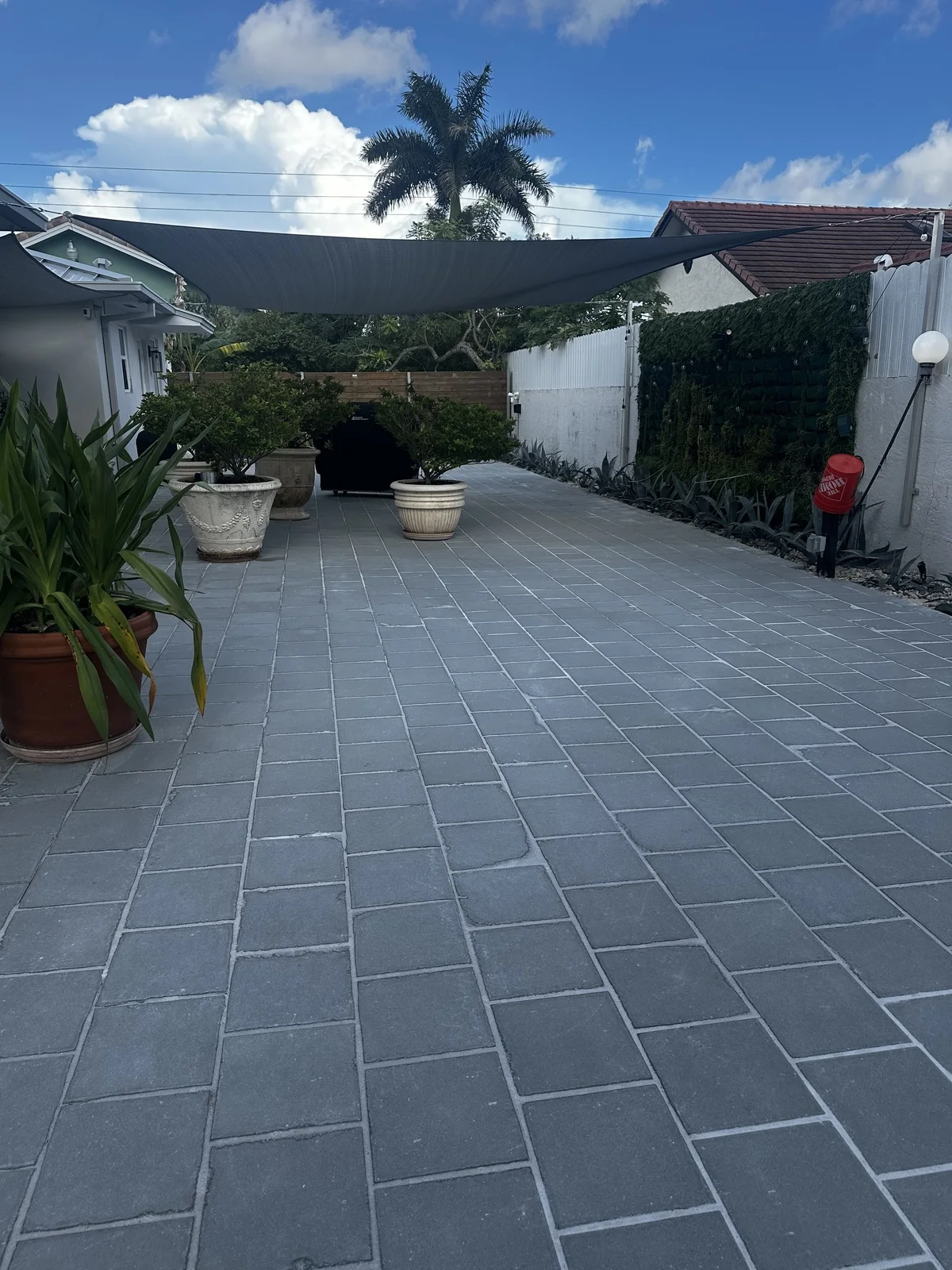
What salt air and a high water table do to a surface
Most of the work on a paver job is buried by the end of it. You see the pavers. You do not see the compacted crushed aggregate base under them, which is the part carrying the load, or the screeded layer of sharp sand they sit in, or the subgrade at the bottom, which is just whatever soil the property came with. The pavers spread weight and take the wear. Holding the surface up is the base’s job, and that is where we spend our time.
The same paver can go on a garden path or a delivery drive. What changes is everything under it. People on foot put very little load on a base, so a walkway can sit shallow. A driveway with a loaded pickup on it every day needs more depth, and a commercial drive that takes delivery trucks needs the most. Picking the paver is the easy decision. Sizing the base is the one that gets measured.
Compaction in lifts is the most commonly skipped step in paver work, and it is easy to see why. Nobody can tell from the finished surface. A single thick layer compacted from the top gives you a hard skin over loose aggregate, and that holds up just long enough for the job to be paid and forgotten. Building in layers of a few inches, each compacted before the next, is what keeps it flat.
A sunken paver is a symptom. The base under it is the disease.
Slope is one of the easiest things to get wrong and one of the hardest to fix later, because it is built into the base. We set the base to fall about an eighth to a quarter inch per foot away from the building. Too little and water stands. Reverse it and the water goes straight for the foundation.
The question to ask is where the water ends up after it leaves the pavers. On a commercial site that answer drives part of the design. A tight lot with no fall available might need a channel drain at the low edge, a permeable section draining into a stone reservoir, or a regraded planting bed. Building any of them during the install beats cutting the job back open later.
The rain that falls on your pavers is the least of it. A well-jointed surface sheds most of that. The water that undermines a base is water delivered to one spot again and again, from a gutter downspout, an irrigation head, or the slope of the property next door. We look for those sources on every walk.
Separation
Geotextile between subgrade and base stops fine soil migrating up and destroying the aggregate structure.
Base depth
Set by what the surface carries, not by habit. A walkway and a truck-bearing drive are not the same excavation.
Compaction
Aggregate goes down in lifts and each one gets compacted. One dump and a quick pass gives you a crust over loose material.
More coastal work
You will find us doing this across the region, often in these areas:
What it asks of you afterwards
Keep an eye on paver edges. A lip of roughly a quarter inch is where a surface stops being uneven and starts tripping people. At home that means a stubbed toe. On a commercial property it also means a liability question, so a lifted edge there should not wait for the next maintenance round.
Debris in the joints is the thing to stay ahead of. Leaves and grass clippings break down into soil, and soil in a joint is where weeds start. Sweep it out, keep the sand topped up, and a well-built surface will ask very little else of you.
Whether to seal is your call. A good sealer brings the color up a shade and makes an oil drip or a spill easier to clean off. The tradeoff is upkeep, since it wears and has to be reapplied every few years, and the wrong product can leave a plastic shine or trap moisture underneath. We will tell you which way we would go on yours.
Around a pool, people want to walk barefoot at two in the afternoon, and travertine is the paver that lets them. It holds noticeably less heat than concrete in full sun. Being natural stone, each piece varies a bit in tone and veining, and if it sits near a grill or anywhere oil lands, plan on sealing it.
Porcelain is hard on a sloppy installer. It will not forgive a slightly uneven bed, so the base and bedding have to be dead accurate. Cutting it takes the right blade and time. Do that and you get a dense surface that barely absorbs anything and holds up well against stains.
Concrete pavers are the easiest material to live with over the long run. If one cracks or a section needs resetting, matching it is usually straightforward. The color is part of the paver itself, so it softens gradually in the sun. It also changes a little in the first year or two as the units cure, which surprises some owners, so we mention it up front.
How this gets done badly
Nothing on this list shows when the work is new. Each one waits a while before it surfaces, which is how it keeps getting repeated.
Using the wrong sand in the bedding
Pavers only hold their line if the bedding grips them. That takes sharp, angular concrete sand. Rounded mason or beach sand behaves like ball bearings once there is weight on it.
Sealing too early
Of all the shortcuts, early sealing is one of the hardest to undo. A new concrete paver has to cure and let its efflorescence come out before sealing. Seal it in the first month and that white haze can stay under the sealer permanently.
Laying over the old surface
Skipping the tear-out saves time and some money. It also keeps every defect in the ground below. If a weak base is what wrecked the old surface, the new one hides that failure briefly and then repeats it.
Skipping the geotextile
Between the native soil and the base, there should be a geotextile fabric. It keeps the two from mixing. Without it, fines migrate into the aggregate until the base weakens, and the settling that follows comes back after every surface repair.
If nobody talks to you about drainage, they are quoting a different job.
Common questions
Do I need to be home while you work
No. Many of our customers come home to a finished section after work. Just make sure we can reach the area and have a water source. Surprises get a same-day call.
Will the new pavers match what I already have
New pavers start out looking newer than the ones already down, because concrete pavers change color a little with sun and age. Sometimes the match is exact and sometimes it is close. When a line is discontinued or the difference is too obvious, we walk you through the options before anything gets ordered.
What happens to the old surface
You do not have to deal with it. Our crew breaks out the old surface and hauls it away, and the concrete and pavers are recycled wherever a recycler is available. Haul-off is already in the scope.
How do you keep it from settling again
We start with a question: where is the water going? That answer usually explains the settling. From there it is a matter of correcting the drainage and putting a proper base back in, plus handling any root or downspout feeding the problem.
Do you work with HOAs and property managers
Yes. If your board only meets monthly, we plan the job around that meeting. Submittals and phased work that keeps residents moving are normal for us, so tell us how approvals run.
Do you cover Miami, FL
Yes. Miami is where Paverson is based, and we work across the city regularly. Reach us by phone or at info@paverson.com and we will tell you honestly how soon we could get there.
Tell us what you are looking at
The quickest start is a call. Describe what is sinking or lifting, or send a couple of pictures, and we will tell you straight what we think it is and what it takes. Honest answers include ‘this can wait.’
Quality you can stand on