Paver Driveway Extensions that is still level in ten years
Widening a drive for a third car, a turnaround, or a guest pad.
What actually goes wrong
When a paver surface goes wrong in Florida, the pavers are rarely the thing that failed. Water got into the base, the base moved, and the surface followed it down. Fix the surface only and you are back in two years.
The soil here is sand, and sand moves when water flows through it. Add South Florida’s habit of dropping a lot of rain in a short burst and the base under a paver surface is working much harder than it would up north. That is why the base gets so much of our time.
Then there are trees. A ficus or a black olive near a walkway sends roots out shallow and far, and the damp ground under pavers draws them in. Older shade trees do the same.
That is why the schedule on our jobs is mostly spent on the part you will never see again. The surface takes a day or two. The ground it sits on takes the rest, and the ground is what you are actually paying for.
How we run this job
We come look at it
Somebody from the crew comes out, stands on the problem, and tells you what is actually going on underneath it. No sales visit, just a look and an honest read.
You get the plan in writing
Scope, materials, schedule, and cost on paper before a shovel moves. The number you approve is the number, not an opening position.
We build the base first
Excavation to the depth this job actually needs, aggregate compacted lift by lift, bedding screeded flat. The slow part, and the part that decides whether the surface is still flat in ten years.
Pavers go down and get cut in
The field goes down to the pattern, edge cuts happen on site, and the perimeter gets a restraint so nothing creeps.
Joints get filled and the site gets cleaned
Sand swept in and compacted, the surface washed down, and the property left the way we found it. We haul our own debris.
What a driveway asks of the ground under it
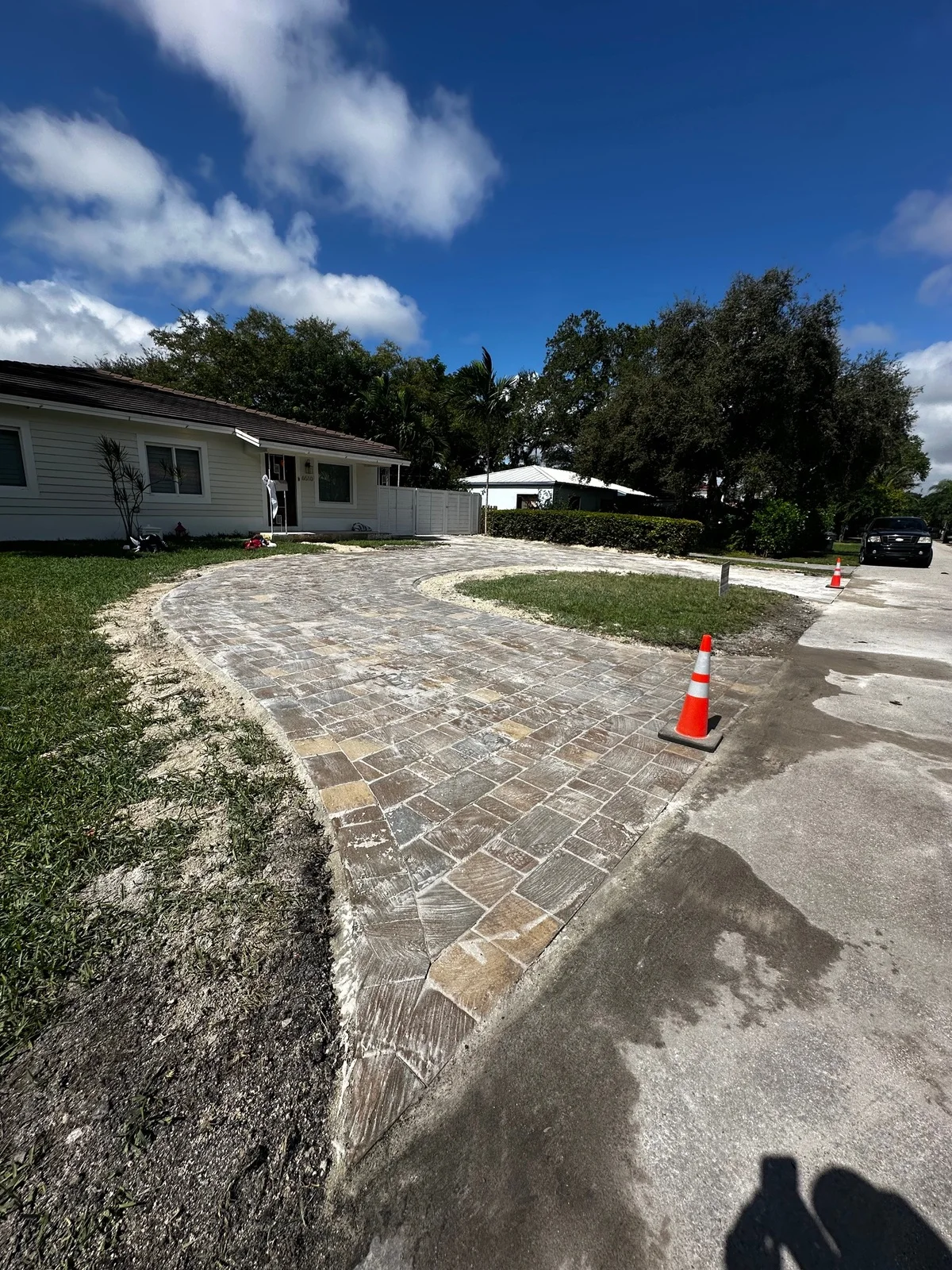
A driveway is the only paver surface on most properties that carries a vehicle, and that changes everything under it. Passenger cars are not the design case; the design case is the delivery truck, the moving van, and the day somebody parks a loaded trailer on the apron.
The apron, where the drive meets the street, takes the worst of it. Vehicles turn there under load, which grinds and shoves the surface sideways rather than just pressing down. That is why aprons need the deepest base on the job and the most serious edge restraint.
Width matters more than people expect. A drive built to the minimum feels fine until somebody steps out of a car onto wet grass every time it rains, and the edge course starts breaking down from being driven over.
A sunken paver is a symptom. The base under it is the disease.
Joint sand looks like filler between the pretty parts, and it does more work than anything else you can see. Sand packed into the joints is how one paver hands part of its load to the ones around it, and that sharing is what turns loose units into a surface. Lose the sand and the sharing stops. Each paver bears its own load, and that is exactly when rocking and cracking begin.
Ask what goes in the joints. On most patios now the answer is polymeric sand, which binds when it is wetted and holds up to washout much better than plain sand does. It is also easy to get wrong. It has to be installed dry, swept off the surface completely before any water, and watered in per the manufacturer’s directions. Hurry any of that and you get a hazy film.
Separation
Geotextile between subgrade and base stops fine soil migrating up and destroying the aggregate structure.
Base depth
Set by what the surface carries, not by habit. A walkway and a truck-bearing drive are not the same excavation.
Compaction
A compactor can only reach so far down. That is why aggregate goes in lifts, each compacted on its own, instead of one deep pile with a firm crust on top.
More driveway work
We are on jobs like this across the region. A handful of the places we work most:
What it asks of you afterwards
It does not take much. An edge lifted a little more than a quarter inch looks minor and still catches toes. That makes it the item to act on quickly once an install has settled in. If the pavers serve a commercial property, the stakes include liability, beyond keeping the surface in shape.
Small problems stay small on pavers if you catch them. A low spot fixed early is a quick reset. Left alone, it collects water and grows. Beyond watching for that, keeping the joints full and clean covers nearly everything a good install asks of you.
The upside of sealing is mostly cosmetic and practical: richer color, easier cleanup, a bit more hold on the joint sand. The downside is commitment. A sealed surface needs another coat every few years, and once it starts wearing unevenly it can look patchy. We will give you our honest opinion on yours before you decide.
People drawn to porcelain usually want a surface that will not stain, and it comes close. Its density means it absorbs almost nothing. Expect the install to be slower and more exacting than concrete pavers, since the bed has to be precisely flat and every cut needs the right blade.
If you are unsure which material to choose, concrete pavers are the safe default. The range of shapes and colors is the widest of anything we install, and matching them for a repair or an addition down the road is easier than with any other paver. Know going in that the color moves a little during the first year or two as they cure out.
Clay brick ages without changing color. The color is the fired clay, so sun has nothing to bleach out. It is more expensive and the shape options are narrower, and for a surface you want looking the same in twenty years, it is hard to beat.
What we see when somebody else did it
A finished job hides all of these. Because nobody can spot them at handover, they keep showing up on paver work.
Laying over the old surface
An overlay inherits everything beneath it. Settled spots and a soft base stay exactly where they were. If the base is what sank the old surface, the new layer just hides it for a season before the same failure comes back.
Skipping the geotextile
When we tear out a failed paver job, a muddy base with no fabric under it is a common sight. The soil and the stone have blended into one weak layer. That is exactly what separation fabric is there to prevent, and why resetting pavers on top of that mess never holds.
Using the wrong sand in the bedding
Beach sand and mason sand are round, so they roll under load like ball bearings. Bedding needs sharp, angular concrete sand that locks together and keeps pavers where they were set.
Sealing too early
Sealer works like a lid. Put it on a new concrete paver too early, in the first month, and whatever efflorescence has not come out yet gets trapped underneath as a permanent white haze. Let the pavers cure first.
The pavers are a wearing surface. The base is the building.
Common questions
Will the new pavers match what I already have
Sometimes exactly, sometimes closely. Concrete pavers change color a little with sun and age, and older lines get discontinued. If we cannot match, we will show you the options before we order anything, including pulling units from a less visible area to patch a visible one.
What happens to the old surface
It leaves with us. We demo the existing surface, load it out, and send concrete and old pavers to a recycler when there is one nearby. Removal is part of the job we price, so it will not show up later as an extra.
How do you keep it from settling again
The answer depends on what made it settle, which is why we look before we price it. Drainage problems get corrected and a failed base gets dug out and rebuilt, and if a root is pushing, it gets dealt with too. Then the pavers go back down on a base with a reason to stay put.
Do you work with HOAs and property managers
HOA, condo and multifamily properties are a regular part of our work. We are used to board timelines and submittals, and we schedule in phases so residents can still get around. Tell us how your approvals work.
Do you cover Miami, FL
Miami, FL is squarely in our regular area. We work there most weeks. If you send a few photos of the job, we can usually tell you a lot before anyone even comes out.
Is there a warranty
We do offer one, in writing, on the workmanship. The manufacturer handles the warranty on the pavers, and that documentation comes to you from us. We also tell you now what is not covered, things like roots or drainage that change after we finish, so it never comes as a surprise.
Let us walk the property
Send a couple of photos or just call. We will tell you what we think is going on, what it would take to fix, and whether it needs doing now or can wait.
Quality you can stand on