Paver Entertainment Areas, from the subgrade up
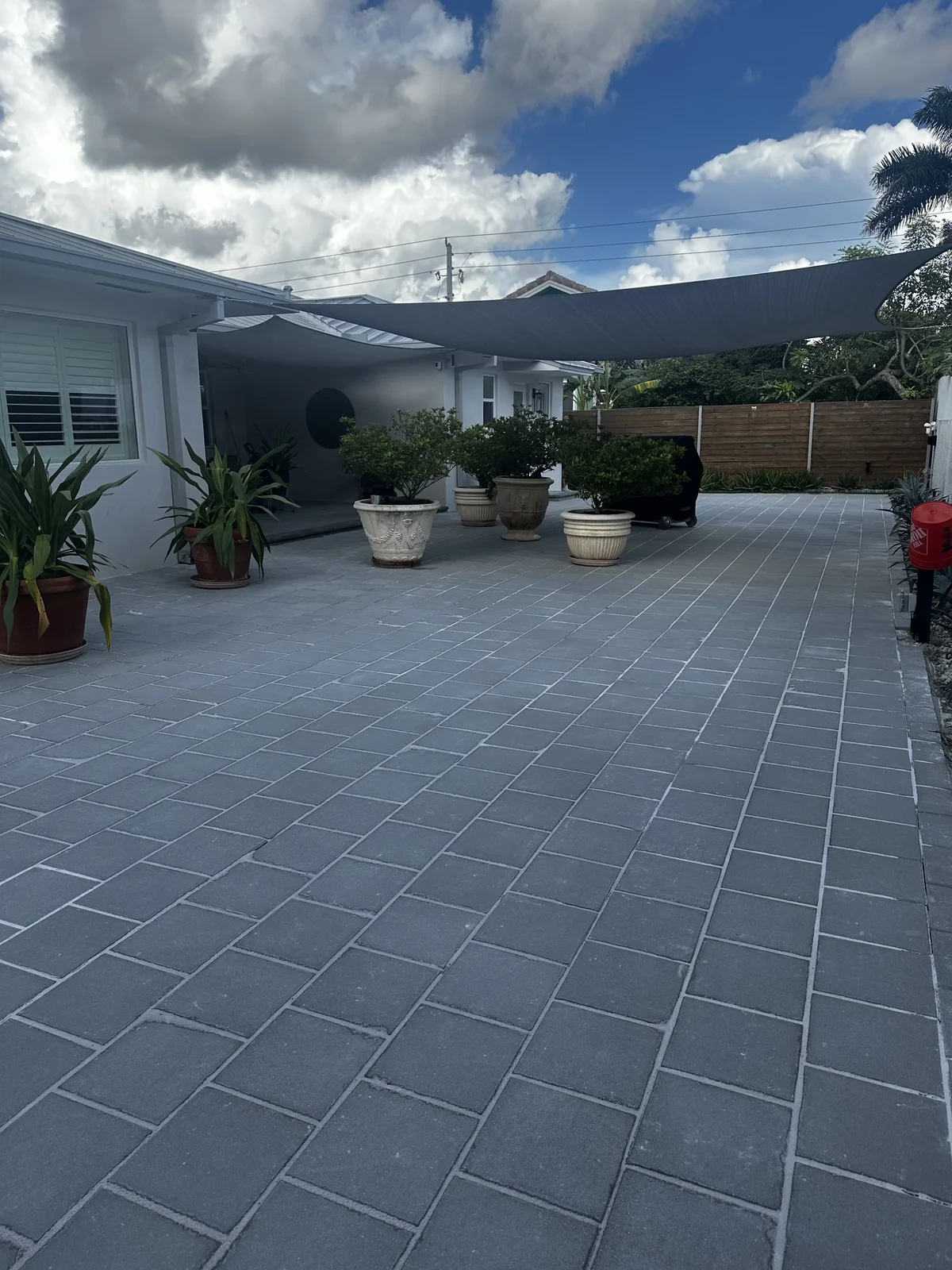
Space laid out for how people move when there are people over.
What actually goes wrong
When a paver surface goes wrong in Florida, the pavers are rarely the thing that failed. Water got into the base, the base moved, and the surface followed it down. Fix the surface only and you are back in two years.
The soil here is sand, and sand moves when water flows through it. Add South Florida’s habit of dropping a lot of rain in a short burst and the base under a paver surface is working much harder than it would up north. That is why the base gets so much of our time.
Moisture collects under a walkway, and roots go where the moisture is. Ficus, black olive and a lot of older shade trees root shallow and wide, so they find that damp layer and push the pavers up.
None of this is visible in a finished photo, which is why the cheap version and the right version look identical on day one. They stop looking identical around year two.
How we run this job
We come look at it
If the problem turns out smaller than you feared, you will hear that from us. We walk the property with you, look at where water is going, and tell you plainly what we see.
You get the plan in writing
Everything in writing up front: what we are doing, what it is made of, how long it takes, and what it costs. Nothing changes without you signing off on it.
We build the base first
Excavation to the depth this job actually needs, aggregate compacted lift by lift, bedding screeded flat. The slow part, and the part that decides whether the surface is still flat in ten years.
Pavers go down and get cut in
Laying the field is the fast part. The care is in the cuts at the edges and the restraint that locks the whole field in place.
Joints get filled and the site gets cleaned
Joints filled and set, everything washed down, our own debris on our own truck. The site is yours again the same day we finish.
What outdoor rooms do to a surface
Under a screen enclosure the cuts have to be clean to the track and the drainage has to work with the cage rather than against it. Water coming off a cage lands in a line, not spread out, so it concentrates in one place.
Heat is a real material constraint around fire features. Some units spall when they take repeated direct heat, so the ring immediately around a fire pit gets specified differently from the field around it.
Outdoor living surfaces get treated as furniture rather than pavement, which is exactly how they fail. A kitchen run takes grease and heat; a fire feature takes heat and foot traffic in the dark; a lanai floor lives under a cage that concentrates runoff.
The pavers are a wearing surface. The base is the building.
Irrigation is the one people overlook. A sprinkler head that hits the same few feet of paver twice a day keeps that part of the base saturated, and over time the sand underneath washes. Downspouts discharging at the edge and runoff coming off a neighboring grade do the same. The rain itself, landing on a well-jointed surface, is rarely the problem.
When water stands on pavers, the slope is usually the reason. A paver surface should fall about an eighth to a quarter inch per foot away from the building, a pitch you cannot feel underfoot that still moves water off. Flatten it and puddles form. Tip it the wrong way and runoff ends up at the foundation.
Drainage is the cheapest thing to fix while the ground is open and the most expensive thing to add later. Once water leaves the paved surface it has to land somewhere, and on a tight commercial lot with no fall to work with, that takes planning. We look at a channel drain along the low edge, a permeable section over a stone reservoir, or regrading the planting bed next door.
Base depth
Set by what the surface carries, not by habit. A walkway and a truck-bearing drive are not the same excavation.
Compaction
Compacting the whole base in one go only firms up the top. We place aggregate in layers and compact each one, so the base is solid all the way down.
Fall
The surface drops about an eighth to a quarter inch every foot away from the building. It feels level and drains like it should.
More outdoor work
We cover this across the region. A few of the areas we work most:
What it asks of you afterwards
Plenty of good paver jobs are never sealed. Unsealed concrete pavers weather to a softer color and the joints still do their job if they are kept topped up. Sealing earns its keep where stains are likely, around a grill or under a parked car, and where you want a darker, richer color. Ask us and we will give you a straight read on your surface.
Most small things on a paver surface can wait for a convenient day. A lifted edge cannot. Anything raised more than about a quarter inch will catch someone’s foot sooner or later, and where the property is commercial, that turns into a liability question on top of the repair.
Owners are often surprised how little a properly built paver surface needs from them. The joints are where most of the attention goes: keep them full of sand and free of leaves that would otherwise rot in place. Beyond that, keep an eye out for any area that starts to sink.
Travertine is a natural stone, and it behaves like one. Color and texture shift from unit to unit, so a deck has a less uniform look than concrete pavers give you. It also stays cooler under bare feet in direct sun, which is why pool owners ask for it. Seal it if it is going to see oil or heavy stains.
Of everything we install for homeowners, porcelain is the newest. What it brings is density: it soaks up almost no water and resists staining better than nearly anything else. What it demands is precision, both in the base, which has to be truly even, and in the cutting.
If you are unsure which material to choose, concrete pavers are the safe default. The range of shapes and colors is the widest of anything we install, and matching them for a repair or an addition down the road is easier than with any other paver. Know going in that the color moves a little during the first year or two as they cure out.
The shortcuts that surface two years later
Each of these hides under a clean new surface. Since the owner cannot see them at the end, they keep getting done.
Skipping the geotextile
This one cannot be checked after the fact. Once the pavers are down, nobody can see whether there is fabric under the base. If there is not, fine soil gradually moves up into the aggregate and weakens it, and the settling that follows takes a full rebuild to fix.
Using the wrong sand in the bedding
Cheap, rounded sand in the bedding layer is how pavers end up drifting. Mason sand and beach sand roll under load. Bedding should be sharp, angular concrete sand.
Sealing too early
Sealing is a timing job on new concrete pavers. They have to cure, and their efflorescence has to work out to the surface, before the sealer goes on. Rush it into the first month and the white haze gets sealed in.
Laying over the old surface
It is quick, it is cheap, and it inherits every problem underneath. If the base was the reason the old surface failed, putting a new one on top of it just hides the failure for a season.
The edge restraint is the piece nobody thinks about and the reason the field holds.
Common questions
Do I need to be home while you work
Not at all. With access to the site and a water source, we can work whether you are home or not. The one thing we will not do is make a big decision without you, so if something unexpected shows up, we phone you the same day.
Will the new pavers match what I already have
You will know before we order anything. Plenty of repairs match exactly. Others come close, since concrete pavers shift color a little with sun and age and older lines get discontinued. When close is not good enough, we can move units from a less visible area onto the visible patch.
What happens to the old surface
That part is on us. The existing surface gets broken out and hauled off the property, and concrete and pavers go to recycling when there is a recycler in the area. It is covered in the scope you sign.
How do you keep it from settling again
We find out why it sank before we touch it. Resetting pavers on the same weak base or over the same wet spot only buys you a little time. Usually the cure is better drainage and a properly rebuilt base, and sometimes it means dealing with a root or a downspout.
Do you work with HOAs and property managers
HOA, condo and multifamily properties are a regular part of our work. We are used to board timelines and submittals, and we schedule in phases so residents can still get around. Tell us how your approvals work.
Do you cover Miami, FL
Miami, FL is squarely in our regular area. We work there most weeks. If you send a few photos of the job, we can usually tell you a lot before anyone even comes out.
Let us walk the property
Give us a look at it in person. We walk the whole property, pay attention to drainage, and write up what we found, which is quicker than trading descriptions over the phone.
Quality you can stand on