What paver patio borders should actually involve
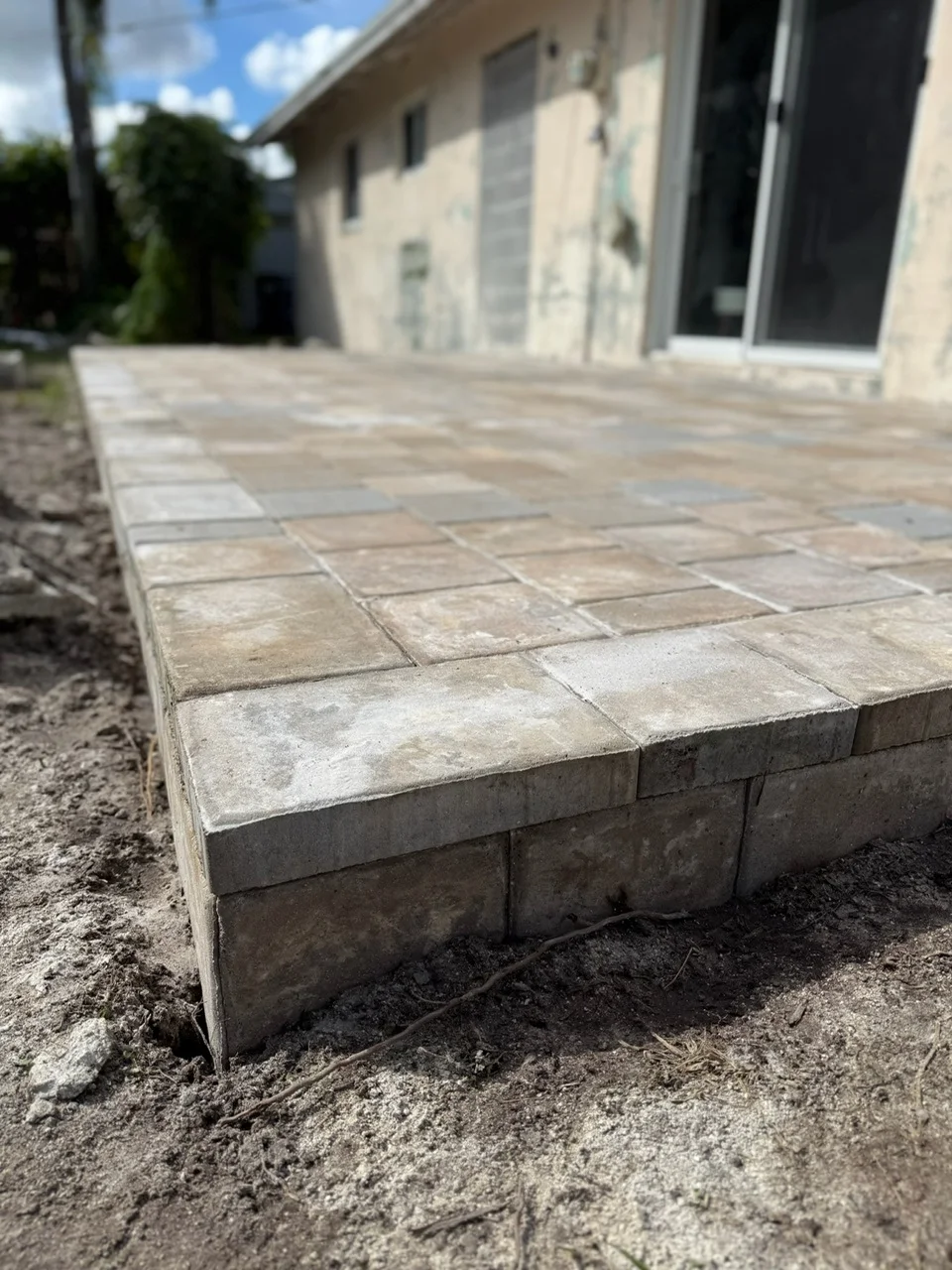
A soldier course that frames the patio and restrains the field.
What actually goes wrong
Almost every paver problem we get called out to is a base problem wearing a surface disguise. The pavers themselves are fine. They are concrete or stone, and they will outlast most of us. What moves is what is underneath them.
Sunken driveway edges here usually trace back to groundwater. Much of the coast has a high water table, so water cannot drop very far before it starts moving laterally. That lateral movement is what works the sand loose from under the edge.
A lifted section near a tree is usually the roots. The base under pavers holds moisture, so roots grow into it and push the surface up as they get bigger.
So the real question to ask anybody bidding this work is not what pavers they use. It is how deep they excavate, how they compact, and where they think your water goes. The answers tell you everything about how long the job will last.
How we run this job
We come look at it
We start in person. Someone from the crew comes out, looks at the problem and follows the water across the property. You get our honest read on the spot, and if the fix is small, we say it is small.
You get the plan in writing
Scope, materials, schedule, and cost on paper before a shovel moves. The number you approve is the number, not an opening position.
We build the base first
Most of the job is buried before you see a paver. We excavate to the depth the work calls for and compact the aggregate base in lifts, then screed the bedding layer. That hidden part is what holds the surface flat for years.
Pavers go down and get cut in
Field laid to the pattern, edges cut on site, and a restraint set around the perimeter so the field cannot creep.
Joints get filled and the site gets cleaned
Sand swept in and compacted, the surface washed down, and the property left the way we found it. We haul our own debris.
What makes a patio last
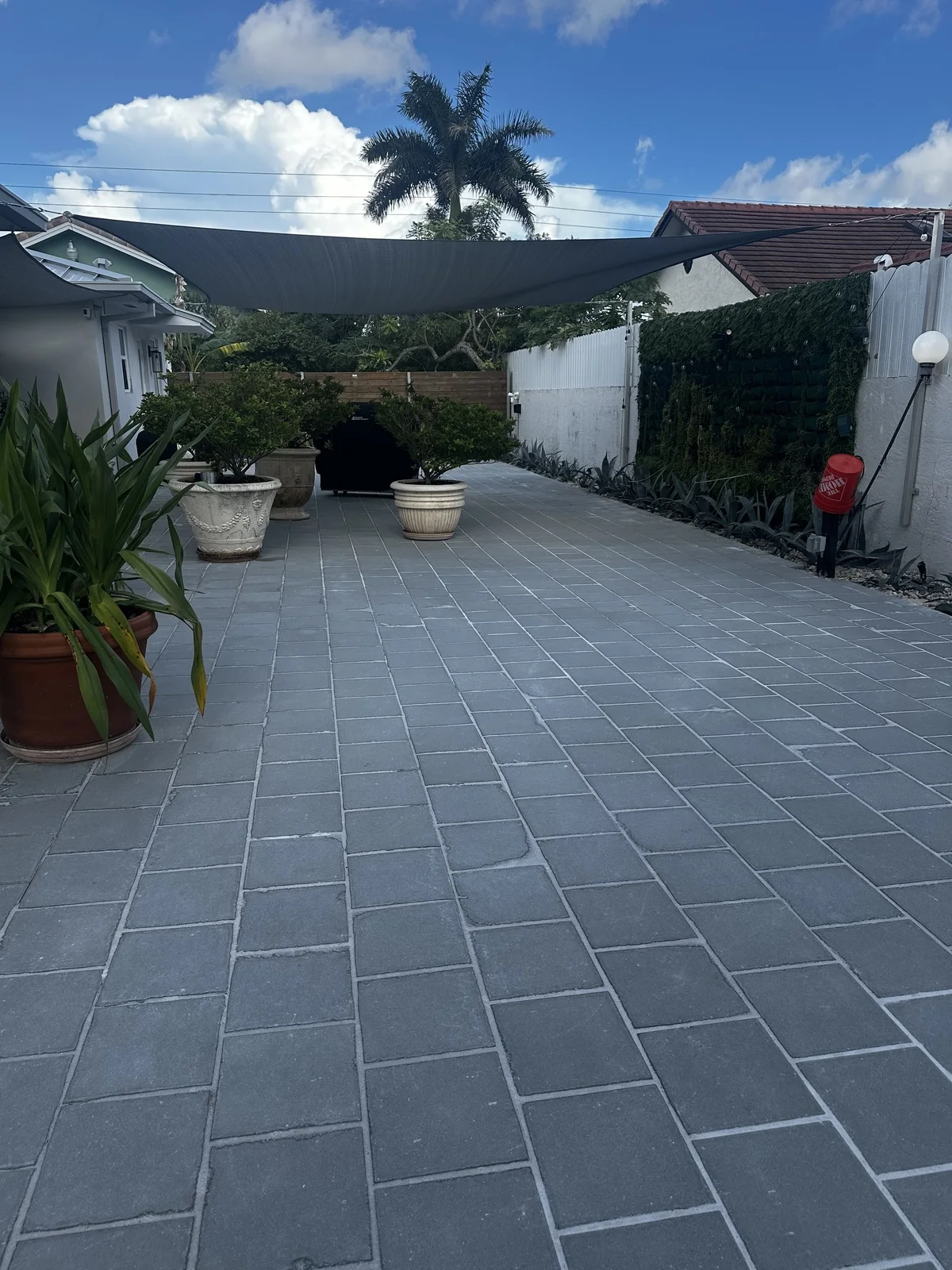
Fall away from the building is the whole game. A patio wants a gentle slope carrying water into the yard, never toward a slab or a door threshold. On a tight lot with no fall available that means a channel drain or a permeable section built in from the start.
Furniture is the quiet load. Table and chair legs concentrate weight on a tiny footprint and will dish an under-compacted patio in a season. Sun umbrellas with heavy bases are the usual culprit.
A patio carries people and furniture rather than vehicles, so the base can be shallower than a driveway. What it cannot be is badly drained. A patio that holds water grows algae, gets slick, and pushes moisture back at the house.
Compaction in lifts is the difference between ten years and two.
When a paver surface fails, look at the edges before you blame the rain. A downspout emptying right against the border, a sprinkler that wets the same corner every day, runoff from the lot next door: those are the usual suspects. Rain falling on a properly jointed field mostly runs off. Concentrated water from one source is what washes the base out.
Getting the fall right is quiet work. It means setting the base so the finished surface drops about an eighth to a quarter inch per foot away from the building, then checking it as the job goes. Done right, nobody notices it. Done wrong, you either get standing water or water pushed back against the foundation.
We draw the water’s route before we draw the paver pattern. On a commercial job, once rain runs off the surface, the design has to say where it goes next. With a tight lot and no fall available, that might be a channel drain along the low side or a permeable section feeding a stone reservoir. Sometimes it is a regrade of the planting bed beside it. All of them are cheaper now than later.
Joint sand
Structural, not cosmetic. It transfers load between units, which is the whole reason a field of loose pavers behaves like a surface.
Separation
Geotextile between subgrade and base stops fine soil migrating up and destroying the aggregate structure.
Base depth
Set by what the surface carries, not by habit. A walkway and a truck-bearing drive are not the same excavation.
More patio work
This is work we do throughout the region. Here are a few of our most frequent areas:
What it asks of you afterwards
Sealing really is a preference, which is why you hear different opinions on it. Our view: it is worth it where the surface takes oil, food or heavy staining, and less worth it on a walkway that only sees foot traffic. A poorly chosen sealer can leave a glossy sheen or trap moisture underneath, so product choice matters as much as the decision itself.
Most small things on a paver surface can wait for a convenient day. A lifted edge cannot. Anything raised more than about a quarter inch will catch someone’s foot sooner or later, and where the property is commercial, that turns into a liability question on top of the repair.
Owners are often surprised how little a properly built paver surface needs from them. The joints are where most of the attention goes: keep them full of sand and free of leaves that would otherwise rot in place. Beyond that, keep an eye out for any area that starts to sink.
Pick clay brick if you want a surface that still looks like the day it went in twenty years from now. Its color is the fired clay, so it stays put. You will pay more and have fewer shapes to choose from.
Travertine is a natural stone, and it behaves like one. Color and texture shift from unit to unit, so a deck has a less uniform look than concrete pavers give you. It also stays cooler under bare feet in direct sun, which is why pool owners ask for it. Seal it if it is going to see oil or heavy stains.
Of everything we install for homeowners, porcelain is the newest. What it brings is density: it soaks up almost no water and resists staining better than nearly anything else. What it demands is precision, both in the base, which has to be truly even, and in the cutting.
What we see when somebody else did it
On the day the job wraps, all of these look like good work. The damage comes later, so the habits never get corrected.
Sealing too early
Leave new concrete pavers unsealed through their first month. They are still curing, and efflorescence is still working out of them. Seal over that and the white haze can be locked under the sealer permanently.
Laying over the old surface
An overlay inherits everything beneath it. Settled spots and a soft base stay exactly where they were. If the base is what sank the old surface, the new layer just hides it for a season before the same failure comes back.
Skipping the geotextile
When we tear out a failed paver job, a muddy base with no fabric under it is a common sight. The soil and the stone have blended into one weak layer. That is exactly what separation fabric is there to prevent, and why resetting pavers on top of that mess never holds.
Using the wrong sand in the bedding
Bedding sand that is round acts like a layer of ball bearings. Pavers set on mason or beach sand drift under load. Sharp, angular concrete sand stays put.
The pavers are a wearing surface. The base is the building.
Common questions
Do I need to be home while you work
No. We need access and a water source. Most people go to work and come home to a finished section. If we hit something unexpected we call you that day, not at the end.
Will the new pavers match what I already have
Concrete pavers drift a little in color as the sun and the years work on them, so a fresh unit next to one that has been down a while can stand out. Sometimes we match exactly and sometimes closely. If we cannot get close enough, you see the options before we order.
What happens to the old surface
Old surfaces come out completely before anything new is built. We haul the debris away and recycle the concrete and pavers wherever we have a recycler to take them. Nothing about removal gets billed as an add-on.
How do you keep it from settling again
Settled pavers almost always point to something underneath. We trace it, whether it is drainage, a soft base or a root moving in, and fix that first. Pavers go back down only once the reason for the dip is gone.
Do you work with HOAs and property managers
Yes. Property managers usually want clear communication and no surprises, and that is how we like to work too. Tell us what your approval process requires and we will work inside it.
Do you cover Miami, FL
Miami, FL is squarely in our regular area. We work there most weeks. If you send a few photos of the job, we can usually tell you a lot before anyone even comes out.
Start with a conversation
Send a couple of photos or just call. We will tell you what we think is going on, what it would take to fix, and whether it needs doing now or can wait.
Quality you can stand on