What paver replacement should actually involve
Pulling a failed surface and rebuilding it from the subgrade up.

What actually goes wrong
Here is the honest version: a sunken paver is a symptom. The base under it lost material, usually to water, and the surface settled into the gap. Resetting the pavers without correcting the base just buys you a season.
Most of the region sits on sand over limestone. That sand drains quickly in normal weather, then hits its limit in a heavy downpour, when two inches can fall in an hour. A base built for that holds. One that was not starts to wash out.
Then there are trees. A ficus or a black olive near a walkway sends roots out shallow and far, and the damp ground under pavers draws them in. Older shade trees do the same.
So the real question to ask anybody bidding this work is not what pavers they use. It is how deep they excavate, how they compact, and where they think your water goes. The answers tell you everything about how long the job will last.
How we run this job
We come look at it
We look before we talk about fixes. One of us walks the property alongside you and follows the water, then tells you straight what is going on, including when it is a smaller job than you expected.
You get the plan in writing
Scope, materials, schedule, and cost on paper before a shovel moves. The number you approve is the number, not an opening position.
We build the base first
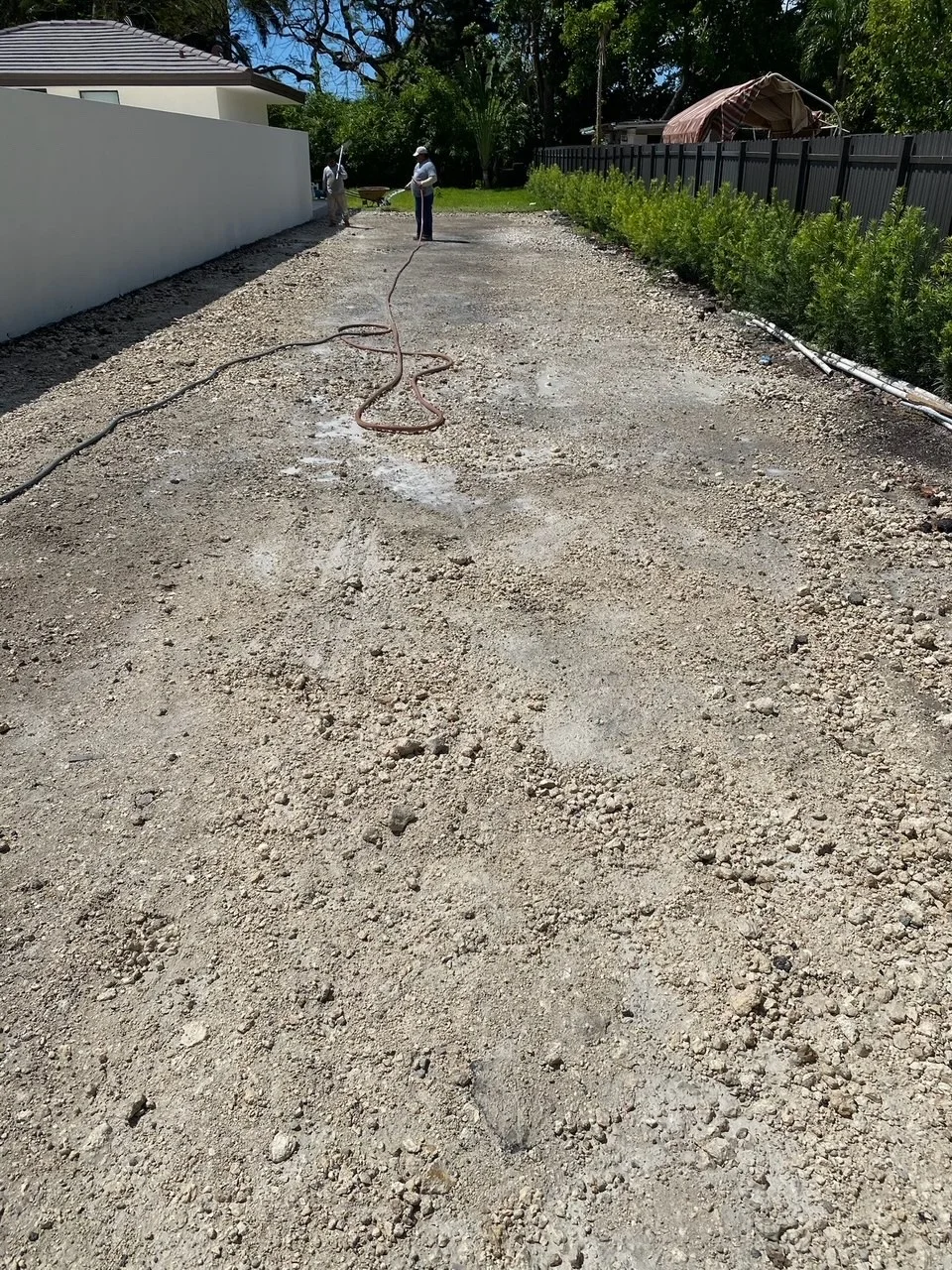
Excavation to the depth this job actually needs, aggregate compacted lift by lift, bedding screeded flat. The slow part, and the part that decides whether the surface is still flat in ten years.
Pavers go down and get cut in
Laying the field is the fast part. The care is in the cuts at the edges and the restraint that locks the whole field in place.
Joints get filled and the site gets cleaned
Sand swept in and compacted, surface washed, debris hauled by us. You get the property back the way we found it, minus the problem.
What a proper installation actually involves
A plate compactor only reaches so deep. That is why the base goes in as a series of lifts, each a few inches thick and compacted before the next one lands on top. Put the full depth down at once and the plate firms up the top and leaves the bottom loose. It feels solid when you walk it. Then over the first year or two, the loose layer underneath consolidates unevenly and the surface settles in patches.
On site the order runs backwards from what you end up seeing. We dig out to the subgrade, the native soil, and check it. We bring in crushed aggregate and compact it into a base, which is the layer that actually carries the surface. We screed a thin bed of sharp sand dead flat on top. Only then do the pavers go down. They are the wearing surface and the part people photograph, and they sit on top of the work that holds everything up.
The heaviest thing that ever crosses the surface sets the depth, even if it only comes once a week. A walkway for people can sit on a shallow base. A home driveway that sees a loaded pickup needs a deeper one. A commercial drive where delivery trucks pull in needs deeper still. If somebody hands you the same base depth for a garden path and a driveway, they did not measure anything.
The edge restraint is the piece nobody thinks about and the reason the field holds.
When we look at an older paver surface, the joints are one of the first things we check. That sand transfers load from paver to paver, so a field of separate units works as a single surface. Where joints have washed out, each paver is carrying its own load, and that is the spot where they start rocking and cracking. Empty joints are the early warning.
Ask what goes in the joints. On most patios now the answer is polymeric sand, which binds when it is wetted and holds up to washout much better than plain sand does. It is also easy to get wrong. It has to be installed dry, swept off the surface completely before any water, and watered in per the manufacturer’s directions. Hurry any of that and you get a hazy film.
Separation
Geotextile between subgrade and base stops fine soil migrating up and destroying the aggregate structure.
Base depth
Set by what the surface carries, not by habit. A walkway and a truck-bearing drive are not the same excavation.
Compaction
Layered, then compacted, then layered again. One load spread and run over once looks finished and leaves loose material below the crust.
More installation work
We are on jobs like this across the region. A handful of the places we work most:
What it asks of you afterwards
A well-laid surface mostly looks after itself. What it does need is joints that stay full, so add sand when you see it dropping, and attention to any low spot before it spreads. Catching settling early keeps the repair small.
Plenty of good paver jobs are never sealed. Unsealed concrete pavers weather to a softer color and the joints still do their job if they are kept topped up. Sealing earns its keep where stains are likely, around a grill or under a parked car, and where you want a darker, richer color. Ask us and we will give you a straight read on your surface.
It does not take much. An edge lifted a little more than a quarter inch looks minor and still catches toes. That makes it the item to act on quickly once an install has settled in. If the pavers serve a commercial property, the stakes include liability, beyond keeping the surface in shape.
Concrete pavers win on choice: they come in more shapes and colors than any other material we install. They also lay up consistently, which makes for a predictable job. The color runs through the whole unit, so it fades slowly and gently in the sun. Expect it to shift a bit in the first year or two as it cures out.
Clay brick ages without changing color. The color is the fired clay, so sun has nothing to bleach out. It is more expensive and the shape options are narrower, and for a surface you want looking the same in twenty years, it is hard to beat.
Travertine is quarried stone, so no two pieces look quite alike. Some people love that variation and some find it busy, so it is worth seeing a few units side by side before you commit. Its big practical advantage is temperature: in direct sun it stays cooler underfoot than concrete, which is why it shows up around so many pools.
The shortcuts that surface two years later
A finished job hides all of these. Because nobody can spot them at handover, they keep showing up on paver work.
Laying over the old surface
Overlaying is tempting because it skips the tear-out and costs less up front. It also inherits every problem below. When the old surface failed because of the base, the new one is sitting on the same bad base and goes the same way.
Skipping the geotextile
The base only works if it stays clean crushed aggregate. Fabric under it keeps the soil below from mixing in. Skip it and the two layers blend a little more every rainy season, and once enough soil has moved up, the base cannot carry the load and the pavers settle.
Using the wrong sand in the bedding
Concrete sand goes in the bedding for a reason: its grains are sharp and angular, so they lock. Mason sand and beach sand are rounded and let pavers wander under load.
Sealing too early
Sealing is a timing job on new concrete pavers. They have to cure, and their efflorescence has to work out to the surface, before the sealer goes on. Rush it into the first month and the white haze gets sealed in.
If nobody talks to you about drainage, they are quoting a different job.
Common questions
How long does the job take
A typical paver replacement job runs two to five working days once we start. Base work is the slow part; laying the field goes quickly. Weather moves things, and in summer we plan around the afternoon storms rather than pretending they will not happen.
Do I need to be home while you work
Not at all. With access to the site and a water source, we can work whether you are home or not. The one thing we will not do is make a big decision without you, so if something unexpected shows up, we phone you the same day.
Will the new pavers match what I already have
Sometimes exactly, sometimes closely. Concrete pavers change color a little with sun and age, and older lines get discontinued. If we cannot match, we will show you the options before we order anything, including pulling units from a less visible area to patch a visible one.
What happens to the old surface
It leaves with us. We demo the existing surface, load it out, and send concrete and old pavers to a recycler when there is one nearby. Removal is part of the job we price, so it will not show up later as an extra.
How do you keep it from settling again
Pulling up the low pavers is the easy part. Keeping them level means fixing what let them drop, which is usually water undermining the base or a base that was weak to begin with. We correct both before anything goes back down, and handle a root if one is involved.
Do you cover Miami, FL
It is our home turf. We are based in Miami, FL and out on jobs around it most weeks, so getting to you is rarely the hard part. Call and we will give you a real answer on dates.
Start with a conversation
Tell us when works and we will come stand on it. Walking the property and seeing where the water goes answers more than any amount of back and forth, and you get our findings written up.
Quality you can stand on