Permeable Paver Systems done so it stays flat
A full system, from the open graded base to the surface course.
What actually goes wrong
When a paver surface goes wrong in Florida, the pavers are rarely the thing that failed. Water got into the base, the base moved, and the surface followed it down. Fix the surface only and you are back in two years.
Our soil does well with steady rain and badly with a sudden flood of it. Across much of the region it is sand over limestone, and an afternoon storm can deliver two inches in an hour. That is when the base either holds its shape or starts to wash.
Then there are trees. A ficus or a black olive near a walkway sends roots out shallow and far, and the damp ground under pavers draws them in. Older shade trees do the same.
That is why the schedule on our jobs is mostly spent on the part you will never see again. The surface takes a day or two. The ground it sits on takes the rest, and the ground is what you are actually paying for.
How we run this job
We come look at it
If the problem turns out smaller than you feared, you will hear that from us. We walk the property with you, look at where water is going, and tell you plainly what we see.
You get the plan in writing
Everything in writing up front: what we are doing, what it is made of, how long it takes, and what it costs. Nothing changes without you signing off on it.
We build the base first
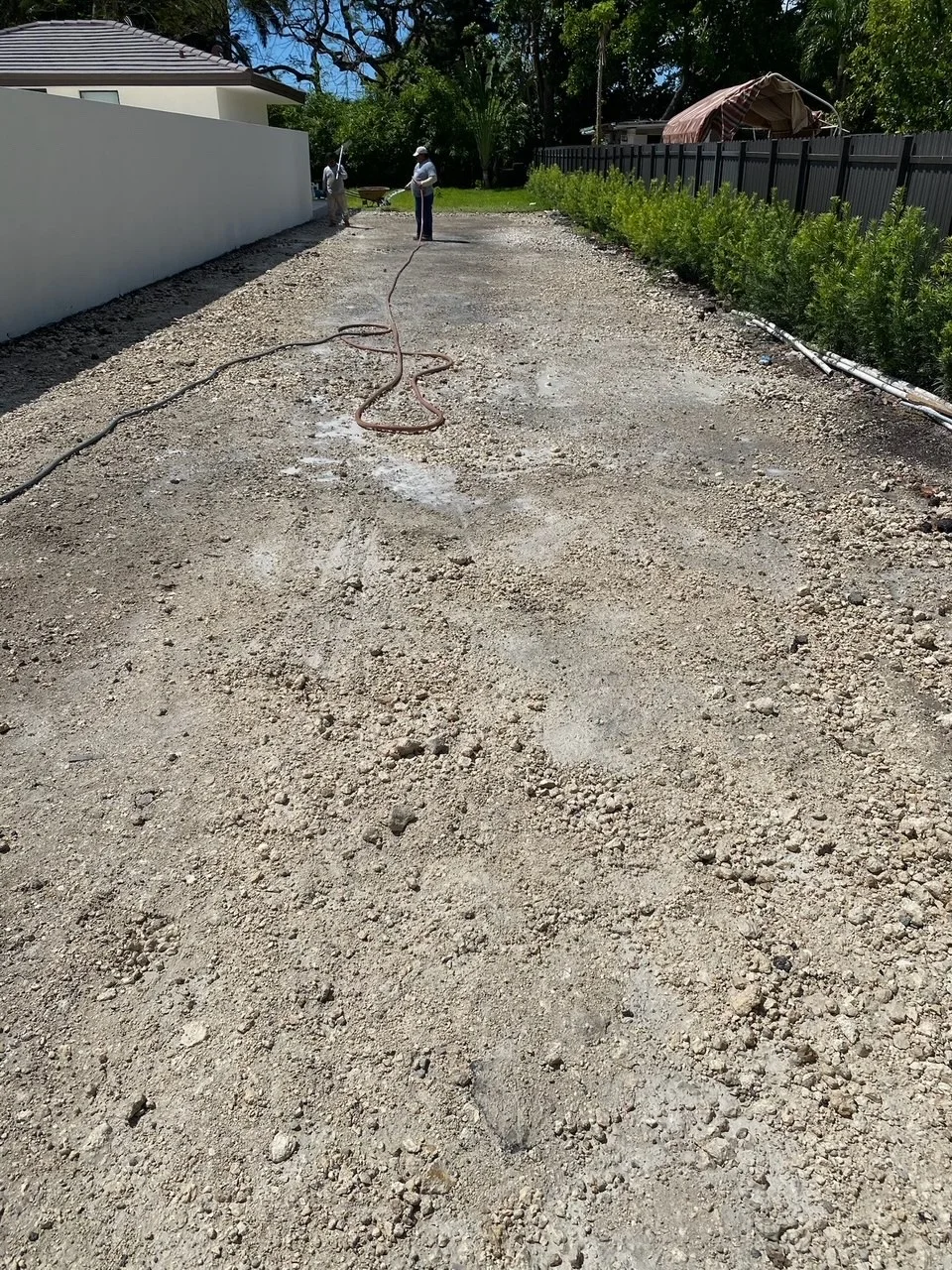
Excavation to the depth this job actually needs, aggregate compacted lift by lift, bedding screeded flat. The slow part, and the part that decides whether the surface is still flat in ten years.
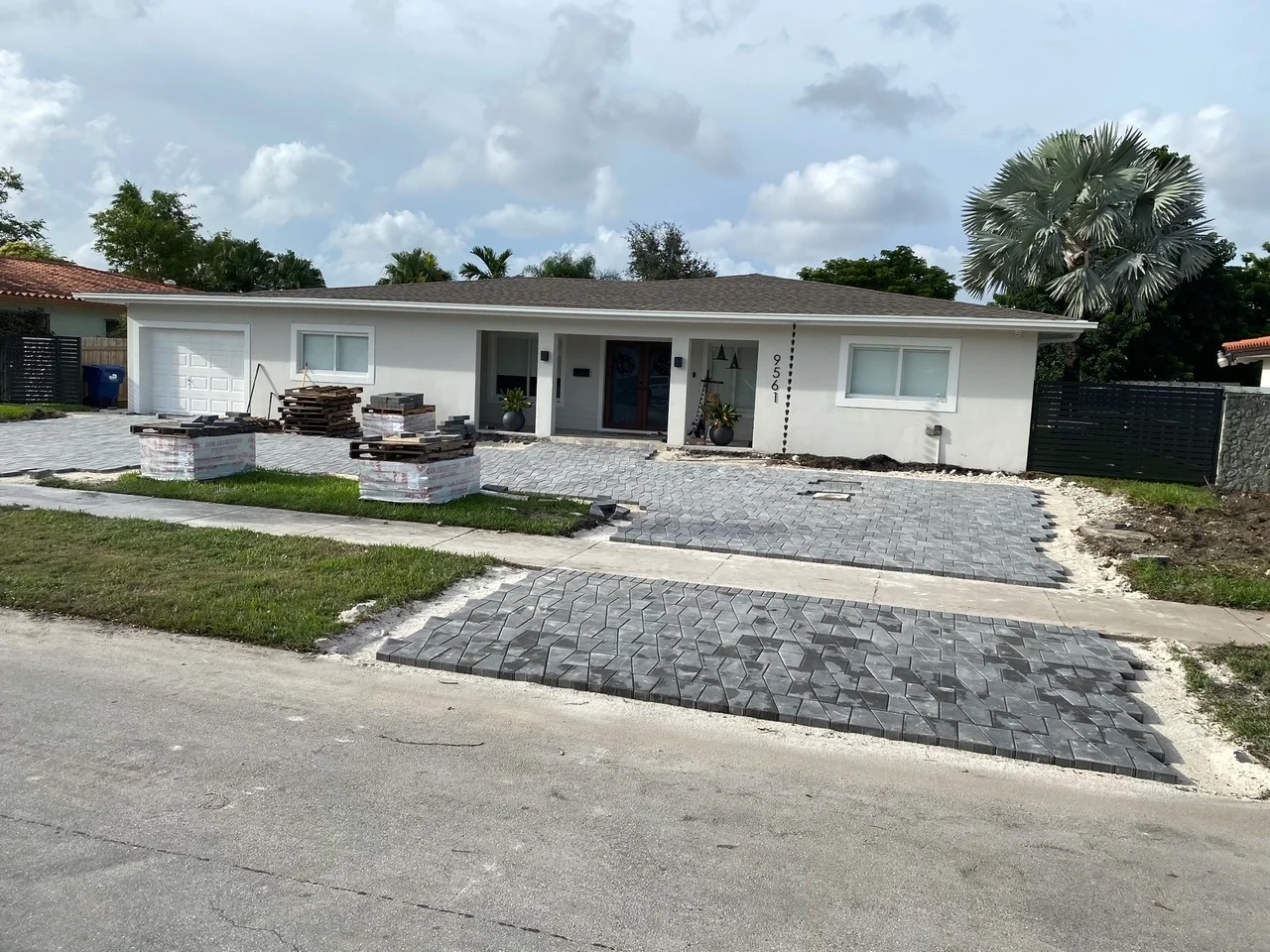
Pavers go down and get cut in
Laying the field is the fast part. The care is in the cuts at the edges and the restraint that locks the whole field in place.
Joints get filled and the site gets cleaned
Joints filled and set, everything washed down, our own debris on our own truck. The site is yours again the same day we finish.
Where the water goes when it rains here
Depth is decided by what the surface has to carry. A walkway that only ever sees people can sit on a shallower base than a driveway that takes a loaded pickup every day, and a commercial drive that takes delivery trucks needs more again. Anybody who quotes the same base depth for a garden path and a driveway is not measuring, they are guessing.
We do not move on to the next layer of base until the one below it is compacted. Each lift is a few inches of aggregate. It is slower than filling the excavation and running a plate over the top, and that is precisely why the faster method is so common: on day one, both look identical. The difference shows up a year later as patchy settlement.
Start at the bottom and work up. The subgrade is the soil your property already has, and nothing we do changes what it is made of. On top of it goes the base: crushed aggregate, compacted until it carries weight on its own. Then a thin course of sharp sand, screeded flat so every paver beds at the same height. Then the pavers. Three of those four layers get buried on the first day, and they are the three that decide how the job ages.
The edge restraint is the piece nobody thinks about and the reason the field holds.
Irrigation is the one people overlook. A sprinkler head that hits the same few feet of paver twice a day keeps that part of the base saturated, and over time the sand underneath washes. Downspouts discharging at the edge and runoff coming off a neighboring grade do the same. The rain itself, landing on a well-jointed surface, is rarely the problem.
Getting the fall right is quiet work. It means setting the base so the finished surface drops about an eighth to a quarter inch per foot away from the building, then checking it as the job goes. Done right, nobody notices it. Done wrong, you either get standing water or water pushed back against the foundation.
We draw the water’s route before we draw the paver pattern. On a commercial job, once rain runs off the surface, the design has to say where it goes next. With a tight lot and no fall available, that might be a channel drain along the low side or a permeable section feeding a stone reservoir. Sometimes it is a regrade of the planting bed beside it. All of them are cheaper now than later.
Base depth
Set by what the surface carries, not by habit. A walkway and a truck-bearing drive are not the same excavation.
Compaction
Each lift of aggregate gets compacted before the next one goes down. The shortcut, one dump and a quick pass, compacts the surface and leaves the rest loose.
Fall
A gentle pitch away from the structure, roughly an eighth to a quarter inch per foot, so water runs off instead of pooling or heading for the foundation.
More drainage work
This is work we do throughout the region. Here are a few of our most frequent areas:
What it asks of you afterwards
The upside of sealing is mostly cosmetic and practical: richer color, easier cleanup, a bit more hold on the joint sand. The downside is commitment. A sealed surface needs another coat every few years, and once it starts wearing unevenly it can look patchy. We will give you our honest opinion on yours before you decide.
It does not take much. An edge lifted a little more than a quarter inch looks minor and still catches toes. That makes it the item to act on quickly once an install has settled in. If the pavers serve a commercial property, the stakes include liability, beyond keeping the surface in shape.
Most of the maintenance happens before the pavers go down. Get the base and joints right and the owner’s part is short: keep organic debris out of the joints, refill sand as needed, and address any settled patch early.
If staining is your main worry, porcelain is close to stain-proof. It absorbs almost nothing. It asks more of the installer than most materials, though: an uneven bed shows through, so base work has to be precise, and cutting it cleanly takes the proper blade and some patience.
Most of what we put down is concrete pavers. They come in more shapes and colors than any other option and lay up predictably. Years later, when you want to add on or patch, they are also the easiest to match. The pigment runs all the way through each unit, so sun softens the color over time and there is no surface coat to wear through.
Clay brick is the long-game material. Fired clay keeps its color essentially forever, since the clay is the color. Expect a higher price and fewer shapes. In exchange, the surface should look about the same twenty years from now as it does the week we finish.
The failures we get called out to fix
Every one of these looks fine on the last day of the job. That is why contractors keep getting away with them.
Skipping the geotextile
We put a geotextile down on the subgrade before any base goes in. Its whole purpose is separation. Soil stays below, aggregate stays above, and the base keeps the structure it was compacted into. Leave it out and the mixing happens slowly and does not reverse.
Using the wrong sand in the bedding
If pavers are wandering out of line, check the bedding. It should be angular concrete sand with sharp grains. Rounded mason or beach sand rolls under load and lets them move.
Sealing too early
Sealing is a timing job on new concrete pavers. They have to cure, and their efflorescence has to work out to the surface, before the sealer goes on. Rush it into the first month and the white haze gets sealed in.
Laying over the old surface
It is quick, it is cheap, and it inherits every problem underneath. If the base was the reason the old surface failed, putting a new one on top of it just hides the failure for a season.
Compaction in lifts is the difference between ten years and two.
Common questions
Will the new pavers match what I already have
On a small repair in the middle of an older patio, the new units have to sit right next to weathered ones. Concrete pavers change color a little with sun and age, so we look for the closest match and tell you honestly how close it is. If it falls short, borrowing pavers from a less visible area is one option.
What happens to the old surface
That part is on us. The existing surface gets broken out and hauled off the property, and concrete and pavers go to recycling when there is a recycler in the area. It is covered in the scope you sign.
How do you keep it from settling again
We find out why it sank before we touch it. Resetting pavers on the same weak base or over the same wet spot only buys you a little time. Usually the cure is better drainage and a properly rebuilt base, and sometimes it means dealing with a root or a downspout.
Do you work with HOAs and property managers
Your rules come first. We regularly work for associations and property managers, which means board timelines and submittals are routine for us. Share your approval process and we will schedule the work, in phases if needed, so residents keep access.
Do you cover Miami, FL
Yes. Miami, FL is inside our regular working area and we are out that way most weeks. Call and we will tell you honestly when we could get to you.
Is there a warranty
Yes. Get any contractor’s warranty in writing and read what it excludes. Ours is written and covers our workmanship. It is also clear about its limits, like a root that arrives later or a drainage change. The pavers have separate manufacturer coverage, and we give you those papers.
Start with a conversation
Send a couple of photos or just call. We will tell you what we think is going on, what it would take to fix, and whether it needs doing now or can wait.
Quality you can stand on