Paver Walkway Restoration, built on a base that holds
Clean, re-level and re-sand a walk that has drifted.

What actually goes wrong
Almost every paver problem we get called out to is a base problem wearing a surface disguise. The pavers themselves are fine. They are concrete or stone, and they will outlast most of us. What moves is what is underneath them.
An afternoon storm here can drop two inches of rain in an hour. Our ground, mostly sand over limestone across the region, normally drains fast, but a cloudburst like that overwhelms it and sends water moving through the base. Whether the base holds or washes depends on how it was built.
Old trees cause plenty of it too. Their roots go wherever there is water, and since the base under pavers holds water, the roots move in and slowly jack the surface upward.
None of this is visible in a finished photo, which is why the cheap version and the right version look identical on day one. They stop looking identical around year two.
How we run this job
We come look at it
Somebody from the crew comes out, stands on the problem, and tells you what is actually going on underneath it. No sales visit, just a look and an honest read.
You get the plan in writing
Everything in writing up front: what we are doing, what it is made of, how long it takes, and what it costs. Nothing changes without you signing off on it.
We build the base first
When pavers sink, it is almost always the base that went first. We build the base before anything else, digging to the depth your job needs and compacting aggregate in lifts under a screeded bedding layer, so the surface stays flat for years.
Pavers go down and get cut in
Laying the field is the fast part. The care is in the cuts at the edges and the restraint that locks the whole field in place.
Joints get filled and the site gets cleaned
Sand swept in and compacted, the surface washed down, and the property left the way we found it. We haul our own debris.
Why walkways move before anything else
Roots are the usual reason a walkway moves. A path that runs past mature trees is running through their root zone, and roots follow the moisture a paver base holds.
A walkway is a trip-hazard question before it is anything else. People walk it in the dark, carrying things, not looking down. A quarter inch of lift is enough to catch a toe, and on a commercial property that is a liability question as well as a maintenance one.
Walkways are narrow, which makes edge restraint proportionally more important. There is less field to hold itself together, so the perimeter is doing more of the structural work than it does on a wide surface.
If nobody talks to you about drainage, they are quoting a different job.
Hard rain and pressure washers both pull sand out of paver joints, and that matters more than it looks. The sand is structural. It carries load across from each paver to its neighbors, which is the whole reason a bed of loose units behaves like a solid surface. Empty the joints and every paver has to hold up its own share, and that is when they rock and crack.
Polymeric sand binds when it is wetted and resists washout better than plain sand, which is why it has become the default. It has to go in dry, get swept properly off the surface before wetting, and be watered in the way the manufacturer specifies. Rushed installation is why some jobs end up with a hazy residue over the pavers.
Fall
We pitch the surface roughly an eighth to a quarter inch per foot away from the building, enough to shed water without anyone noticing a slope.
Restraint
A perimeter edge restraint is what stops the field creeping outward and the joints opening from the outside in.
Joint sand
Structural, not cosmetic. It transfers load between units, which is the whole reason a field of loose pavers behaves like a surface.
More walkway work
You will find us doing this across the region, often in these areas:
What it asks of you afterwards
A lifted edge is the one problem worth fixing the week you notice it. Past about a quarter inch it becomes a trip hazard. Catching it early usually means resetting a few pavers. On a commercial property, waiting also means carrying a liability question until it is done.
If the base was built right, you will spend very little time on it. An occasional sweep keeps organic material from composting in the joints, and a top-up of joint sand now and then keeps the pavers locked together. That is the list.
Sealing is maintenance you sign up for. Once a surface is sealed, it looks best if it gets recoated every few years, and skipping that leaves it patchy. In exchange you get deeper color and stains that lift with less scrubbing. Some owners love that look. Others prefer pavers left natural. Either is a reasonable choice, and we will tell you which suits your surface.
Concrete pavers are the workhorse and cover most of what gets installed. Widest range of shapes and colors, most predictable to lay, and the easiest to match later. Color is pigment through the unit, so it fades gently with sun rather than wearing off, though it does shift over the first year or two as it cures out.
If budget is tight, clay brick is usually not where we start, since it costs more and comes in fewer shapes. If the priority is a surface that looks the same in twenty years, it is the answer. Its color is the fired clay, and that does not fade.
Concrete in the midday sun can get uncomfortable on bare feet. Travertine stays noticeably cooler, which is the main reason it is the paver people ask for around pools. The tradeoffs are that natural stone varies from piece to piece and that it should be sealed anywhere it is likely to get oil or heavy staining.
How this gets done badly
None of these are visible on the day the work finishes, which is exactly why they keep happening.
Laying over the old surface
Whatever made the old surface fail is still down there when you pave over it. If the base was the problem, a new layer on top only covers the failure for a season, and then it shows through again.
Skipping the geotextile
Fine soil moves. Water carries it and traffic pumps it, and without a barrier it ends up in the aggregate base. A layer of separation fabric under the base stops that. Skip it and the base gradually turns soft, and the settlement it causes sits below anything a surface repair can reach.
Using the wrong sand in the bedding
Pavers only hold their line if the bedding grips them. That takes sharp, angular concrete sand. Rounded mason or beach sand behaves like ball bearings once there is weight on it.
Sealing too early
Everybody wants the new pavers sealed right away. That is the mistake. Concrete pavers need to cure and clear their efflorescence first, and sealing in the first month can lock a white haze under the sealer permanently.
Compaction in lifts is the difference between ten years and two.
Common questions
Will the new pavers match what I already have
First we find out whether your paver line is still made. Older lines get discontinued, and even a current one can look a little different from units that have sat in the sun for years. If we can match, exactly or closely, we order. If not, we show you the options first, like pulling pavers from a less visible area.
What happens to the old surface
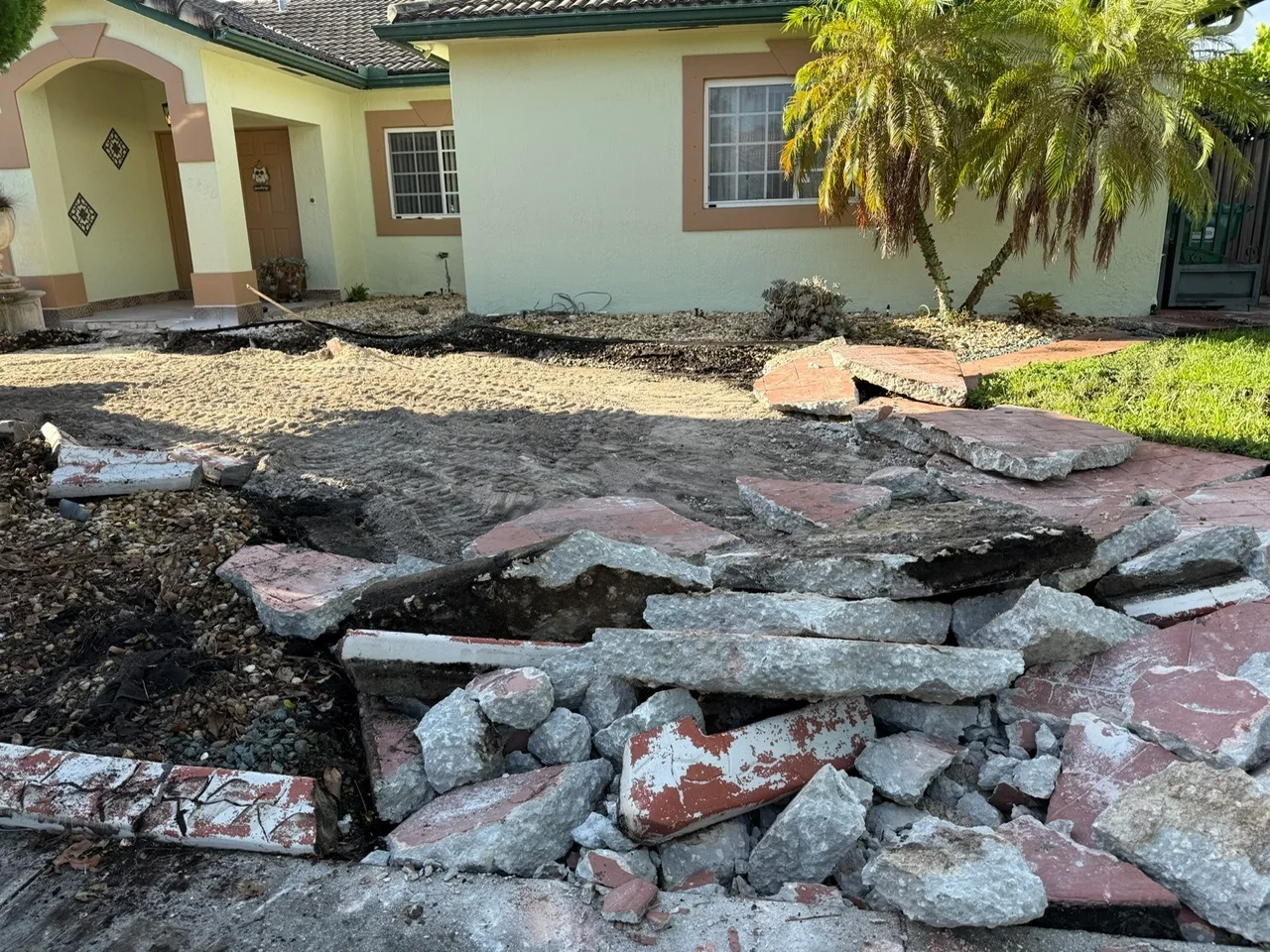
Gone before the new base goes in. We demolish it, haul it, and recycle the concrete and pavers if a recycler is available locally. You will see it listed in the scope from the start.
How do you keep it from settling again
We start with a question: where is the water going? That answer usually explains the settling. From there it is a matter of correcting the drainage and putting a proper base back in, plus handling any root or downspout feeding the problem.
Do you work with HOAs and property managers
Yes. If your board only meets monthly, we plan the job around that meeting. Submittals and phased work that keeps residents moving are normal for us, so tell us how approvals run.
Do you cover Miami, FL
Yes, Miami is our home area. Tell us where the property is and what you are thinking about, and we will give you a realistic idea of when we could be there.
Is there a warranty
Two warranties apply. Ours covers the workmanship and comes in writing. The manufacturer covers the pavers, and we give you their documentation. Our warranty does not cover conditions that change after the job, such as a new root or a drainage change, and we tell you that up front.
Have somebody come look at it
A real answer comes from being there. We will walk the property, follow where the water goes, and give you a written account of what we see, so you are not guessing from a phone call.
Quality you can stand on