Paver Stormwater Management without the part that fails later
Where the water goes in a South Florida downpour, worked out first.
What actually goes wrong
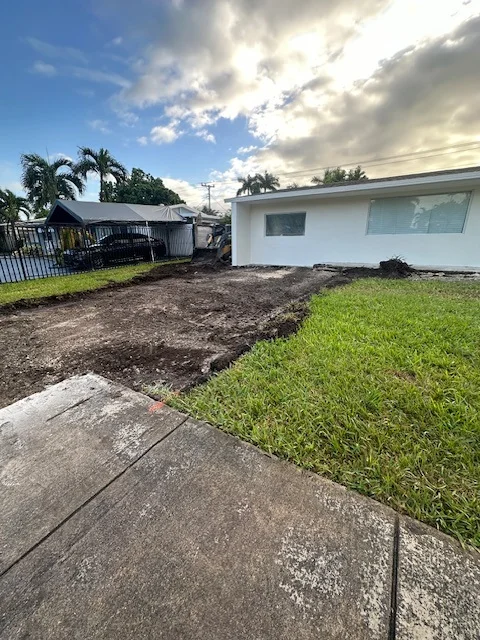
The failure is almost always below the pavers. Sand washes out of the joints, water gets down into the bedding, the bedding migrates, and the surface drops. Everything you can see is downstream of that.
Base work matters more in South Florida than it does up north. Water moving through sandy soil carries some of it along, and a summer storm can dump a lot of water fast. A paver base built here has to hold up to both, every single year.
Tree roots lift pavers here too. The usual culprits are ficus, black olive and older shade trees, whose shallow, wide roots follow moisture straight under a walkway and push it up from below.
That is why the schedule on our jobs is mostly spent on the part you will never see again. The surface takes a day or two. The ground it sits on takes the rest, and the ground is what you are actually paying for.
How we run this job
We come look at it
One of us walks the property with you, looks at where the water goes, and gives you a straight read on what we see. If it is smaller than you feared, we say so.
You get the plan in writing
Scope, materials, how long it takes, and what it costs, written down before anybody starts. No verbal numbers that change later.
We build the base first
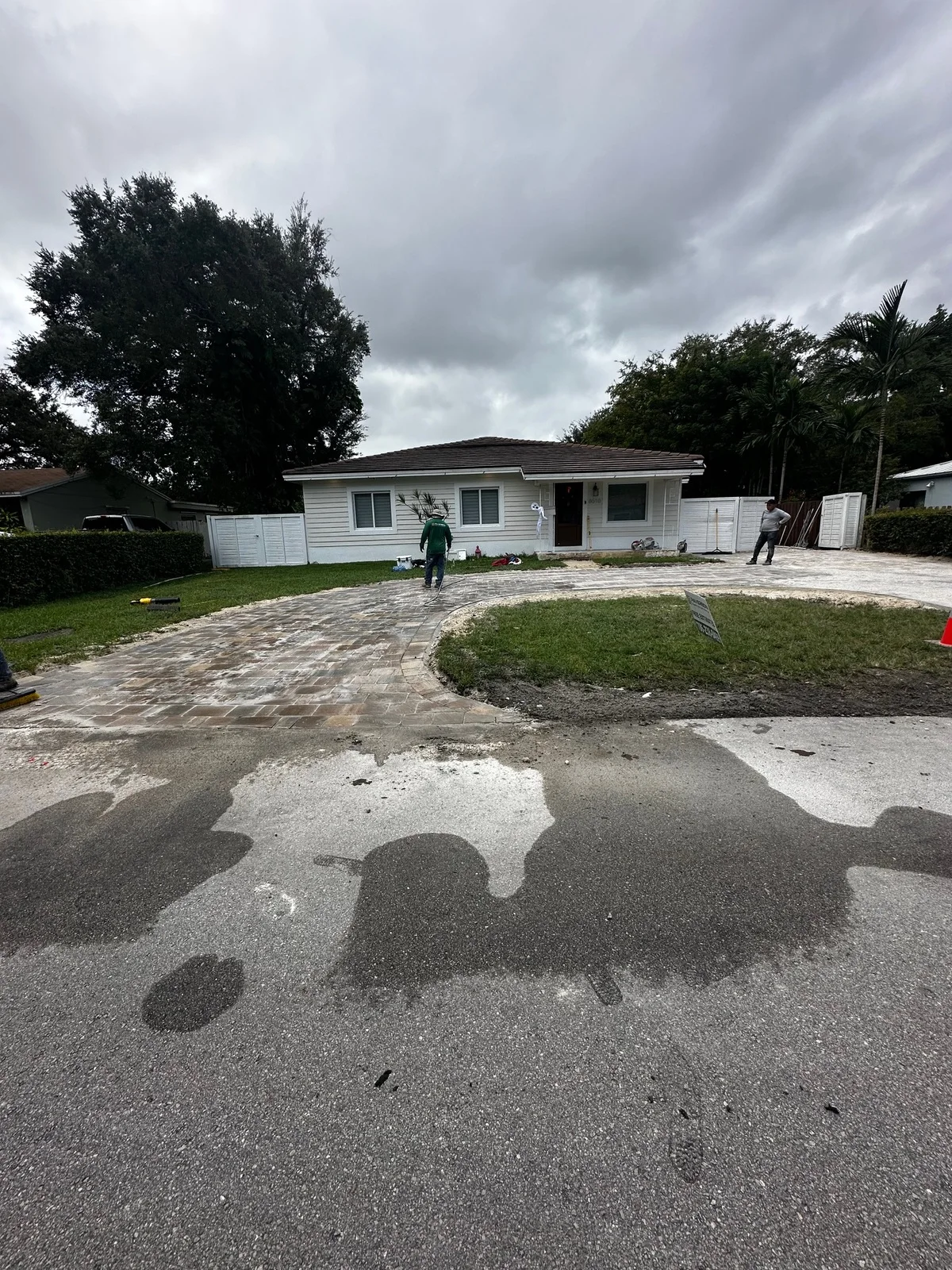
Dig to depth, compact the aggregate in layers, screed the bedding. Nobody ever sees this part again, which is exactly why most failures start here.
Pavers go down and get cut in
The field goes down to the pattern, edge cuts happen on site, and the perimeter gets a restraint so nothing creeps.
Joints get filled and the site gets cleaned
Sand swept in and compacted, the surface washed down, and the property left the way we found it. We haul our own debris.
Where the water goes when it rains here
A paver surface is really four layers and only one of them is visible. Under the pavers there is a thin bedding course of sharp sand, screeded dead flat. Under that is the base, which is compacted crushed aggregate and does the actual structural work. Under that is the subgrade, which is whatever your property is made of. The pavers on top are a wearing surface. They spread load and they look good, but they are not what holds the thing up.
The same paver can go on a garden path or a delivery drive. What changes is everything under it. People on foot put very little load on a base, so a walkway can sit shallow. A driveway with a loaded pickup on it every day needs more depth, and a commercial drive that takes delivery trucks needs the most. Picking the paver is the easy decision. Sizing the base is the one that gets measured.
The base is a stack of thin layers, each one compacted on its own. That is what building in lifts means. The shortcut is to spread all the aggregate in one go and compact the surface, which leaves a firm top over material that never got pressed down. For a while you cannot tell the difference. Then, about a year in, the surface starts settling in uneven spots.
Water is what ends most paver surfaces, and it rarely arrives from the sky.
Polymeric sand became the default joint fill for one reason: it stays put. It binds once it is wetted, so heavy rain and hoses wash it out far less than plain sand. That only holds if it goes in right. The joints get filled dry, the surface gets swept clean, and the watering follows the manufacturer’s directions. A rushed job can leave a haze across the pavers.
Joints should be filled all the way, and kept that way. The sand in there is structural: it shares load from one paver to the next, and that sharing is what makes a set of loose units work like a surface. Half-full joints wash out faster, and once they do, every paver is carrying its own load. Rocking comes next, then cracking.
Compaction
Loose stone under a firm crust is what a single dump and quick pass produces. Placing aggregate in lifts and compacting each one is how the base gets dense all the way through.
Fall
Set at roughly an eighth to a quarter inch per foot, away from the structure. Subtle to walk on, and the reason water leaves instead of standing.
Restraint
A perimeter edge restraint is what stops the field creeping outward and the joints opening from the outside in.
More drainage work
You will find us doing this across the region, often in these areas:
What it asks of you afterwards
On a commercial property, a lifted paver is a liability item before it is a repair item. An edge that rises more than about a quarter inch above the surface around it is enough to catch a toe, so it deserves a quick response rather than a spot on next year’s list.
Pavers that went down on a proper base do not ask for much. Every so often, look at the joints. If the sand is low, refill it, and if leaves or dirt are packed in, clear them out. Watch for settling and deal with it while it is small.
Think of sealer as a coat you can choose to put on, and then have to keep putting on. It helps the joint sand stay put and gives stains less grip. Pick the wrong product and you get a shiny, plastic look you will not like, or a film that holds water under it. We tell people plainly when theirs is better left alone.
Concrete pavers carry their color through the whole unit. Sun will mellow it slowly over the years, and there is no surface layer to wear off. Expect some shift in the first year or two while the paver finishes curing, which is normal. This is the material behind most of the driveways, patios and walkways we build, because it is predictable to lay and easy to match later.
If budget is tight, clay brick is usually not where we start, since it costs more and comes in fewer shapes. If the priority is a surface that looks the same in twenty years, it is the answer. Its color is the fired clay, and that does not fade.
Travertine gets requested for pool decks because it stays noticeably cooler than concrete under bare feet in the sun. It does want a sealer if the area sees oil or heavy staining, and as a natural stone, expect variation from one unit to the next.
How this gets done badly
None of these are visible on the day the work finishes, which is exactly why they keep happening.
Using the wrong sand in the bedding
Pavers only hold their line if the bedding grips them. That takes sharp, angular concrete sand. Rounded mason or beach sand behaves like ball bearings once there is weight on it.
Sealing too early
Give new concrete pavers time before sealing. They have to cure and let efflorescence work its way out. Sealing during the first month risks catching that white bloom under the sealer, where it stays for good.
Laying over the old surface
Skipping the tear-out saves time and some money. It also keeps every defect in the ground below. If a weak base is what wrecked the old surface, the new one hides that failure briefly and then repeats it.
Skipping the geotextile
Fabric between the ground and the base is a small step that keeps the base doing its job. Sandy soil especially wants to wash up into the stone layer above it. When it does, the base loses its strength and you get low spots that come back no matter how often they are reset.
The edge restraint is the piece nobody thinks about and the reason the field holds.
Common questions
Do I need to be home while you work
No. We just need a way in and a water source to hook up to. If you want to check in, call us anytime, and if we hit something we did not plan for, we will be the ones calling you that day.
Will the new pavers match what I already have
First we find out whether your paver line is still made. Older lines get discontinued, and even a current one can look a little different from units that have sat in the sun for years. If we can match, exactly or closely, we order. If not, we show you the options first, like pulling pavers from a less visible area.
What happens to the old surface
You do not have to deal with it. Our crew breaks out the old surface and hauls it away, and the concrete and pavers are recycled wherever a recycler is available. Haul-off is already in the scope.
How do you keep it from settling again
We start with a question: where is the water going? That answer usually explains the settling. From there it is a matter of correcting the drainage and putting a proper base back in, plus handling any root or downspout feeding the problem.
Do you work with HOAs and property managers
Yes. If your board only meets monthly, we plan the job around that meeting. Submittals and phased work that keeps residents moving are normal for us, so tell us how approvals run.
Do you cover Miami, FL
Yes. We are based in Miami, and our working area reaches about 100 miles out from there, so Miami itself is never a stretch. Call and ask what our schedule looks like.
Have somebody come look at it
Send a couple of photos or just call. We will tell you what we think is going on, what it would take to fix, and whether it needs doing now or can wait.
Quality you can stand on