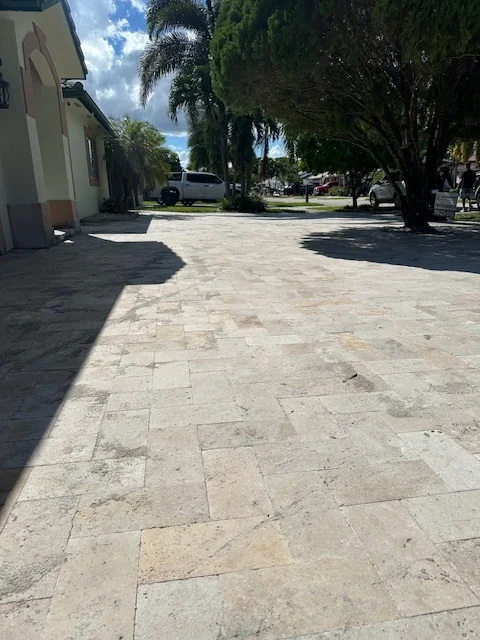
Natural Stone Paver Installation done so it stays flat
Cut stone where every unit is slightly its own thing.
What actually goes wrong
Almost every paver problem we get called out to is a base problem wearing a surface disguise. The pavers themselves are fine. They are concrete or stone, and they will outlast most of us. What moves is what is underneath them.
Our soil does well with steady rain and badly with a sudden flood of it. Across much of the region it is sand over limestone, and an afternoon storm can deliver two inches in an hour. That is when the base either holds its shape or starts to wash.
The second common cause is roots. Shallow, wide root systems on ficus, black olive and older shade trees head toward moisture, and the ground under a walkway holds plenty of it.
We would rather lose a bid than skip the base work, because the base work is the job. Everything above it is finish.
How we run this job
We come look at it
If the problem turns out smaller than you feared, you will hear that from us. We walk the property with you, look at where water is going, and tell you plainly what we see.
You get the plan in writing
Scope, materials, how long it takes, and what it costs, written down before anybody starts. No verbal numbers that change later.
We build the base first
Most of the job is buried before you see a paver. We excavate to the depth the work calls for and compact the aggregate base in lifts, then screed the bedding layer. That hidden part is what holds the surface flat for years.
Pavers go down and get cut in
The field goes down to the pattern, edge cuts happen on site, and the perimeter gets a restraint so nothing creeps.
Joints get filled and the site gets cleaned
Sand swept in and compacted, surface washed, debris hauled by us. You get the property back the way we found it, minus the problem.
How the layout gets decided before anything is cut
On a commercial property the base is usually the first thing we size, because delivery trucks put more weight on a drive than anything a house will see. A residential driveway with a loaded pickup every day needs less than that, and a walkway that only carries people needs less again. Each one gets dug to its own depth. One depth for every surface on the property is a shortcut, and it shows up first where the trucks turn.
We do not move on to the next layer of base until the one below it is compacted. Each lift is a few inches of aggregate. It is slower than filling the excavation and running a plate over the top, and that is precisely why the faster method is so common: on day one, both look identical. The difference shows up a year later as patchy settlement.
When we pull up a sunken section on somebody else’s job, the pavers themselves are usually fine. The problem is below them. A paver surface is built in four layers: the pavers, a screeded course of sharp bedding sand, a base of compacted crushed aggregate, and the subgrade, which is the soil the property sits on. The base is the structural layer. If it was too thin or never compacted properly, the pavers on top simply followed it down.
If nobody talks to you about drainage, they are quoting a different job.
Puddles that sit on a patio for hours after a storm are a grading problem. So is water that runs toward the building. Both come from getting the fall wrong. The target is about an eighth to a quarter inch of drop per foot, heading away from the structure, which is too gentle to notice underfoot and enough to move the water off.
Water that leaves a paved area still has to go somewhere, and on a commercial property it tends to head for a doorway or the planting bed next to it. When the lot is tight and there is no fall to work with, we plan for it: a channel drain across the low edge, a permeable section into a stone reservoir, or a regrade of the bed alongside. Each is far cheaper during construction.
A downspout that discharges right at the edge of a paver surface puts a whole roof’s worth of water into one small patch of base every storm. Irrigation heads that spray the same spot twice a day and runoff from a neighboring grade do similar damage. Compared with those, rain falling across a properly jointed surface is minor.
Separation
Geotextile between subgrade and base stops fine soil migrating up and destroying the aggregate structure.
Base depth
Set by what the surface carries, not by habit. A walkway and a truck-bearing drive are not the same excavation.
Compaction
Layered, then compacted, then layered again. One load spread and run over once looks finished and leaves loose material below the crust.
More design work
We cover this across the region. A few of the areas we work most:
What it asks of you afterwards
People walking across pavers are rarely looking at their feet, which is why a raised edge matters. More than about a quarter inch of lift is enough to catch a toe. Deal with that one quickly, especially on commercial property, where it is a liability concern along with a maintenance one.
Owners are often surprised how little a properly built paver surface needs from them. The joints are where most of the attention goes: keep them full of sand and free of leaves that would otherwise rot in place. Beyond that, keep an eye out for any area that starts to sink.
The upside of sealing is mostly cosmetic and practical: richer color, easier cleanup, a bit more hold on the joint sand. The downside is commitment. A sealed surface needs another coat every few years, and once it starts wearing unevenly it can look patchy. We will give you our honest opinion on yours before you decide.
Where it fits, porcelain is a very low-fuss surface to own. Spills sit on top instead of soaking in, because the material absorbs almost nothing. The work is all on the install side: precise base preparation, a perfectly even bedding course and careful cutting with the right blade.
Pick a paver at random from our jobs and it is probably concrete. You get the widest pick of shapes and colors, and a unit that lays predictably. Because the color is mixed into the concrete, it fades slowly with sun and does not peel or wear away. Early on it does drift a little as the pavers finish curing.
Pick clay brick if you want a surface that still looks like the day it went in twenty years from now. Its color is the fired clay, so it stays put. You will pay more and have fewer shapes to choose from.
What we see when somebody else did it
On the day the job wraps, all of these look like good work. The damage comes later, so the habits never get corrected.
Laying over the old surface
An overlay inherits everything beneath it. Settled spots and a soft base stay exactly where they were. If the base is what sank the old surface, the new layer just hides it for a season before the same failure comes back.
Skipping the geotextile
A separation fabric between the subgrade and the base stops the two from mixing. Without it, fine soil migrates up into the aggregate, the base loses its structure, and you get settlement that no amount of surface work will fix.
Using the wrong sand in the bedding
Concrete sand goes in the bedding for a reason: its grains are sharp and angular, so they lock. Mason sand and beach sand are rounded and let pavers wander under load.
Sealing too early
Leave new concrete pavers unsealed through their first month. They are still curing, and efflorescence is still working out of them. Seal over that and the white haze can be locked under the sealer permanently.
A sunken paver is a symptom. The base under it is the disease.
Common questions
Will the new pavers match what I already have
Concrete pavers drift a little in color as the sun and the years work on them, so a fresh unit next to one that has been down a while can stand out. Sometimes we match exactly and sometimes closely. If we cannot get close enough, you see the options before we order.
What happens to the old surface
It leaves with us. We demo the existing surface, load it out, and send concrete and old pavers to a recycler when there is one nearby. Removal is part of the job we price, so it will not show up later as an extra.
How do you keep it from settling again
Settled pavers almost always point to something underneath. We trace it, whether it is drainage, a soft base or a root moving in, and fix that first. Pavers go back down only once the reason for the dip is gone.
Do you work with HOAs and property managers
Your rules come first. We regularly work for associations and property managers, which means board timelines and submittals are routine for us. Share your approval process and we will schedule the work, in phases if needed, so residents keep access.
Do you cover Miami, FL
Absolutely. We are headquartered in Miami, FL and work there regularly. The quickest way to find out how soon we could start is a phone call to 786-717-9244.
Is there a warranty
Yes. We put our workmanship warranty in writing. Before you sign, we also walk you through what falls outside it, like damage from new roots or from drainage that changes after we leave, so nobody is surprised later. Coverage for the pavers themselves comes from the manufacturer, and you get that paperwork from us.
Let us walk the property
Tell us about it by phone, or email us photos at info@paverson.com. We will explain what is wrong and what it takes to fix it properly. If the honest answer is that nothing needs doing for a year, you will hear that.
Quality you can stand on