Paver Joint Sand Installation done so it stays flat
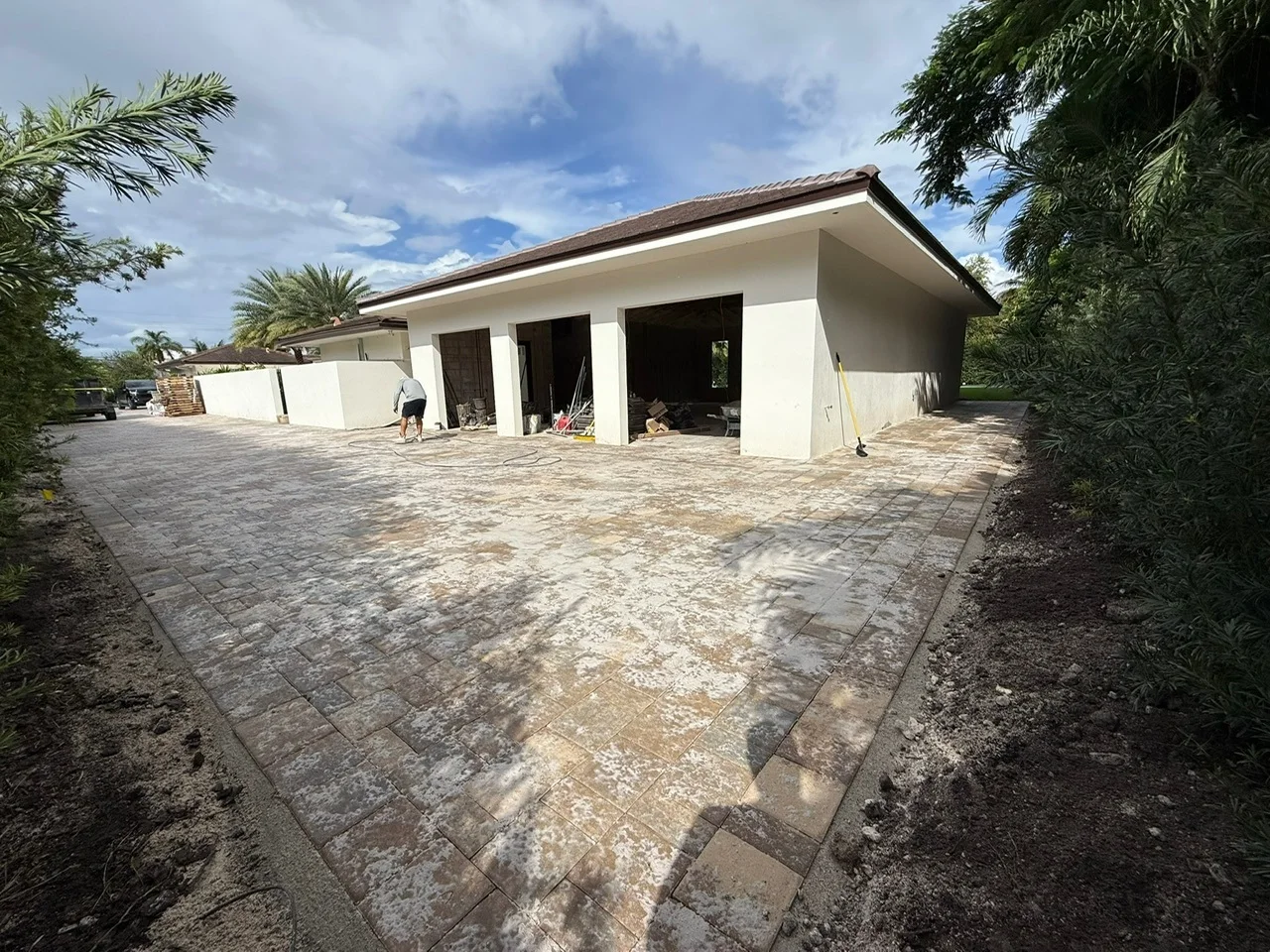
Joint sand installed dry, swept clean, set properly.
What actually goes wrong
Almost every paver problem we get called out to is a base problem wearing a surface disguise. The pavers themselves are fine. They are concrete or stone, and they will outlast most of us. What moves is what is underneath them.
We build bases for the conditions South Florida actually has. Sand that moves when water runs through it is one. Rain that comes all at once is the other. A base that would be fine somewhere drier gets checked by both of those every summer here.
Shade is nice until the roots arrive. Older trees like ficus and black olive spread their roots near the surface and a long way out, and they will follow moisture under a walkway and lift it.
That is why the schedule on our jobs is mostly spent on the part you will never see again. The surface takes a day or two. The ground it sits on takes the rest, and the ground is what you are actually paying for.
How we run this job
We come look at it
Somebody who actually does the work comes out and walks it with you. They look at the problem, look at the drainage around it, and tell you what they see. Small fixes get called small fixes.
You get the plan in writing
Scope, materials, schedule, and cost on paper before a shovel moves. The number you approve is the number, not an opening position.
We build the base first
Dig to depth, compact the aggregate in layers, screed the bedding. Nobody ever sees this part again, which is exactly why most failures start here.
Pavers go down and get cut in
Laying the field is the fast part. The care is in the cuts at the edges and the restraint that locks the whole field in place.
Joints get filled and the site gets cleaned
Sand swept in and compacted, the surface washed down, and the property left the way we found it. We haul our own debris.

What cleaning and sealing can and cannot do
Efflorescence is not a defect. New concrete pavers push mineral salts to the surface as they cure, and it clears on its own or with the right cleaner. Sealing over it before it has finished is what turns a temporary haze into a permanent one.
Restoration is chemistry more than construction. Cleaning, sealing and stain removal all depend on what the unit is made of, how old it is, and what is actually on the surface.
Pressure is the most common way people damage their own pavers. Too much pressure erodes the cement paste off a concrete unit and blows the joint sand out, which looks clean for a week and then fails faster than before. Cleaning is a chemistry job with pressure as an assist, not the other way around.
The edge restraint is the piece nobody thinks about and the reason the field holds.
If your patio has a cloudy film that will not rinse off, look at the joint sand. Polymeric sand binds when water hits it, which is great inside a joint because it resists washout far better than plain sand. On the paver face it is a problem. It must go in dry, be swept off the surface thoroughly before wetting, and be watered in as the manufacturer specifies. Rushing those steps leaves the haze.
Packed sand wedges each paver against the ones around it. Step on one and the joints push part of that weight sideways into its neighbors, which is how loose units end up behaving like one surface. If the joints wash out, nothing is passing load across anymore. Every paver carries itself, and a paver carrying a car tire on its own is the one that rocks and cracks.
Base depth
Set by what the surface carries, not by habit. A walkway and a truck-bearing drive are not the same excavation.
Compaction
Thin layers, each one compacted before the next goes on. A thick dump with one pass of the plate leaves loose stone hiding under a firm skin.
Fall
About an eighth to a quarter inch of drop per foot, heading away from the building. You will never feel it. The water will.
More restoration work
You will find us doing this across the region, often in these areas:
What it asks of you afterwards
The main job is the joints. When the sand drops below the edge of the pavers, add more. When leaves collect in them, sweep them out before they rot and start growing weeds. A properly built surface really does not need much beyond that.
Sealing is maintenance you sign up for. Once a surface is sealed, it looks best if it gets recoated every few years, and skipping that leaves it patchy. In exchange you get deeper color and stains that lift with less scrubbing. Some owners love that look. Others prefer pavers left natural. Either is a reasonable choice, and we will tell you which suits your surface.
Keep an eye on paver edges. A lip of roughly a quarter inch is where a surface stops being uneven and starts tripping people. At home that means a stubbed toe. On a commercial property it also means a liability question, so a lifted edge there should not wait for the next maintenance round.
Concrete pavers shift in color as the sun works on them. Clay brick holds steady, because its color is the fired clay itself. Brick costs more and comes in fewer shapes, and it is the material to choose when the look has to hold for twenty years.
Concrete in the midday sun can get uncomfortable on bare feet. Travertine stays noticeably cooler, which is the main reason it is the paver people ask for around pools. The tradeoffs are that natural stone varies from piece to piece and that it should be sealed anywhere it is likely to get oil or heavy staining.
Porcelain is the material where installer skill shows most. It is dense and close to stain-proof, yet it will not hide an uneven bed, and it takes the right blade and patience to cut cleanly. It has only come into residential work fairly recently.
The failures we get called out to fix
None of these are visible on the day the work finishes, which is exactly why they keep happening.
Skipping the geotextile
Between the native soil and the base, there should be a geotextile fabric. It keeps the two from mixing. Without it, fines migrate into the aggregate until the base weakens, and the settling that follows comes back after every surface repair.
Using the wrong sand in the bedding
Bedding wants sharp, angular concrete sand. Rounded mason sand or beach sand behaves like ball bearings under load and lets the pavers wander.
Sealing too early
Of all the shortcuts, early sealing is one of the hardest to undo. A new concrete paver has to cure and let its efflorescence come out before sealing. Seal it in the first month and that white haze can stay under the sealer permanently.
Laying over the old surface
Whatever made the old surface fail is still down there when you pave over it. If the base was the problem, a new layer on top only covers the failure for a season, and then it shows through again.
The pavers are a wearing surface. The base is the building.
Common questions
Will the new pavers match what I already have
First we find out whether your paver line is still made. Older lines get discontinued, and even a current one can look a little different from units that have sat in the sun for years. If we can match, exactly or closely, we order. If not, we show you the options first, like pulling pavers from a less visible area.
What happens to the old surface
Gone before the new base goes in. We demolish it, haul it, and recycle the concrete and pavers if a recycler is available locally. You will see it listed in the scope from the start.
How do you keep it from settling again
We start with a question: where is the water going? That answer usually explains the settling. From there it is a matter of correcting the drainage and putting a proper base back in, plus handling any root or downspout feeding the problem.
Do you work with HOAs and property managers
All the time. We keep boards and managers informed as approval moves along, and we phase the work so residents keep access throughout. Tell us your process and we will fit the job into it.
Do you cover Miami, FL
Yes. Miami is where Paverson is based, and we work across the city regularly. Reach us by phone or at info@paverson.com and we will tell you honestly how soon we could get there.
Is there a warranty
There is. Our workmanship warranty is written down and handed to you with the job. The pavers carry their own coverage from the manufacturer, and we pass that paperwork along as well. We will also be clear about the limits, since a warranty cannot cover something like a tree root that arrives later or a drainage change on the property.
Start with a conversation
The water usually explains the problem, so that is what we look at first. We come out, walk the property, trace where the water goes, and write up what we find. It is the fastest way to a real answer.
Quality you can stand on