Paver work done properly in Clewiston
Clewiston sits by the lake with soft organic soils in places, which makes base preparation the whole job.

What we see on Clewiston properties
Clewiston sits by the lake with soft organic soils in places, which makes base preparation the whole job.
Here is the honest version: a sunken paver is a symptom. The base under it lost material, usually to water, and the surface settled into the gap. Resetting the pavers without correcting the base just buys you a season.
The water table sits high across a lot of the coast, so there is less room for water to go down and more reason for it to move sideways. That is what takes the sand out from under a driveway edge.
Mature trees are the second cause. Roots go where the water is, and a paver base holds moisture, so they grow straight into it and push the surface up.
We are out this way most weeks, so a look at the property is usually a matter of days rather than months. If it turns out the honest answer is that it can wait, we will tell you that too.
How a job here runs
We come look at it
Somebody from the crew comes out, stands on the problem, and tells you what is actually going on underneath it. No sales visit, just a look and an honest read.
You get the plan in writing
Scope, materials, schedule, and cost on paper before a shovel moves. The number you approve is the number, not an opening position.
We build the base first
Dig to depth, compact the aggregate in layers, screed the bedding. Nobody ever sees this part again, which is exactly why most failures start here.
Pavers go down and get cut in
The field goes down to the pattern, edge cuts happen on site, and the perimeter gets a restraint so nothing creeps.
Joints get filled and the site gets cleaned
Sand swept in and compacted, the surface washed down, and the property left the way we found it. We haul our own debris.
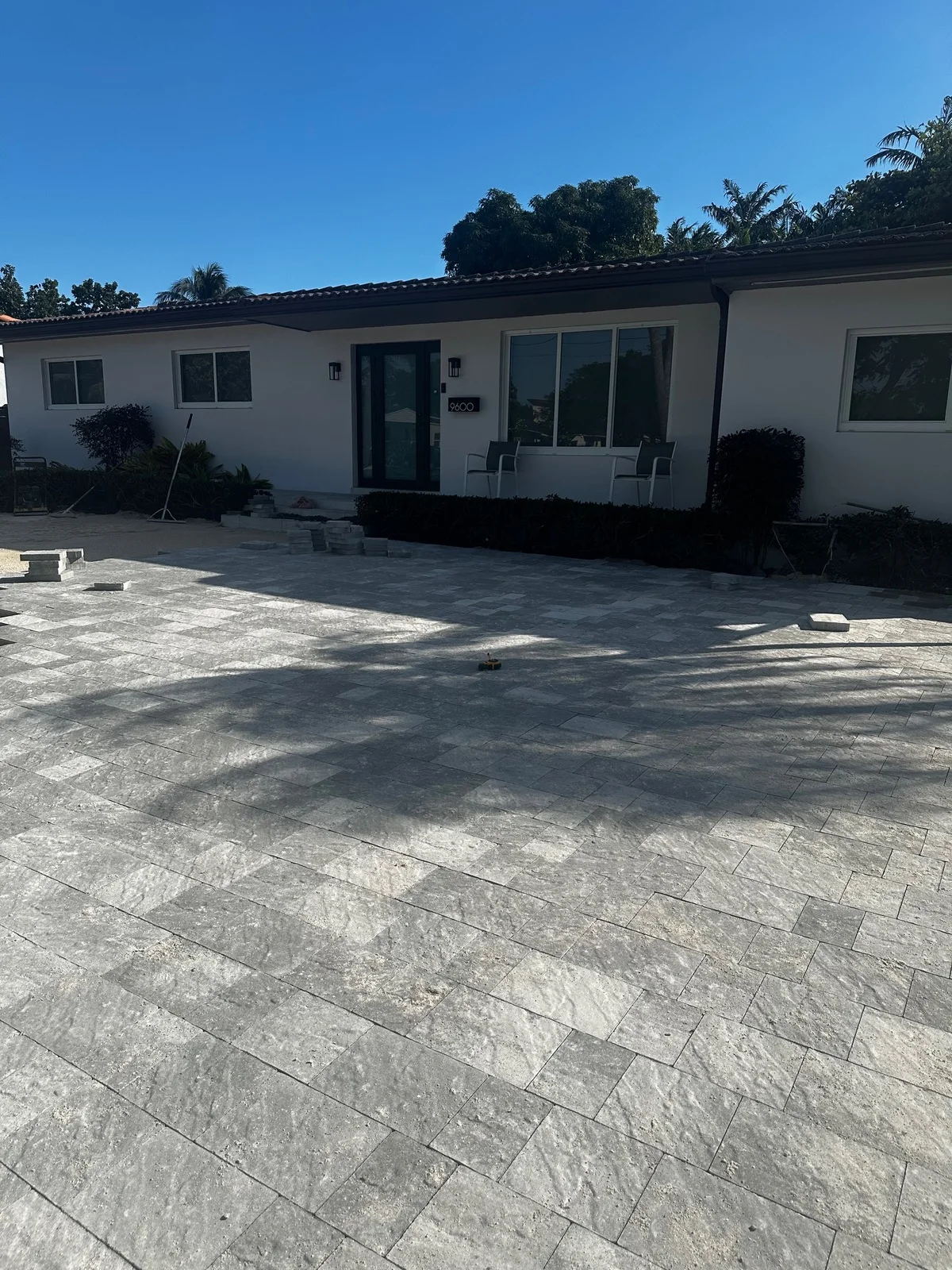
What we run into on properties nearby
A paver surface is really four layers and only one of them is visible. Under the pavers there is a thin bedding course of sharp sand, screeded dead flat. Under that is the base, which is compacted crushed aggregate and does the actual structural work. Under that is the subgrade, which is whatever your property is made of. The pavers on top are a wearing surface. They spread load and they look good, but they are not what holds the thing up.
We work out depth by asking about the traffic. Mostly we want to know what parks on it and whether a truck ever backs onto it. A walkway carrying people gets a shallower base. A driveway with a loaded pickup on it daily gets more, and a commercial drive with deliveries gets more again. That number comes from your property, so it changes from job to job. When it never changes, it was a guess.
The base is a stack of thin layers, each one compacted on its own. That is what building in lifts means. The shortcut is to spread all the aggregate in one go and compact the surface, which leaves a firm top over material that never got pressed down. For a while you cannot tell the difference. Then, about a year in, the surface starts settling in uneven spots.
If nobody talks to you about drainage, they are quoting a different job.
We think about where water will run before we think about pattern or color. Every paver surface needs a gentle fall, roughly an eighth to a quarter inch per foot, pointed away from the house or building. It is subtle enough to go unnoticed and steep enough to work. A flat or backward pitch shows up in the first heavy rain.
The question to ask is where the water ends up after it leaves the pavers. On a commercial site that answer drives part of the design. A tight lot with no fall available might need a channel drain at the low edge, a permeable section draining into a stone reservoir, or a regraded planting bed. Building any of them during the install beats cutting the job back open later.
The rain that falls on your pavers is the least of it. A well-jointed surface sheds most of that. The water that undermines a base is water delivered to one spot again and again, from a gutter downspout, an irrigation head, or the slope of the property next door. We look for those sources on every walk.
Joint sand
Structural, not cosmetic. It transfers load between units, which is the whole reason a field of loose pavers behaves like a surface.
Separation
Geotextile between subgrade and base stops fine soil migrating up and destroying the aggregate structure.
Base depth
Set by what the surface carries, not by habit. A walkway and a truck-bearing drive are not the same excavation.
What Clewiston calls us for
Also nearby in Hendry County:
What we tend to use around here
Porcelain is the material where installer skill shows most. It is dense and close to stain-proof, yet it will not hide an uneven bed, and it takes the right blade and patience to cut cleanly. It has only come into residential work fairly recently.
Concrete pavers carry their color through the whole unit. Sun will mellow it slowly over the years, and there is no surface layer to wear off. Expect some shift in the first year or two while the paver finishes curing, which is normal. This is the material behind most of the driveways, patios and walkways we build, because it is predictable to lay and easy to match later.
With clay brick there is no pigment to fade. The color comes from the clay as it is fired, so the paver looks essentially the same for as long as it lasts. The trade is a higher price and a smaller choice of shapes.
The edge restraint is the piece nobody thinks about and it is what stops the whole field from spreading. Pavers work by interlock, which means each unit is held by its neighbors. Take away the restraint at the perimeter and the outermost course starts creeping outward, the joints open, the sand washes, and the failure marches inward from the edge.
You can see this on almost any failing driveway. The middle usually looks fine and the outer two feet are a mess with wide joints and rocking units. That is not the edge wearing out faster, it is the edge restraint having failed and the field unlocking from the outside in.
Finding us in Clewiston
We are based in Miami and out this way regularly.
Where these jobs go wrong
None of these leave a mark you could spot at the final walk. That is the whole reason they keep coming back.
Sealing too early
Give new concrete pavers time before sealing. They have to cure and let efflorescence work its way out. Sealing during the first month risks catching that white bloom under the sealer, where it stays for good.
Laying over the old surface
It is the shortcut that costs the most later. A new surface on top of a failed one goes down fast and cheap, and it still sits on the same ground. If the base caused the original failure, the overlay hides it for one season.
Skipping the geotextile
Geotextile fabric is a thin layer that does a big job. It sits on the subgrade and keeps the native soil out of the aggregate base. Leave it out and the fines work their way up over time until the base is half dirt, and then the surface starts to sink.
Using the wrong sand in the bedding
Pavers only hold their line if the bedding grips them. That takes sharp, angular concrete sand. Rounded mason or beach sand behaves like ball bearings once there is weight on it.
Water is what ends most paver surfaces, and it rarely arrives from the sky.
Common questions
How long does the job take
A typical paver work job runs two to five working days once we start. Base work is the slow part; laying the field goes quickly. Weather moves things, and in summer we plan around the afternoon storms rather than pretending they will not happen.
Do I need to be home while you work
No. Many of our customers come home to a finished section after work. Just make sure we can reach the area and have a water source. Surprises get a same-day call.
Will the new pavers match what I already have
First we find out whether your paver line is still made. Older lines get discontinued, and even a current one can look a little different from units that have sat in the sun for years. If we can match, exactly or closely, we order. If not, we show you the options first, like pulling pavers from a less visible area.
What happens to the old surface
We take it out and take it away. Old concrete and pavers get recycled where a facility is available, and hauling is built into the scope from the start, so there is no surprise charge at the end.
How do you keep it from settling again
Most of the time it comes down to the base. If it was laid too thin or compacted in one pass, we dig it out and rebuild it in lifts, then check that water is leaving the area the way it should. Fixing the surface without the base just repeats the problem.
Do you cover Clewiston, FL
Yes. Clewiston, FL is inside our regular working area and we are out that way most weeks. Call and we will tell you honestly when we could get to you.
Let us walk the property
A real answer comes from being there. We will walk the property, follow where the water goes, and give you a written account of what we see, so you are not guessing from a phone call.
Quality you can stand on