A new paver driveway built from the subgrade up
Coral Gables driveways carry real weight and sit on sand. We build the part underneath to handle both, then lay the surface on top of it.
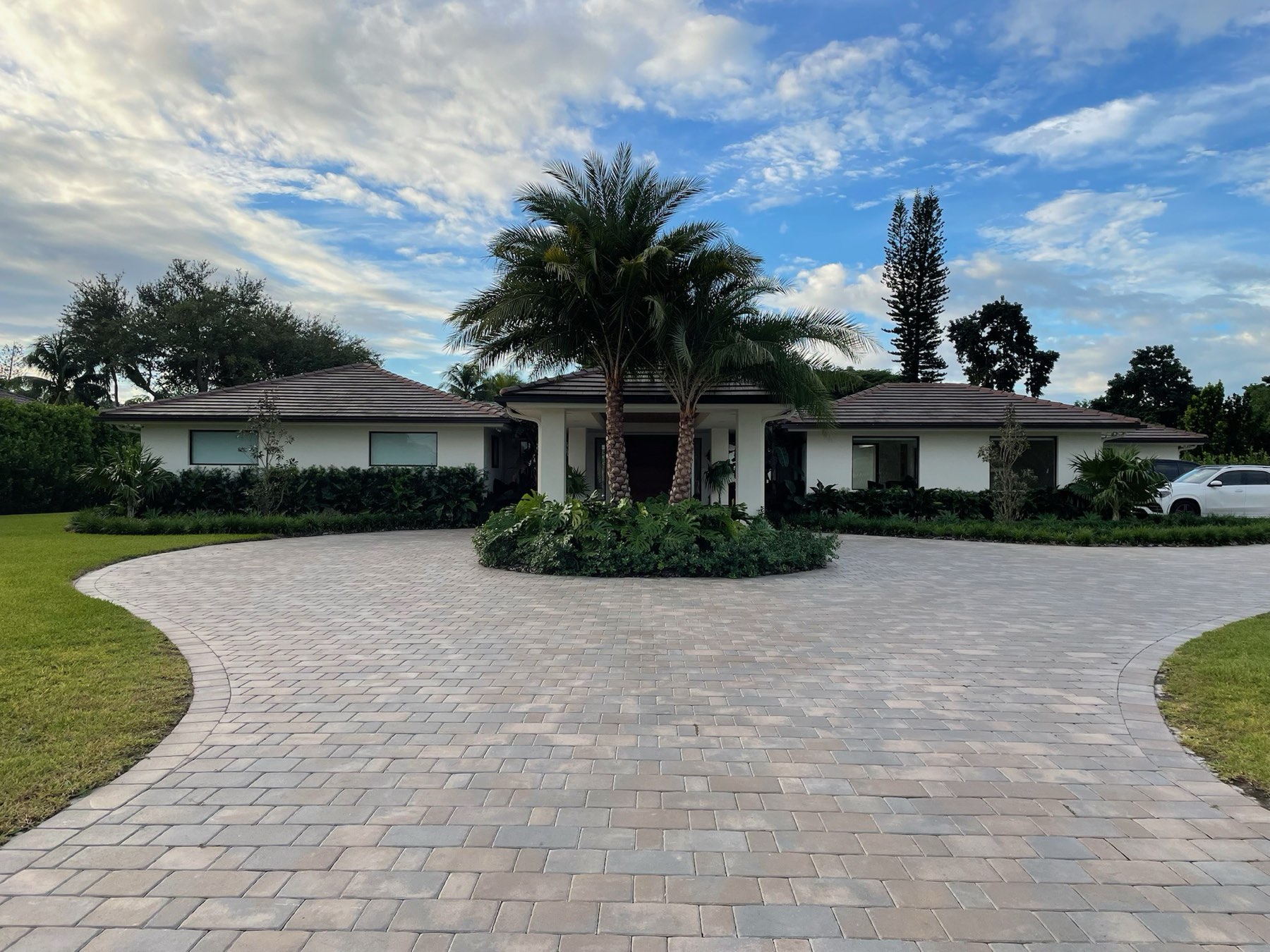
Everything that matters happens before the first paver
A driveway is the heaviest thing most homeowners will ever ask a paver surface to do, and almost none of the work that decides whether it holds is visible once we are finished. It is excavation depth, it is how the aggregate goes in, and it is what happens at the perimeter.
The pavers themselves are a wearing surface. They spread the load of a vehicle across a wider footprint and they take the abuse, but they are not what holds the driveway up. The compacted base under them is doing that job, and it either has the depth it needs or it does not.
Around here that base sits on sand over limestone. Sand drains beautifully and it also moves the moment water is given a reason to carry it somewhere. Get the depth and the compaction right and that stops mattering.
So when you are comparing anybody bidding a new drive, the question is not which paver they carry. It is how deep they are digging, how many passes the compactor makes, and what they are putting along the edges.
How the install actually runs
Somebody walks the drive with you
We measure, look at how the drive meets the street, check where the roof and the irrigation put water, and note anything a board or a reviewer is likely to ask about. You get a straight read the same day.
Layout, materials and timing in writing
Pattern, unit, border treatment, how many days, and what it costs. If your neighborhood requires a submittal, that goes together before anything is ordered, and nothing changes without you signing off.
Demolition and excavation to depth
The old surface comes out and goes on our truck. Then we dig, and we dig deeper for a driveway than we would for a walkway, because the load is different.
Base in lifts, then bedding
Aggregate goes in a few inches at a time and each layer gets compacted before the next one lands. Then a thin bedding course of sharp sand, screeded dead flat.
Field, cuts, restraint, joints
The field goes down to pattern, edge cuts are made on site, the perimeter gets a restraint, joint sand is swept in and compacted. Everything is washed down before we leave.
Nobody ever looks at the base again. That is exactly why it gets skipped.
Most of a driveway install is earthwork. The day the pavers go down only looks fast because the slow days already happened.
Why a drive is not a walkway with cars parked on it
Depth is decided by what the surface has to carry. A path that only ever sees people can sit on a shallower base than a drive that takes a loaded pickup every day, and a commercial drive that takes delivery trucks needs more again. Anybody quoting the same depth for a garden path and a driveway is guessing rather than measuring.
The design case is never the family sedan. It is the moving van, the concrete truck when somebody down the block pours a pool, and the delivery driver who backs over the corner because it is easier than turning around.
The apron, where your drive meets the street, takes the worst of it. Vehicles turn there under load, which grinds and shoves the surface sideways instead of just pressing straight down. That area wants the deepest base on the job and the most serious restraint we install anywhere.
Water is what ends most paver surfaces, and it almost never arrives from where people expect. It is rarely the rain landing on the field, because properly filled joints shed most of that. It is the downspout discharging at the edge, the irrigation head spraying the same spot twice a day, or the neighboring grade sending runoff across a corner.
The high water table along this stretch of coast changes the math. There is less room for water to travel down, so it travels sideways instead, and sideways is where your driveway edge is. That is the mechanism behind most of the sunken outer courses we get called to look at.
Fall matters more than people think. A paver surface wants a slope of roughly an eighth to a quarter inch per foot away from the building. Subtle enough that you will not feel it walking on it, steep enough that water leaves instead of standing. Flat gives you puddles, backwards sends water at the foundation.
Depth
Set by the heaviest thing that will ever cross it, not by the car in the garage today.
Lifts
A few inches at a time, compacted between each one. One dump and a single pass gives you a crust over loose material.
Bedding
Sharp, angular concrete sand. Rounded mason or beach sand behaves like ball bearings under a vehicle.
Driveways fail from the outside in
Look at almost any failing driveway and the middle is fine while the outer two feet are a mess: wide joints, rocking units, sand washed out. That is not the edge wearing faster than the rest. That is the edge restraint having failed and the field unlocking from the perimeter inward.
Pavers work by interlock, which means every unit is held in place by the ones around it. The units at the perimeter have neighbors on one side only, so something has to hold them. Take the restraint away and the outermost course creeps outward, the joint behind it opens, the sand leaves through the gap, and the failure walks toward the center a course at a time.
On a drive, the load makes it happen faster. Every turn of a wheel near the edge pushes sideways, and there is nothing on the outside to push back except whatever restraint got installed. A restraint that was set into loose fill instead of compacted base is not restraint, it is decoration.
The restraint is the piece nobody asks about and the reason the field holds.
Working inside a city that reviews what you build
Coral Gables has its own look and its own review process, and a lot of the older homes there were built with surfaces that predate anything we would install today. We are used to working inside those constraints.
Practically, that means the material and color conversation happens early rather than after demolition. A unit that reads well on a sample board and a unit that suits the house are not always the same unit, and the second one is the one that gets through review without a second round.
If you are inside an association as well, there is usually a submittal, a board that meets on its own schedule, and a preference for work that does not block neighbors any longer than it has to. We are used to submittals, board timelines, and phasing work so residents keep access. Tell us what your approval process looks like and we will work inside it.
If the timeline depends on an approval date we do not control, we say so up front and plan the crew around it rather than tearing out your drive and then waiting on a meeting.
We are out this way most weeks, so a look at the property is usually a matter of days rather than months. If it turns out the honest answer is that your existing drive has years left in it, we will tell you that too.
Other work we do on the same properties
Everything we do in Coral Gables · See the work · Tell us what you are looking at
Questions we get on new drives
How long are we without the driveway
Most residential drives run a handful of working days from demolition to the final wash down, weather permitting. You lose vehicle access for the whole of it, so plan on parking elsewhere. We tell you the number before we start and we tell you the same day if weather moves it.
Can you go straight over the concrete that is there now
Almost never on a driveway. It is quick, it is cheap, and it inherits every problem underneath. If the old slab moved because the ground under it moved, laying a new surface on top of it just hides that for a season and raises your grade at the garage door.
Will a paver drive hold up to a heavy truck
Yes, when the base was built for it. Interlocking pavers handle vehicle loads well because the load spreads through the field and down into compacted aggregate. The failures people have seen are base failures, not paver failures.
Do you handle the permit and the association submittal
We prepare what the submittal needs and we work to the timeline the board sets. Tell us early what your approval process looks like, because that date usually decides when the crew comes rather than the other way around.
What about the tree roots along the edge of the drive
We look at that during the walk. Ficus, black olive, and a lot of the older shade trees run their roots shallow and wide, and they will follow moisture right under a surface. There are ways to build around them, and the plan for it belongs in the scope before we dig.
Do you cover Coral Gables
Yes. It is inside our regular working area and we are out that way most weeks. Call and we will tell you honestly when we could get to you.
Coral Gables on the map
Have somebody come look at it
Call and describe the drive, or send pictures over. You will hear what we would build, how deep we would go, and what the timeline looks like against your approval schedule.
Quality you can stand on