Find out what moved before anybody touches a paver
A dip, a rocking unit, a joint that keeps opening. Those are readings, not the problem. We work out what is underneath first, then we put your own pavers back.
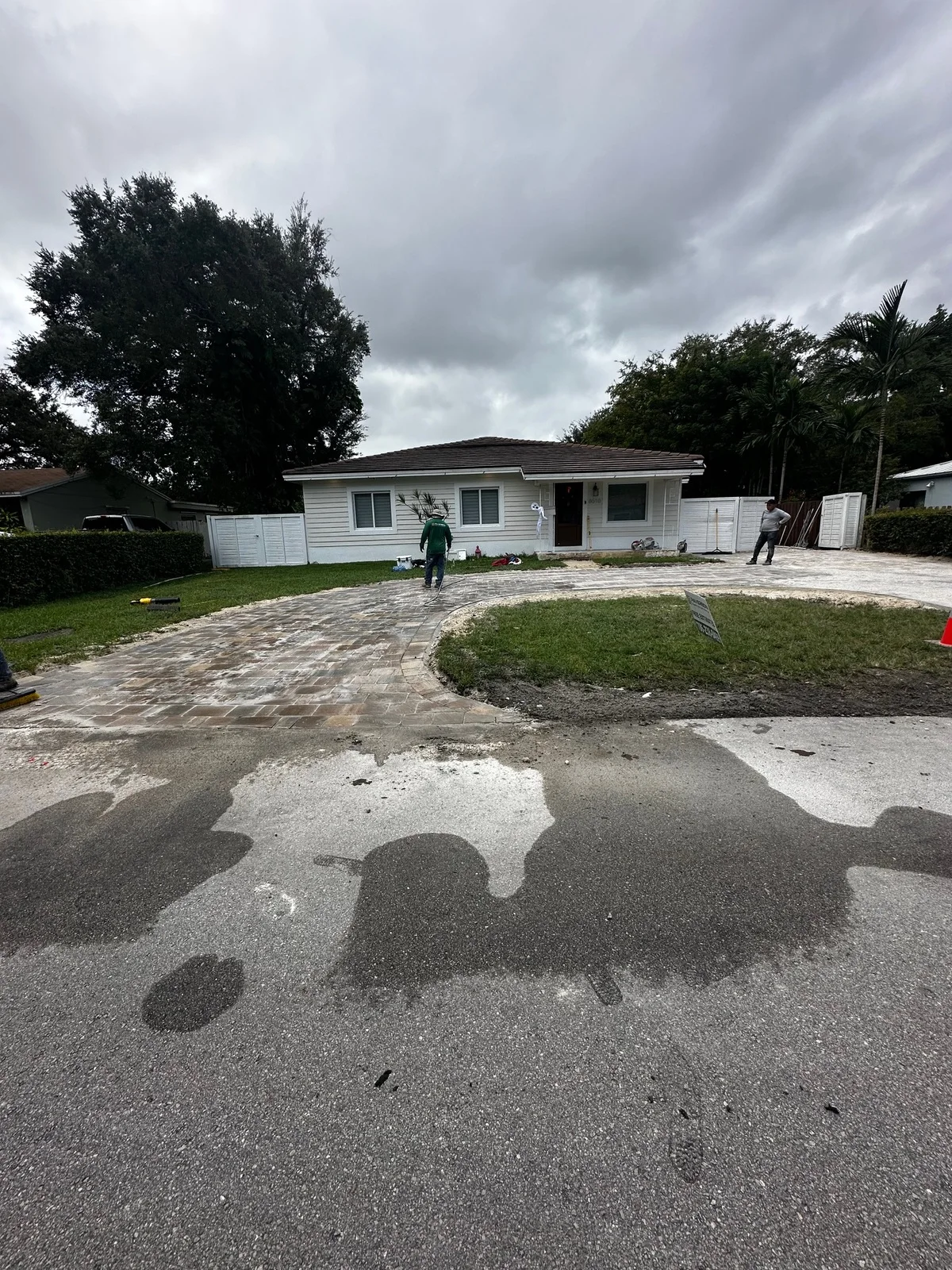
Three very different problems that look identical from the street
Homeowners describe all of them the same way: part of the drive has gone down. What is causing it splits three ways, and the three call for entirely different work.
The first is plain settlement. Material under one area washed out, the surface followed it, and everything else is intact. The dip has soft edges and the pavers around it are still tight.
The second is a base failure, where the aggregate layer itself has lost its structure across a wider footprint. The tell is scale and shape: not one saucer but a broad low area, sometimes with a second starting nearby. The third is heave, working in the opposite direction. Something under the drive is pushing up, and around here that something is almost always a root.
How we tell them apart on site
Where the low spot sits relative to water
We stand where the downspouts land, where the irrigation heads throw, and where the neighboring grade sheds. A dip lining up with one of those is a washout, and moving the water is half the repair.
Whether the surrounding field is still locked
Tight joints around a dip means one localized loss. Loose units two courses out means the base under a larger area is done, and a patch will just move the dip a few feet.
Which way the surface is pointed
Down is a loss of material. Up, in a line rather than a circle, is something growing. We follow the ridge to the trunk.
What comes up when we lift a few units
Pulling half a dozen pavers tells us more than any amount of looking. We see the bedding, whether the aggregate is still angular and locked or has gone to fines, and whether soil has migrated up into it.
What the rest of the drive is doing
Then we walk the whole surface, not just the complaint. If three other places are early in the same failure, you want to hear that now.
The dip is the readout. Something else is the fault.
A visit like this takes under an hour and decides the scope, the days, and whether the answer is a repair at all.
When a tree is the reason your drive is not flat
Older Coral Gables streets are lined with mature shade trees, and a lot of them root shallow and travel far. Ficus and black olive are the two we meet most often. They spread laterally rather than down, they chase moisture, and the underside of a paver drive is a reliably damp corridor to follow.
What we do about it depends on the root’s size and where it sits in relation to the tree. A small feeder root can be cut back and the area rebuilt with a barrier installed to steer future growth deeper. A structural root close to the trunk is a different conversation, because cutting it can destabilize a tree you would rather keep and may involve the city.
What we will not do is grind the pavers flat over a live root and call it repaired. The root keeps growing, the ridge comes back within a season or two, and you have paid to remove material from the top of a surface that was going to move again anyway.
Settlement
A bowl with soft edges and tight joints around it. Localized loss of material, usually water carrying sand out.
Base failure
Broad low areas and units that rock two or three courses out. The aggregate layer itself has stopped working.
Heave
A ridge running in a line, pavers still locked together, pointing back at a trunk. Something under it is growing.
Why lifting and re-laying beats tearing it out
The single best thing about a paver surface is that it comes apart. Concrete cracks and your only real move is demolition. Pavers are individual units sitting on sand, so we lift the affected area, correct whatever went wrong beneath it, and put the same pavers back down in the same pattern.
Full replacement makes sense when a large share of the drive has failed at once, when the units themselves are spalling under load, or when you were changing the look anyway. Outside of those, replacing a drive to fix a section is spending on new material to solve a problem the old material did not cause.
Depth and buildup on a rebuilt section are not guesswork, and we go through what a driveway base actually asks for on the new driveway page rather than repeating it here.
The corrected section also has to tie into the existing surface at exactly the right height. Too high is a new trip edge, too low is a place for water to sit. Getting that seam invisible is most of the skill in this work.
Pavers come apart on purpose. That is the whole point of them.
Sand loss and weeds are telling you something
People treat open joints and sprouting weeds as housekeeping. They are usually the first visible sign of the mechanical problem.
Joint sand does structural work. It transfers load sideways from one paver to its neighbors, which is the mechanism that lets a field of loose units behave like a single surface. So sand that keeps disappearing from the same stretch is a report: water is moving through that spot with enough force to carry it away, and it is taking fines out of the bedding underneath at the same time.
Weeds work the same way as evidence. Seeds land everywhere on your property and only establish where there is enough retained moisture to support them. A joint growing things is a joint holding water. Which is why we look at where the sand is leaving before we refill anything. Often the fix is a foot of regrading at an edge, moving a downspout discharge, or adjusting one irrigation head.
What we do when your paver is no longer made
This is the part that surprises people most on a repair. Manufacturers retire lines, change color blends, and adjust unit dimensions between runs. If your drive went down eight or twelve years ago, there is a fair chance the exact unit is not orderable. Sun exposure widens the gap further: concrete holds its pigment well but lightens over years of direct Florida sun, so even an identical unit reads brighter than your weathered field on day one.
The move that solves this most often is harvesting. We pull sound units from somewhere nobody looks at, a side path or the strip behind a gate, and rebuild the visible area with those. The new material goes into the hidden spot where a color difference is nobody’s problem.
When there is not enough to harvest, the other options are a deliberate contrast rather than a near miss: a soldier course, a border, or a defined field of the new unit that reads as a design decision. You see samples against your actual drive in daylight before anything is ordered.
What people ask before a repair
Can you fix just the bad section or does it all have to come up
Almost always just the section, plus a margin around it so the new work ties into ground that has not moved. The exceptions are a drive where the failure is spread across most of the surface or one where the units themselves are breaking up. We tell you which one you have after we lift a few pavers, not before.
How do I know if a root is the cause
Look at the shape. Settlement makes a bowl and the pavers in it tend to loosen. A root makes a ridge running in a line, usually pointing back toward a trunk, and the pavers along it often stay tight because the whole section lifted together. Send a photo from a low angle and we can usually tell you before we come out.
Will the repaired area look obviously different
Not if we can reuse your own pavers, which is our first choice on every repair. Where new units are needed we look at harvesting sound ones from a hidden part of the property so the new material goes where nobody sees it.
My joint sand keeps washing out of the same spot
That is worth looking at rather than refilling again. Sand only leaves where water is moving with enough force to carry it, and the same water is pulling fines out of the layers underneath. Repeated loss in one place is usually a drainage detail nearby.
How long does a repair take
Most single-area repairs are one to two working days on site. Root work or a drainage correction runs longer, and we give you the number after we have looked rather than guessing on the phone.
Should I just replace the whole driveway instead
Only if a large share of it has failed, the pavers themselves are breaking down, or you wanted a different look anyway. Buying a new drive to solve one bad area is paying for material that was never the problem. If somebody quoted you a full tear out for a localized dip, get a second look at it.
Coral Gables on the map
Send a photo of the low spot
A picture taken from a low angle down the length of the drive tells us most of what we need. Send it over and we will tell you which of the three problems it looks like.
Quality you can stand on