A back patio your family will actually sit on
What decides whether a Coral Gables patio gets used is where the water goes when it pours and how the surface feels on bare feet in July. We settle both before anybody talks about pattern.
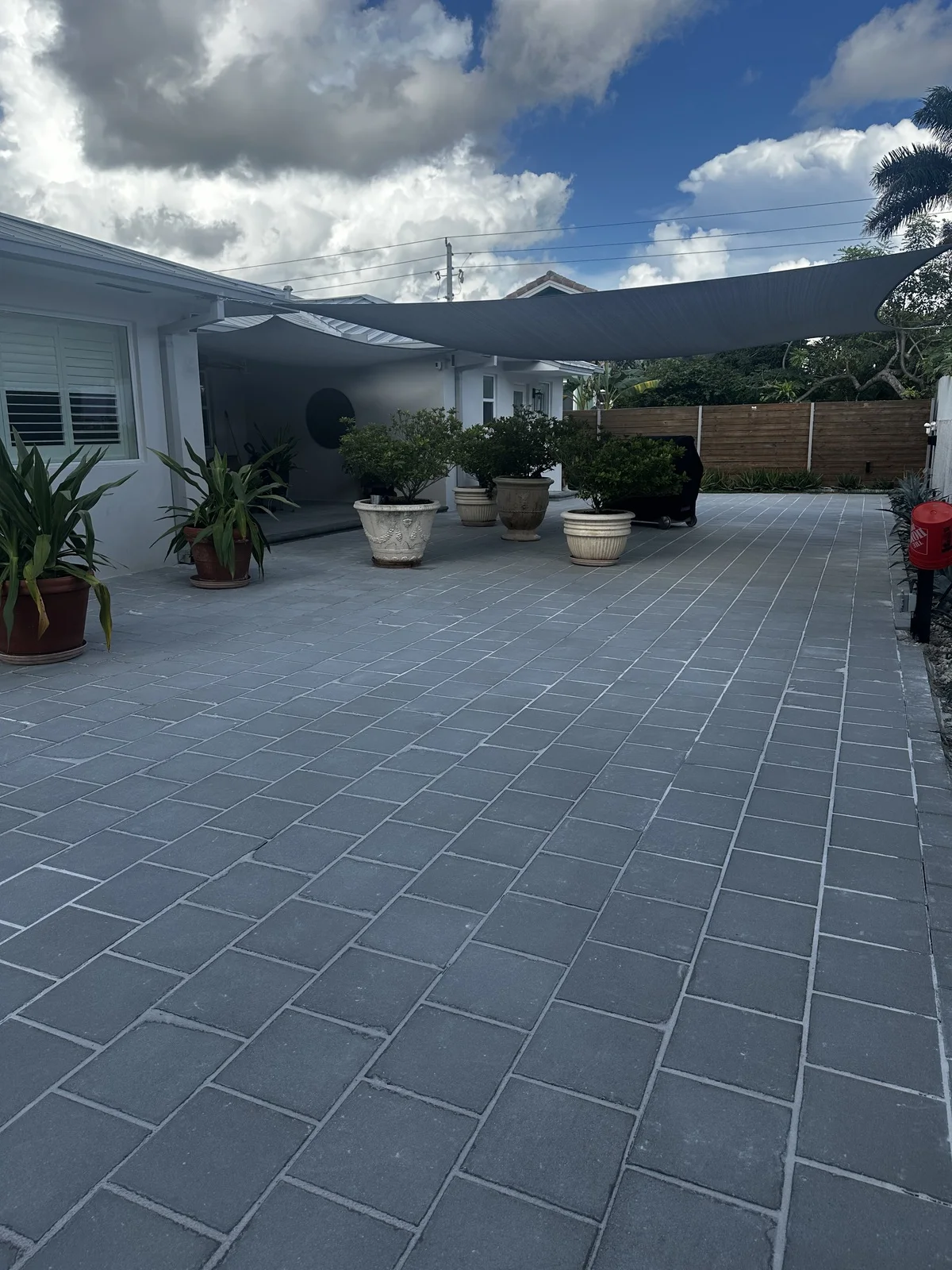
A patio is a room with no roof on it
Think about how you will use the space before you think about material. Where does the grill go, and does anybody have to walk behind whoever is cooking. Where does the table sit, and can four chairs pull out without a back leg dropping off the edge. Is there a corner that stays shaded past four o’clock, because that is where people end up.
Those answers set the footprint, and the footprint sets everything downstream. A patio drawn to a guessed size either feels cramped the first time you have company or eats half the yard for no reason.
The threshold from the house sets your starting height, and every inch of fall has to come out of the run between that door and wherever the yard picks it up. Short run, tight lot, and grading becomes the hard part of the project.
None of this is expensive to decide. It is expensive to decide late.
How we get from a bare yard to a finished slab
We stand in the yard with you
Where the sun lands at different hours, where the downspouts let go, which way the lot falls, and where you actually want to sit. That decides the shape more than any sample board does.
Grades and drainage get worked out on paper
Threshold height, finished height at the far edge, and the path water takes to leave. If the fall is not there naturally, the drain or permeable strip gets designed in here rather than added later.
Material and pattern get chosen together
Surface temperature, unit size and pattern all interact. A larger format changes how many cuts a curved edge needs, and the color decides how the space feels at two in the afternoon.
Excavation, then the layers that hold it
The same discipline we bring to a drive, scaled to what a patio carries. Depth, lifts and bedding are covered on our driveway page.
Field, edges, joints, wash down
The field goes to pattern, curves and step returns are cut on site, the perimeter is locked, joint sand goes in and gets compacted. Then we wash it and put your furniture back.
Decide where you will sit. The rest of the drawing follows from that.
People remember how a patio felt to use. They do not remember the pattern name.
Where the water goes in an August downpour
A Coral Gables rain event is not a drizzle. It arrives sideways, it dumps more in twenty minutes than some places see in a month, and every hard surface points that water somewhere. A patio is the largest new hard surface most backyards will ever gain, so it changes the plumbing of the whole lot whether anybody planned for it or not.
The direction is not negotiable: away from the structure. A patio pitched back toward the slab pushes water at the base of your walls a few hundred times a year, and the damage shows up as staining, then as a mildew smell inside, long before anybody blames the patio.
How much fall is a judgment call. Enough that water leaves briskly, gentle enough that a table does not rock.
Where the water lands after it leaves the pavers is the question people forget. Sending it three feet off the edge into a bed that already sits low just relocates a puddle. If the neighbor’s grade is higher than yours, your low corner collects their runoff too, which is worth knowing before we set an elevation.
When a lot genuinely has nowhere to send it, there are real answers: a channel drain across the low edge, a permeable band that lets water pass into stone underneath, a regraded bed that takes the volume. Each one is a design decision made now, at a fraction of what retrofitting costs later.
Screened enclosures and roof overhangs concentrate runoff into a few points. Where a downspout or screen gutter discharges is exactly where a patio edge loses its joint sand first, so we route those before we build.
Direction
Away from the house, every time. A patio that drains back at the slab is a problem you pay for indoors.
Destination
Water has to have somewhere to arrive. A yard that cannot absorb it needs a drain or a permeable band designed in.
Concentration
Downspouts and screen gutters dump volume at one point. Those get routed before a paver goes down.
What the surface feels like on bare feet
This is the thing nobody asks about and everybody notices. A patio in full South Florida sun gets hot enough that material stops being a preference and becomes whether the kids will cross it at two in the afternoon.
Color carries most of it. A charcoal unit absorbs a great deal more than a light gray or a sand tone, and on the same day, in the same yard, you feel the gap through your feet.
Material matters too. Travertine is the standard answer around pools here because it runs cooler than concrete in direct sun and holds that through the hottest hours. Porcelain in a light finish behaves well. A dense, dark concrete unit is the warmest common choice.
Shade is the other half, and it is a layout question. A sail, a pergola, or simply putting the seating where the house already throws a shadow after three does more than any material swap. That is why we ask about sun hours during the walk rather than after.
Color is not decoration on a patio. It is temperature.
Choices a driveway never has to make
A drive is a rectangle that carries weight. A patio has curved edges, levels that step, and a shape somebody lives inside.
Unit size changes the feel of a space at a glance. Large-format units read calm and make a small yard feel larger because there is less line work in your eye. Smaller units suit the older houses here, and they curve more gracefully because each cut is smaller.
Pattern direction is a quiet trick. Running courses across the short dimension of a narrow patio widens it; running them along a deep space stretches it. Herringbone brings interlock, which matters more under a car than a chair.
Borders are worth the money. A soldier course around the perimeter hides the fact that every curved edge is made of cut pieces, and it gives the edge restraint something clean to sit against.
Steps take the most thought. A riser between the house and the patio has to hold one height across its whole length or people trip on it. On a lot that already slopes, that is where layout and grading argue, and the argument belongs on paper.
Other work we do on the same properties
Everything we do in Coral Gables · See the work · Tell us what you are looking at
Questions we get on new patios
How big should the patio be
Work backwards from furniture. A dining table with chairs pulled out needs a good three feet of clearance on every side, and a grill wants its own zone so nobody squeezes past somebody cooking. Sketch the pieces you own onto the space first, because a patio sized to a guess is usually either tight at the table or larger than the yard can spare.
Will it be too hot to walk on in the summer
That depends almost entirely on color and on shade. Light gray and sand tones run noticeably cooler than charcoal in the same sun, and travertine stays cooler than concrete through the hottest hours. If the space gets full afternoon exposure and there is no shade planned, we will steer you toward the lighter end of the range and say why.
Can you tie the patio into the pool deck later
Yes, and it is worth planning for even if the pool is years away. We can set elevations and pick a unit now that will meet a future deck cleanly, which saves you a visible seam and a second material conversation down the road. Tell us on the walk if that is in your thinking.
What happens if my yard has nowhere for the water to go
Then we build somewhere for it to go. On a flat lot with no fall available that usually means a channel drain along the low edge, a permeable section that lets water pass into stone underneath, or a regrade of the adjacent bed. All of those are ordinary work when they are part of the original scope and awkward when they are a repair.
How long does a patio take
Most residential patios run several working days once we start, with the surface itself being the short part. You keep the use of your house throughout, though the yard is a job site and we would rather the dog stayed inside. We give you the number before we begin and tell you the same day if weather moves it.
Do you cover Coral Gables
Yes. Coral Gables sits inside the area we work every week, so it is a normal stop rather than a special trip. Call and we will tell you honestly when we could get to you.
Coral Gables on the map
Stand in the yard with us
Call and describe the space, or send pictures of the back of the house. You will hear what we would build, where we would send the water, and what the material does to how it feels in July.
Quality you can stand on