Where we work
Out of Miami and across the bottom third of the state. Eight counties, and a lot of towns inside them.
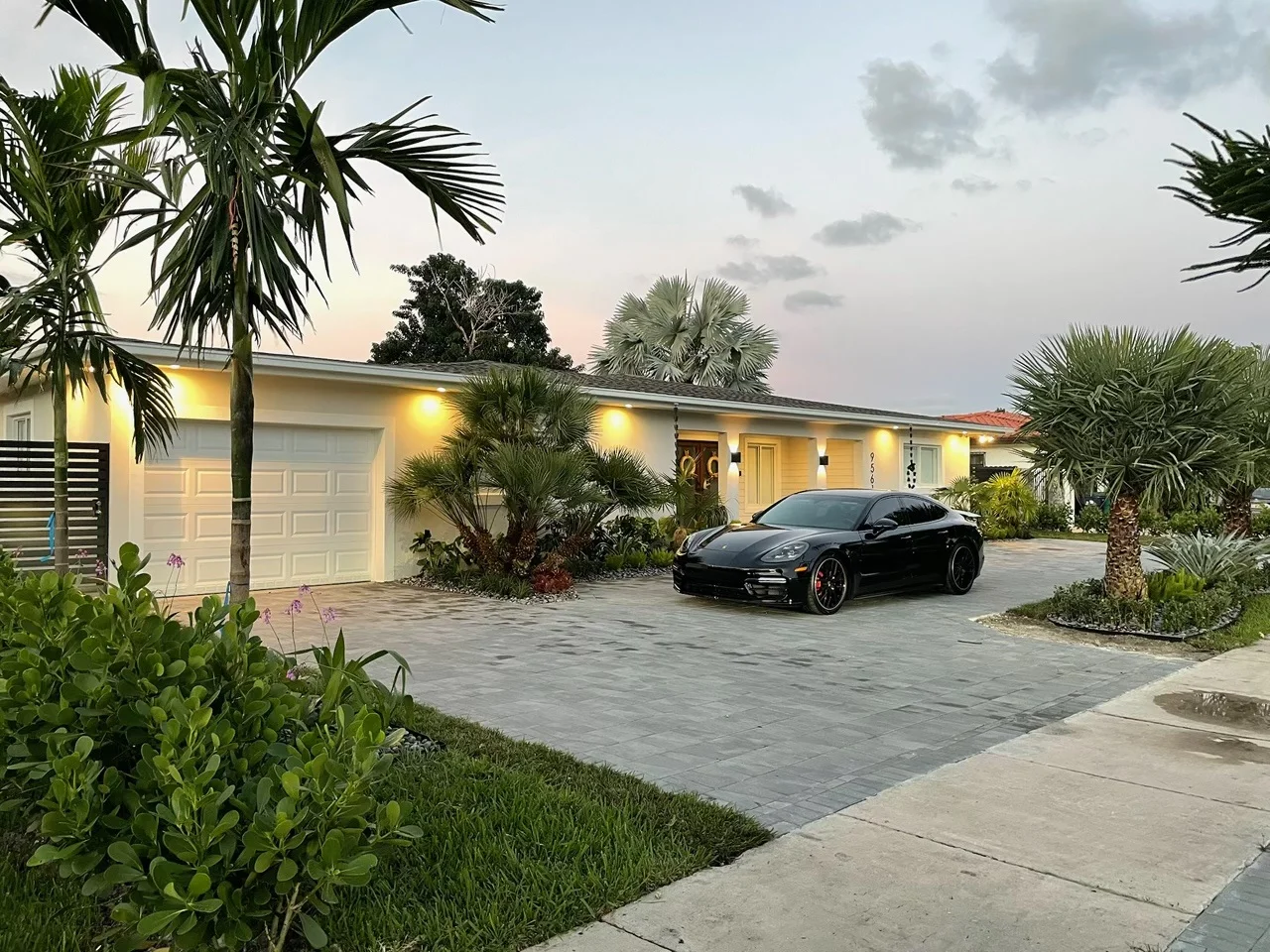
Why the ground changes the job
South Florida is not one substrate. The coast is sand over limestone, the Keys are coral rock, and out toward the lake you get organic soils that need a lot more excavation before anything gets built on them.
The soil here is sand, and sand moves when water flows through it. Add South Florida’s habit of dropping a lot of rain in a short burst and the base under a paver surface is working much harder than it would up north. That is why the base gets so much of our time.
So the base specification is not a template we carry from job to job. It comes from what is actually under your property.
What we are actually doing down there
If you watch one part of the install, watch the base go in. Aggregate should arrive in thin layers, a few inches each, with the compactor running over every layer before more is added. A crew that dumps the whole depth and runs one pass over the top is leaving loose material underneath a firm crust. That base will look perfect and behave for about a year before patches start dropping.
If you are comparing contractors, ask them about the three layers you will never see. A paver surface has four. The pavers on top are the wearing surface. Under them sits a thin bedding course of sharp sand, screeded flat. Under that is the base of compacted crushed aggregate, the layer that does the structural work. Under that is the subgrade, your native soil. A contractor who only wants to talk about paver colors is skipping the part that holds the thing up.
Base depth is the most important number on a paver quote, and you cannot check it once the job is done. It should change with the load. A path that only ever sees people needs less, a driveway taking a loaded pickup every day needs more, and a commercial drive for delivery trucks needs more again. When two quotes differ, ask each contractor what depth they priced and why. A good one has an answer tied to your traffic.
If nobody talks to you about drainage, they are quoting a different job.
Irrigation is the one people overlook. A sprinkler head that hits the same few feet of paver twice a day keeps that part of the base saturated, and over time the sand underneath washes. Downspouts discharging at the edge and runoff coming off a neighboring grade do the same. The rain itself, landing on a well-jointed surface, is rarely the problem.
Fall matters more than people think. A paver surface wants a slope of roughly an eighth to a quarter inch per foot away from the building. That is subtle enough that you will not notice it walking on it and steep enough that water leaves instead of standing. Get it flat and you get puddles; get it backwards and you send water at the foundation.
Water that leaves a paved area still has to go somewhere, and on a commercial property it tends to head for a doorway or the planting bed next to it. When the lot is tight and there is no fall to work with, we plan for it: a channel drain across the low edge, a permeable section into a stone reservoir, or a regrade of the bed alongside. Each is far cheaper during construction.
Base depth
Set by what the surface carries, not by habit. A walkway and a truck-bearing drive are not the same excavation.
Compaction
A compactor can only reach so far down. That is why aggregate goes in lifts, each compacted on its own, instead of one deep pile with a firm crust on top.
Fall
Away from the building, always, at about an eighth to a quarter inch per foot. That small slope decides where every storm ends up.
Miami-Dade County
Dense coastal build, limestone close to the surface, and salt air that finds every weakness in a badly bedded joint.
Broward County
Waterfront lots, high water tables, and a lot of 1970s driveways that have finally run out of base.
Palm Beach County
Estate drives, club properties, and long approaches where the pattern has to hold a line for a hundred feet.
Collier County
Naples and Marco Island work, where finish tolerance is the whole job and travertine is the default expectation.
Martin County
River and coastal properties with mature tree cover, which means roots under a lot of the older surfaces.
Monroe County
Keys work: coral rock, constant salt exposure, and a permeable surface requirement on a lot of lots.
Hendry County
Inland agricultural country where drives run long and heavy equipment crosses them.
Glades County
Lake Okeechobee properties with soft organic soils that make base preparation the entire job.
The region we cover
How this gets done badly
A finished job hides all of these. Because nobody can spot them at handover, they keep showing up on paver work.
Laying over the old surface
It is quick, it is cheap, and it inherits every problem underneath. If the base was the reason the old surface failed, putting a new one on top of it just hides the failure for a season.
Skipping the geotextile
We put a geotextile down on the subgrade before any base goes in. Its whole purpose is separation. Soil stays below, aggregate stays above, and the base keeps the structure it was compacted into. Leave it out and the mixing happens slowly and does not reverse.
Using the wrong sand in the bedding
Cheap, rounded sand in the bedding layer is how pavers end up drifting. Mason sand and beach sand roll under load. Bedding should be sharp, angular concrete sand.
Sealing too early
Sealing is a timing job on new concrete pavers. They have to cure, and their efflorescence has to work out to the surface, before the sealer goes on. Rush it into the first month and the white haze gets sealed in.
A sunken paver is a symptom. The base under it is the disease.
Common questions
What happens to the old surface
That part is on us. The existing surface gets broken out and hauled off the property, and concrete and pavers go to recycling when there is a recycler in the area. It is covered in the scope you sign.
How do you keep it from settling again
The answer depends on what made it settle, which is why we look before we price it. Drainage problems get corrected and a failed base gets dug out and rebuilt, and if a root is pushing, it gets dealt with too. Then the pavers go back down on a base with a reason to stay put.
Do you work with HOAs and property managers
Regularly. We are used to submittals, board timelines, and phasing work so residents keep access. Tell us what your approval process looks like and we will work inside it.
Do you cover Miami, FL
We do. Miami, FL is home base for us, and our crews are in the area most weeks. Call with what you have in mind and we will be straight with you about timing.
Is there a warranty
Yes, in writing, covering our workmanship. Manufacturer coverage on the pavers themselves comes from the manufacturer and we will hand you that paperwork too. We will also tell you plainly what a warranty does not cover, like a new root or a changed drainage condition.
Can you work around my pool being open
Usually. Pool deck work gets staged so you keep a safe path and the water stays covered while we cut. If there is a stretch where the pool has to be off limits we tell you which days up front.
Let us walk the property
Give us a look at it in person. We walk the whole property, pay attention to drainage, and write up what we found, which is quicker than trading descriptions over the phone.
Quality you can stand on