Retiring a patio that has stopped behaving like one
Sections that sank, or a cloudy film sealed in so long ago that no amount of scrubbing will lift it. Once a patio gets there, we take it out, haul it off, and build the new one on a base made for the ground behind your house.
How to tell a patio is finished rather than tired
Plenty of patios look worse than they are. Dirty joints, some weeds and faded color are upkeep, and a proper cleaning with fresh joint sand brings most of them back to life. When that is all yours needs, we say so, because selling someone a replacement they did not need is a fast way to never hear from them again.
Finished looks different. The surface no longer sits on one plane, or damage has been locked under a coating, or something below the pavers is moving and nobody can reach it without demolition. Any one of those on a patio that also holds water against the back of the house usually settles the question for good.
Age by itself is not on that list. A patio laid properly a long time ago can outlast the furniture sitting on it, and one laid badly last spring can already be done. We judge the surface in front of us, whatever its birthday.
Settled
Whole sections sitting lower than their neighbors, with puddles that hang around long after the rain stops. The base under them has lost material.
Hazed
A white cloud trapped under a glossy sealer. Somebody sealed before the pavers had cured, and the efflorescence got locked in with it.
Cracked
Breaks running across several pavers in a straight path. A failing slab under a thin overlay is moving and taking the surface along.
Laying new pavers over the old patio only postpones the bill
Two extra inches at the door can send the rain inside.
Overlays also add height. Outside a door, a couple of extra inches can put the finished surface level with the threshold or above it, and then rain heads toward the house.
The quickest patio price you will hear usually involves setting new pavers straight on top of whatever is there. It skips demolition and hauling, and it goes down fast. A slab that cracked because the ground beneath it moved will keep moving, and thin pavers bonded on top will crack along the same lines.
So before any new surface goes down, we want to know why the old one gave up. If the answer is the slab or the base, the replacement starts with taking them out. If the trouble turns out to be only skin deep, we tell you that too, and the job gets smaller and cheaper.
We also look at how the old patio met the house. Some were poured tight against the wall with no slope at all, and those need the most rethinking before anything new goes down beside the doors.
Getting the old patio off the property
Tear-out and haul-away are part of the job from the first conversation. We break out the old surface and any slab beneath it, load it onto the truck and haul it off.
Before the breaker starts, the things that stay get protected. Door tracks, the wall of the house and any planting beds you want to keep get covered or fenced off, and the tear-out stops at the edges we agreed on.
Demolition is also where we learn the most. With the old patio up, we can see the subgrade, where water has been sitting, and whether roots from nearby trees have moved in underneath. All of that shapes the new base before a single paver arrives on site.
Bringing the patio up to meet the sliding doors
Most of the work in a raised patio ends up hidden inside its edge.
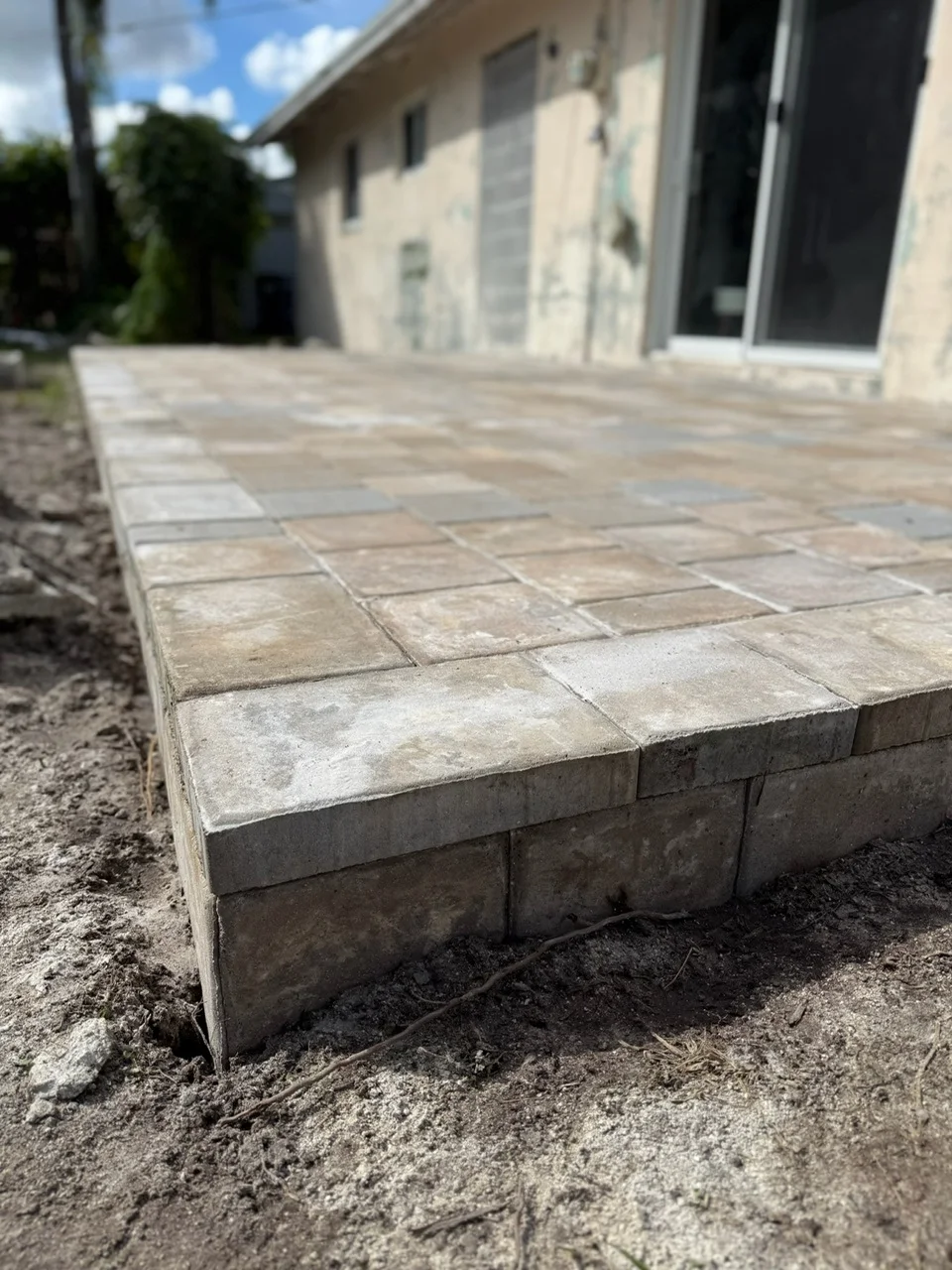
A lot of back doors sit well above the yard, so a patio laid at grade leaves an awkward drop out of the sliders. The answer we build most often is a raised patio held in by a wall-block edge, a short retaining course of segmental block around the open sides with the patio built up inside it.
The inside of that box is where the care goes. Fill and base go in thin lifts, each one compacted before the next, because a raised patio has more depth that can settle than one sitting at grade, and the wall only holds what has been properly compacted behind it. Geotextile goes behind the block and under the base so fine soil stays where it belongs.
The finished surface lands just below the door threshold and gets pitched off the house. Standing on it, you will never notice the slope, and it is enough to send rain off the far edge instead of toward the glass.
Where the yard drains matters as much as the pitch. We look at where that water ends up once it leaves the patio, so it does not simply pool against the block edge or run into a planting bed that already stays wet.
Keeping it clean under all that canopy
Coconut Grove patios live under trees, so leaves and small twigs land on them every day. Left alone, that litter breaks down in the joints into a dark mat that holds water and gives weeds somewhere to start. A broom or a leaf blower once or twice a week keeps ahead of it, and that covers most of the maintenance.
Joint sand settles a little over the first months and after hard rain. Once you can see the joints sitting low, a top-up keeps the units locked against each other. If any section starts to dip, call while it is small, because early dips make for short visits.
A pressure washer is fine now and then with a wide fan tip held well back. Up close with a narrow tip, it blasts sand out of the joints, and a field that loses its joint sand starts shifting the same way a badly built one does.
Sealing is your call. On a patio where you grill or eat outside, a sealer helps oil and food spills wipe off before they soak in. On one that mostly sees bare feet and a couple of chairs, it matters a lot less.
If you do want it sealed, the coating waits until the new pavers have had time to cure and push out their efflorescence. We would rather not be the next crew to seal a haze in.
If the patio is not the only thing on your list
Patios rarely fail alone. If the drive out front has the same sunken patches, our paver driveway replacement page explains a full rebuild there, and a drive with only one or two low spots may just need paver base repair. A path from the driveway around to the new patio is its own job with its own edge details, covered under paver walkway installation.
Some owners treat a replacement as the moment to switch materials, and natural stone comes up often; our travertine pavers page covers how it behaves. The full service description sits on paver patio replacement. Everything else we do nearby is on the Coconut Grove and Miami-Dade County pages, and finished patios are in the gallery.
Before you commit to a new patio
Can my old patio be saved instead
Sometimes. If the base is sound and the problem is dirty joints, weeds or faded color, a deep cleaning and new joint sand may be all it needs. We look first and tell you which side of that line it falls on before anyone starts talking about replacement.
Is removal of the old patio included
Yes. Breaking out the old surface, any slab under it, and hauling the debris away are part of the job. All of it leaves the property with us.
Can the new patio sit higher than the old one
It can. A raised patio built inside a wall-block edge brings the surface up close to the door threshold, so the step out of the sliders gets small. The block wall and the compacted fill behind it are planned together, which keeps the raised section from settling.
Which way should a patio slope
Away from the house, every time. We build a slight fall into the base so rain runs off the outer edge toward the yard or a drain. It is too gentle to feel when you walk across it, and it keeps water from collecting against the doors.
Should the new patio be sealed
That comes down to preference. Sealing helps on a patio that sees grilling, food or heavy staining, and it matters less on one that mostly gets foot traffic. Either way, new concrete pavers need to cure first, because sealing too early can trap a white haze under the coating.
Will the trees cause trouble for the new patio
They can, so we plan for them. During demolition we look for roots that have moved under the old surface and deal with them before the base goes in. A well compacted base that drains properly stays drier, and a drier base gives roots less reason to move in.
Where we will be working
Show us the patio you are ready to replace
A photo from the doorway and another from the yard looking back at the house give us the height and the condition before we visit. Send them over, we set a time to come measure, and the scope and cost come back to you in writing.
Quality you can stand on