When pavers sink, the problem is the layer you cannot see
A paver that rocks underfoot, or a patch of drive sitting half an inch lower than last year, is reporting on what happened below it. Material left the base. We find where it went and why, rebuild that layer properly, and set your own pavers back on top.
What a base is for, and the slow way it quits
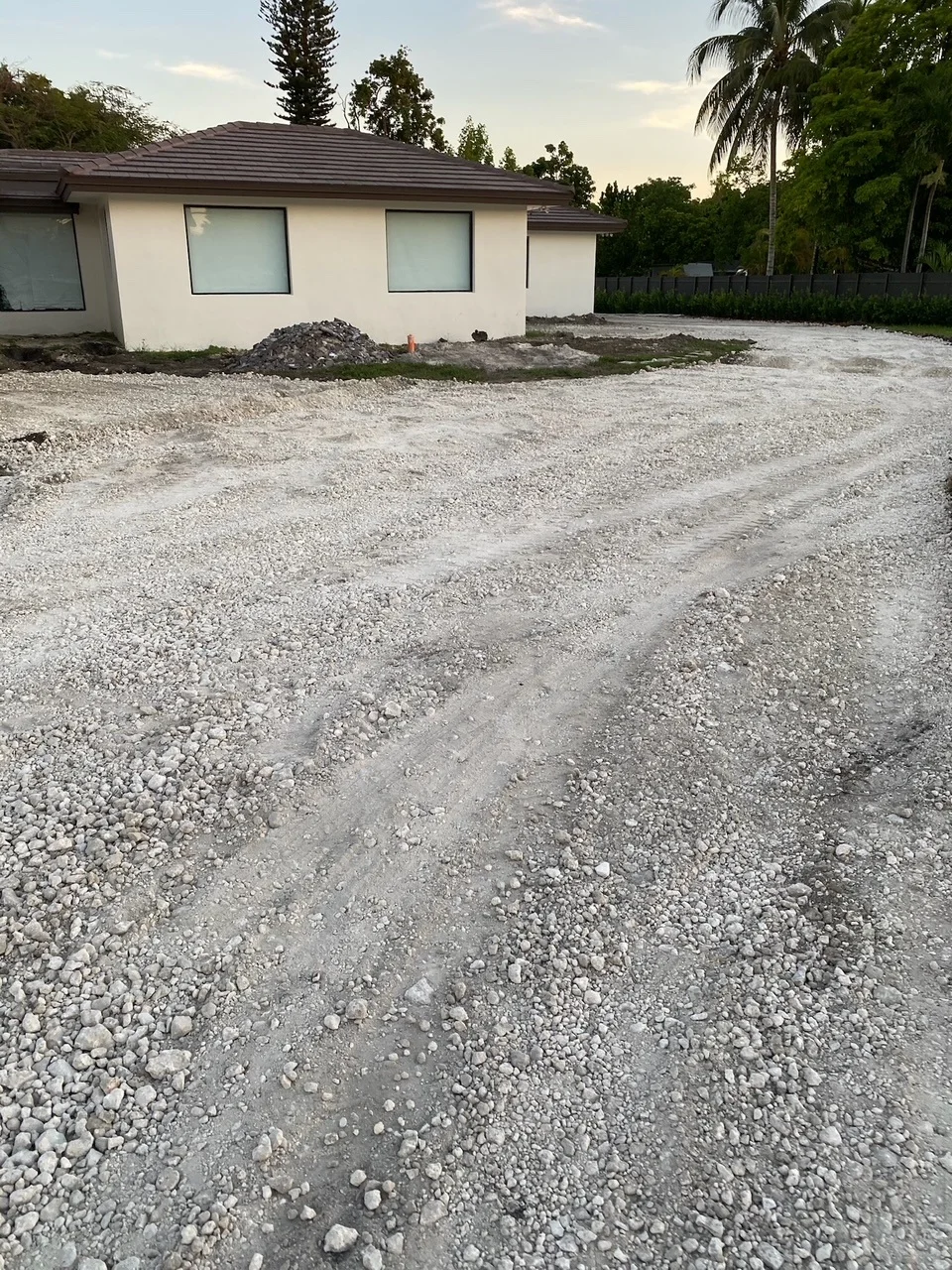
Under every paver drive there is a stack of layers, and the pavers are the thinnest one. Below them sits a screeded bed of sand about an inch deep, then a thick course of crushed rock compacted hard, then whatever ground the house was built on. In the Grove that ground is often a thin layer of sand with the oolite of the old coastal ridge close underneath. The crushed rock carries your car.
A healthy base is dense. Its angular pieces of stone lock against each other, so the weight pressing on one paver gets spread across a wide footprint instead of punching straight down. While that interlock holds, the surface on top stays flat and the joints stay tight.
It quits when it loses material. Fines wash out, small voids open, stone shifts into the voids, and the bedding sand drops in after it. None of that is sudden. A base can lose ground for a couple of years before the first paver sinks far enough to notice, which is why a small dip almost always sits on top of a bigger hole than it looks like from the driveway.
So when somebody tells us one paver has gone low, we hear it as the first visible sign of something that has been going on for a while.
Storm water and tree roots do most of the damage
Most of the year the ground here drains fast. Then an afternoon storm drops two inches in an hour, the sand saturates, and water starts moving sideways through the base looking for a way out. A base that went in properly lets it pass. A base that was dumped in one pass and only compacted on top has loose stone underneath, and loose stone travels with the water. Every heavy storm carries a little more of it off.
The rain falling on the pavers is rarely the culprit. Look instead at a downspout emptying beside the drive, or a sprinkler head that soaks the same joint every single morning. Water concentrated in one spot does the real digging.
Then there is the canopy. The Grove is full of big shade trees, and the underside of a paver drive is cool and damp, the kind of ground a root will travel a long way to reach. Once a root from one of the big shade trees along the drive works into the base, it pushes stone aside as it thickens, opens gaps around itself, and eventually lifts a line of pavers from below.
Washout and root damage can show up on the same drive a few feet apart. We sort out which is which before deciding anything.
Every storm is a test of how the base was built.
How a base repair goes, start to finish
Most of the work happens while your pavers sit stacked on the lawn, and most of the hours go into the part nobody will see again once we leave.
Lift and stack the pavers
We pull the units from the failed area plus a margin of sound field around it, and stack them in order so the pattern goes back the way it came out. Your pavers are almost always fine, and they are coming back.
Dig until the ground is honest
Old bedding and contaminated base come out until we reach firm, clean material. This is where the cause shows itself: a washout channel, a root, or a soft pocket where the stone was never compacted at all.
Deal with the cause
A root gets cut back where that is safe for the tree. A downspout or sprinkler that fed the washout gets redirected. Skip this step and the repair only lasts until the water finds the same path again.
Fabric, then stone in lifts
Geotextile goes over the subgrade so fine soil cannot work its way up into the new stone. Crushed base goes back a few inches at a time, each layer compacted before the next lands on it, up to a depth that suits what the surface carries.
Sharp sand, screeded flat
The bedding layer is angular concrete sand, struck to an even depth and tied into the height of the undisturbed field around it, so the seam between old and new work disappears.
Your pavers go back down
Same units, same pattern, with cut pieces reused where they fit. Joints get filled and compacted, the edge restraint gets checked, and the surface gets washed off before we pack up.
Why a quick reset fails by the next rainy season
The cheap version of this job is to pull the sunken pavers, throw in a few buckets of sand to bring them level, and put them back. It looks perfect the afternoon it is done. The base underneath is still missing everything it lost, and the new sand sits on loose stone with nothing to hold it. The first heavy storm follows the same path, and the dip comes back, often a little wider.
We get called to plenty of drives that were reset two or three times this way. Each round adds more loose sand on top of the same hole, and by the third reset the low area has spread well past where it started. The proper repair at that point is bigger than it ever needed to be.
Sand choice is the other quiet shortcut. Mason sand and beach sand have rounded grains, and rounded grains roll like ball bearings when a tire passes over them. Pavers bedded in that drift out of line and start to rock at the corners. Angular sand keys together under the plate compactor and stays put.
Angular
Concrete sand with sharp, broken grains. It locks under the pavers and holds every unit in line.
Rounded
Mason or beach sand. Easy to screed on the day, then it rolls under weight and lets units wander.
Fabric
Geotextile laid under the base. Nobody sees it once the job is done, and it keeps the stone clean of fine soil.
When the base is only part of the job
Sometimes we open a drive and find the base failed nearly everywhere, or the units on top are cracking and spalling. At that point patching is the wrong place to spend, and our paver driveway replacement page covers how a full rebuild runs. Back patios fail the same way, from below, and that decision is laid out on the paver patio replacement page.
Whichever way it goes, you see what we found before anything gets decided. Scope, materials, timing and cost are agreed first, and anything that changes once the base is open gets agreed with you before the work goes on.
If a root lifted the front walk along with the drive, the edge details on our paver walkway installation page apply there too. Natural stone sits on the same kind of base with a fussier bedding layer, which we explain under travertine pavers.
The general write-up for this service lives at paver base repair. Everything else we do in the neighborhood starts on our Coconut Grove page, the wider county is on the Miami-Dade County page, and finished jobs are in the gallery.
Questions about sunken and rocking pavers
Is one sunken paver worth calling about
Yes, while it is still one. A single low unit usually means a small void has opened in the base, and small voids grow every time water runs through them. Catching it early keeps the repair to a few square feet instead of a whole section of drive.
Can you reuse my existing pavers
In most base repairs, yes. Concrete pavers rarely fail on their own, so we lift them, stack them in order and relay them in the same pattern once the base is rebuilt. We only bring in new units where the old ones are cracked or spalled.
Will the repaired area sit level with the rest of the drive
It will, because we tie the new bedding layer into the height of the undisturbed field around the repair. Color usually matches too, since they are your own pavers, although units that spent time buried or shaded can read slightly fresher for a while after they go back.
What if a tree root caused it
We expose the root and look at its size and how close it sits to the trunk. Smaller roots can usually be cut back before the base is rebuilt. A large structural root needs a more careful decision, because hurting the tree is rarely the outcome you want.
Why does it keep sinking in the same spot
Repeated settling in one place almost always points at water. Something is feeding that spot, often a downspout, a sprinkler or runoff from next door. Until that water is redirected, any fix on top stays temporary, so finding the source is part of every base repair we do.
What should I do until you get here
Keep heavy vehicles off the low area if you can, and turn any downspout near it away from the pavers for now. Avoid filling the dip with loose sand yourself, since that hides the problem without slowing it down and makes the base harder for us to read.
Coconut Grove from above
Tell us where the drive has dropped
Let us know roughly how big the low area is and whether a tree or a downspout sits near it. That usually tells us what we are walking into. Then someone from the crew comes out, lifts a few pavers, and puts the plan and the number in writing.
Quality you can stand on