The Davie crew for driveways, patios and pool decks
Davie mixes ranch properties with suburban lots, and horse and equipment traffic asks more of a driveway base than a family car does.

What we see on Davie properties
Davie mixes ranch properties with suburban lots, and horse and equipment traffic asks more of a driveway base than a family car does.
Almost every paver problem we get called out to is a base problem wearing a surface disguise. The pavers themselves are fine. They are concrete or stone, and they will outlast most of us. What moves is what is underneath them.
Why does base work get so much attention here? South Florida pairs loose, sandy ground that shifts with moving water with rain that falls hard and fast. A drier climate lets a weak base hide. Here, every summer is an inspection.
The second common cause is roots. Shallow, wide root systems on ficus, black olive and older shade trees head toward moisture, and the ground under a walkway holds plenty of it.
We are out this way most weeks, so a look at the property is usually a matter of days rather than months. If it turns out the honest answer is that it can wait, we will tell you that too.
How a job here runs
We come look at it
Somebody from the crew comes out, stands on the problem, and tells you what is actually going on underneath it. No sales visit, just a look and an honest read.
You get the plan in writing
Scope, materials, schedule, and cost on paper before a shovel moves. The number you approve is the number, not an opening position.
We build the base first
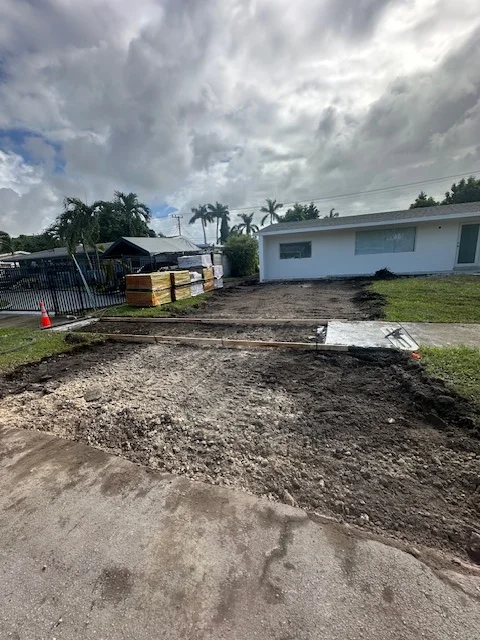
Excavation to the depth this job actually needs, aggregate compacted lift by lift, bedding screeded flat. The slow part, and the part that decides whether the surface is still flat in ten years.
Pavers go down and get cut in
Laying the field is the fast part. The care is in the cuts at the edges and the restraint that locks the whole field in place.
Joints get filled and the site gets cleaned
Sand swept in and compacted, the surface washed down, and the property left the way we found it. We haul our own debris.
What we run into on properties nearby
Base depth is the most important number on a paver quote, and you cannot check it once the job is done. It should change with the load. A path that only ever sees people needs less, a driveway taking a loaded pickup every day needs more, and a commercial drive for delivery trucks needs more again. When two quotes differ, ask each contractor what depth they priced and why. A good one has an answer tied to your traffic.
A plate compactor only reaches so deep. That is why the base goes in as a series of lifts, each a few inches thick and compacted before the next one lands on top. Put the full depth down at once and the plate firms up the top and leaves the bottom loose. It feels solid when you walk it. Then over the first year or two, the loose layer underneath consolidates unevenly and the surface settles in patches.
When we pull up a sunken section on somebody else’s job, the pavers themselves are usually fine. The problem is below them. A paver surface is built in four layers: the pavers, a screeded course of sharp bedding sand, a base of compacted crushed aggregate, and the subgrade, which is the soil the property sits on. The base is the structural layer. If it was too thin or never compacted properly, the pavers on top simply followed it down.
A sunken paver is a symptom. The base under it is the disease.
Getting water off the pavers is half of the drainage job on a commercial property. The other half is deciding where it lands. On a tight lot with no fall to spare, we usually choose between a channel drain at the low edge, a permeable section that lets water through to a stone reservoir, and a regrade of the planting bed next door. Building that in now costs less than coming back for it.
When a paver surface fails, look at the edges before you blame the rain. A downspout emptying right against the border, a sprinkler that wets the same corner every day, runoff from the lot next door: those are the usual suspects. Rain falling on a properly jointed field mostly runs off. Concentrated water from one source is what washes the base out.
Getting the fall right is quiet work. It means setting the base so the finished surface drops about an eighth to a quarter inch per foot away from the building, then checking it as the job goes. Done right, nobody notices it. Done wrong, you either get standing water or water pushed back against the foundation.
Compaction
Layered, then compacted, then layered again. One load spread and run over once looks finished and leaves loose material below the crust.
Fall
Roughly an eighth to a quarter inch per foot away from the building. Invisible underfoot, decisive for where water ends up.
Restraint
A perimeter edge restraint is what stops the field creeping outward and the joints opening from the outside in.
What Davie calls us for
Also nearby in Broward County:
What we tend to use around here
Clay brick is the long-game material. Fired clay keeps its color essentially forever, since the clay is the color. Expect a higher price and fewer shapes. In exchange, the surface should look about the same twenty years from now as it does the week we finish.
Travertine is a natural stone, and it behaves like one. Color and texture shift from unit to unit, so a deck has a less uniform look than concrete pavers give you. It also stays cooler under bare feet in direct sun, which is why pool owners ask for it. Seal it if it is going to see oil or heavy stains.
People drawn to porcelain usually want a surface that will not stain, and it comes close. Its density means it absorbs almost nothing. Expect the install to be slower and more exacting than concrete pavers, since the bed has to be precisely flat and every cut needs the right blade.
You can see this on almost any failing driveway. The middle usually looks fine and the outer two feet are a mess with wide joints and rocking units. That is not the edge wearing out faster, it is the edge restraint having failed and the field unlocking from the outside in.
The edge restraint is the piece nobody thinks about and it is what stops the whole field from spreading. Pavers work by interlock, which means each unit is held by its neighbors. Take away the restraint at the perimeter and the outermost course starts creeping outward, the joints open, the sand washes, and the failure marches inward from the edge.
Finding us in Davie
We are based in Miami and out this way regularly.
How this gets done badly
Every one of these looks fine on the last day of the job. That is why contractors keep getting away with them.
Sealing too early
A white haze trapped under sealer usually means somebody sealed too soon. New concrete pavers need time to cure and push out their efflorescence first. Seal in the first month and that haze can be locked in for good.
Laying over the old surface
Overlaying is tempting because it skips the tear-out and costs less up front. It also inherits every problem below. When the old surface failed because of the base, the new one is sitting on the same bad base and goes the same way.
Skipping the geotextile
When we tear out a failed paver job, a muddy base with no fabric under it is a common sight. The soil and the stone have blended into one weak layer. That is exactly what separation fabric is there to prevent, and why resetting pavers on top of that mess never holds.
Using the wrong sand in the bedding
Concrete sand goes in the bedding for a reason: its grains are sharp and angular, so they lock. Mason sand and beach sand are rounded and let pavers wander under load.
The edge restraint is the piece nobody thinks about and the reason the field holds.
Common questions
Do I need to be home while you work
No need. Leave us access and water, and go about your day. Plenty of customers head out in the morning and come back to a finished section. Anything we did not expect gets a phone call that day.
Will the new pavers match what I already have
Sometimes exactly, sometimes closely. Concrete pavers change color a little with sun and age, and older lines get discontinued. If we cannot match, we will show you the options before we order anything, including pulling units from a less visible area to patch a visible one.
What happens to the old surface
Breaking out the old surface is the first stage of the job. It gets loaded and hauled off, and we recycle the concrete and old pavers when a recycler is in reach. That work is written into the scope.
How do you keep it from settling again
The answer depends on what made it settle, which is why we look before we price it. Drainage problems get corrected and a failed base gets dug out and rebuilt, and if a root is pushing, it gets dealt with too. Then the pavers go back down on a base with a reason to stay put.
Do you work with HOAs and property managers
Regularly. We are used to submittals, board timelines, and phasing work so residents keep access. Tell us what your approval process looks like and we will work inside it.
Do you cover Davie, FL
Yes. Davie, FL is inside our regular working area and we are out that way most weeks. Call and we will tell you honestly when we could get to you.
Start with a conversation
Send a couple of photos or just call. We will tell you what we think is going on, what it would take to fix, and whether it needs doing now or can wait.
Quality you can stand on