What concrete paver driveways should actually involve
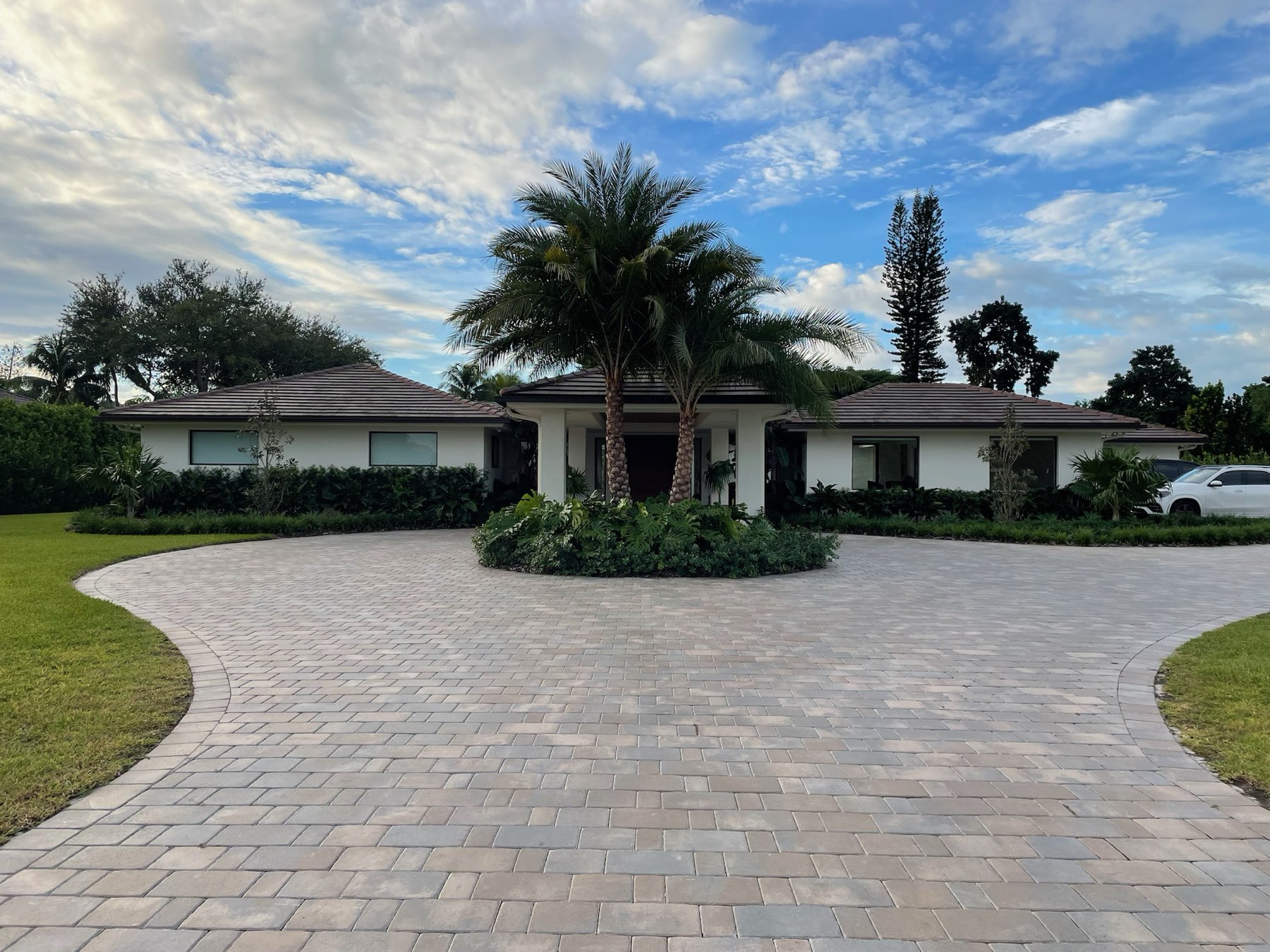
The widest range of shapes and colors, on a base built to carry cars.
What actually goes wrong
Almost every paver problem we get called out to is a base problem wearing a surface disguise. The pavers themselves are fine. They are concrete or stone, and they will outlast most of us. What moves is what is underneath them.
We pay extra attention to driveway edges on the coast. A high water table means rain cannot sink very far, so it moves sideways through the ground, and the edge is where that flow pulls sand out first.
Moisture collects under a walkway, and roots go where the moisture is. Ficus, black olive and a lot of older shade trees root shallow and wide, so they find that damp layer and push the pavers up.
We would rather lose a bid than skip the base work, because the base work is the job. Everything above it is finish.
How we run this job
We come look at it
We start in person. Someone from the crew comes out, looks at the problem and follows the water across the property. You get our honest read on the spot, and if the fix is small, we say it is small.
You get the plan in writing
Scope, materials, how long it takes, and what it costs, written down before anybody starts. No verbal numbers that change later.
We build the base first
The step most likely to get rushed is the one we slow down on. Excavation to proper depth, aggregate compacted in lifts, and a screeded bedding layer go in first. That buried base is what keeps the surface flat for a decade.
Pavers go down and get cut in
The field goes down to the pattern, edge cuts happen on site, and the perimeter gets a restraint so nothing creeps.
Joints get filled and the site gets cleaned
Sand swept in and compacted, the surface washed down, and the property left the way we found it. We haul our own debris.
What a driveway asks of the ground under it
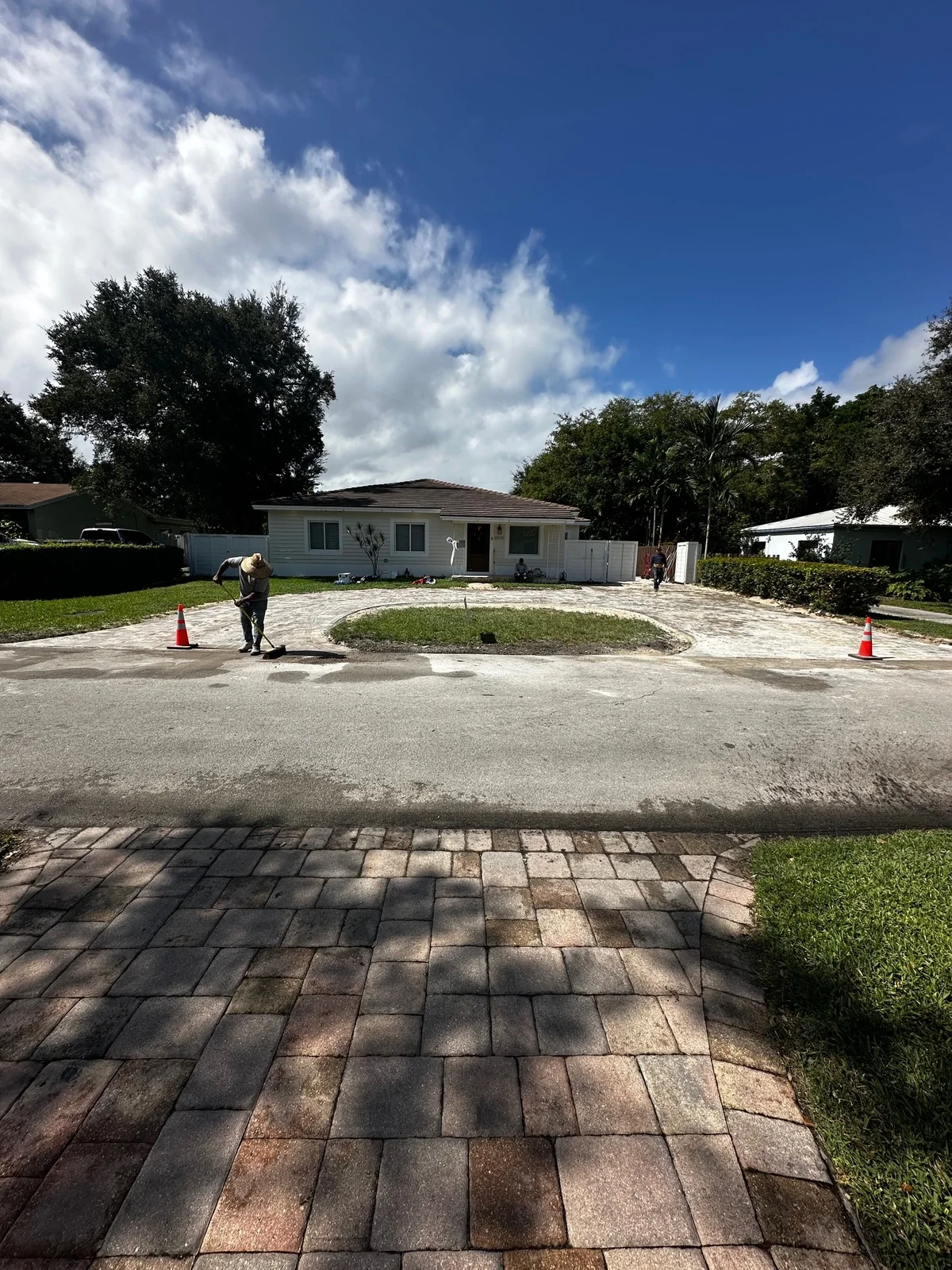
The apron, where the drive meets the street, takes the worst of it. Vehicles turn there under load, which grinds and shoves the surface sideways rather than just pressing down. That is why aprons need the deepest base on the job and the most serious edge restraint.
Width matters more than people expect. A drive built to the minimum feels fine until somebody steps out of a car onto wet grass every time it rains, and the edge course starts breaking down from being driven over.
A driveway is the only paver surface on most properties that carries a vehicle, and that changes everything under it. Passenger cars are not the design case; the design case is the delivery truck, the moving van, and the day somebody parks a loaded trailer on the apron.
Water is what ends most paver surfaces, and it rarely arrives from the sky.
Puddles that sit on a patio for hours after a storm are a grading problem. So is water that runs toward the building. Both come from getting the fall wrong. The target is about an eighth to a quarter inch of drop per foot, heading away from the structure, which is too gentle to notice underfoot and enough to move the water off.
We draw the water’s route before we draw the paver pattern. On a commercial job, once rain runs off the surface, the design has to say where it goes next. With a tight lot and no fall available, that might be a channel drain along the low side or a permeable section feeding a stone reservoir. Sometimes it is a regrade of the planting bed beside it. All of them are cheaper now than later.
A downspout that discharges right at the edge of a paver surface puts a whole roof’s worth of water into one small patch of base every storm. Irrigation heads that spray the same spot twice a day and runoff from a neighboring grade do similar damage. Compared with those, rain falling across a properly jointed surface is minor.
Base depth
Set by what the surface carries, not by habit. A walkway and a truck-bearing drive are not the same excavation.
Compaction
The base is built in lifts with compaction between each one. A base dumped in one load and run over quickly only has a crust holding it together.
Fall
About an eighth to a quarter inch of fall per foot. Underfoot it reads as level. In a downpour it carries the water off and away from the house.
More driveway work
This is work we do throughout the region. Here are a few of our most frequent areas:
What it asks of you afterwards
Upkeep on a well-built paver surface is light. Sweep leaves and debris off before they break down in the joints, top up the joint sand when it gets low, and call about any dip while it is still small. Most owners do little else.
The upside of sealing is mostly cosmetic and practical: richer color, easier cleanup, a bit more hold on the joint sand. The downside is commitment. A sealed surface needs another coat every few years, and once it starts wearing unevenly it can look patchy. We will give you our honest opinion on yours before you decide.
Most small things on a paver surface can wait for a convenient day. A lifted edge cannot. Anything raised more than about a quarter inch will catch someone’s foot sooner or later, and where the property is commercial, that turns into a liability question on top of the repair.
Of everything we install for homeowners, porcelain is the newest. What it brings is density: it soaks up almost no water and resists staining better than nearly anything else. What it demands is precision, both in the base, which has to be truly even, and in the cutting.
If you are unsure which material to choose, concrete pavers are the safe default. The range of shapes and colors is the widest of anything we install, and matching them for a repair or an addition down the road is easier than with any other paver. Know going in that the color moves a little during the first year or two as they cure out.
Clay brick is the long-game material. Fired clay keeps its color essentially forever, since the clay is the color. Expect a higher price and fewer shapes. In exchange, the surface should look about the same twenty years from now as it does the week we finish.
Where these jobs go wrong
These shortcuts all pass a walk-through on day one. The problems arrive later, and that delay is why they stay common.
Laying over the old surface
Before paving over anything, ask why the old surface failed. If the answer is the base, a new surface on top of it is borrowing time. It goes down fast and cheap, and the same problem comes back through it.
Skipping the geotextile
We put a geotextile down on the subgrade before any base goes in. Its whole purpose is separation. Soil stays below, aggregate stays above, and the base keeps the structure it was compacted into. Leave it out and the mixing happens slowly and does not reverse.
Using the wrong sand in the bedding
Beach sand and mason sand are round, so they roll under load like ball bearings. Bedding needs sharp, angular concrete sand that locks together and keeps pavers where they were set.
Sealing too early
Sealer works like a lid. Put it on a new concrete paver too early, in the first month, and whatever efflorescence has not come out yet gets trapped underneath as a permanent white haze. Let the pavers cure first.
Compaction in lifts is the difference between ten years and two.
Common questions
Will the new pavers match what I already have
Concrete pavers drift a little in color as the sun and the years work on them, so a fresh unit next to one that has been down a while can stand out. Sometimes we match exactly and sometimes closely. If we cannot get close enough, you see the options before we order.
What happens to the old surface
Old surfaces come out completely before anything new is built. We haul the debris away and recycle the concrete and pavers wherever we have a recycler to take them. Nothing about removal gets billed as an add-on.
How do you keep it from settling again
Pulling up the low pavers is the easy part. Keeping them level means fixing what let them drop, which is usually water undermining the base or a base that was weak to begin with. We correct both before anything goes back down, and handle a root if one is involved.
Do you work with HOAs and property managers
Your rules come first. We regularly work for associations and property managers, which means board timelines and submittals are routine for us. Share your approval process and we will schedule the work, in phases if needed, so residents keep access.
Do you cover Miami, FL
Absolutely. We are headquartered in Miami, FL and work there regularly. The quickest way to find out how soon we could start is a phone call to 786-717-9244.
Is there a warranty
Yes, in writing, covering our workmanship. Manufacturer coverage on the pavers themselves comes from the manufacturer and we will hand you that paperwork too. We will also tell you plainly what a warranty does not cover, like a new root or a changed drainage condition.
Start with a conversation
Get in touch however suits you, with a call or an email with pictures attached. You will hear plainly what is wrong and what the repair involves. Some problems are better left another year, and when yours is one of them, we will tell you.
Quality you can stand on