Custom Paver Driveways done so it stays flat
Radius, border and pattern set out for your frontage.

What actually goes wrong
When a paver surface goes wrong in Florida, the pavers are rarely the thing that failed. Water got into the base, the base moved, and the surface followed it down. Fix the surface only and you are back in two years.
Why does base work get so much attention here? South Florida pairs loose, sandy ground that shifts with moving water with rain that falls hard and fast. A drier climate lets a weak base hide. Here, every summer is an inspection.
Moisture collects under a walkway, and roots go where the moisture is. Ficus, black olive and a lot of older shade trees root shallow and wide, so they find that damp layer and push the pavers up.
We would rather lose a bid than skip the base work, because the base work is the job. Everything above it is finish.
How we run this job
We come look at it
Nobody can tell you much from a photo. One of us comes and walks the property with you, looks at where water collects, and gives you an honest opinion, small job or big one.
You get the plan in writing
Everything in writing up front: what we are doing, what it is made of, how long it takes, and what it costs. Nothing changes without you signing off on it.
We build the base first
Excavation to the depth this job actually needs, aggregate compacted lift by lift, bedding screeded flat. The slow part, and the part that decides whether the surface is still flat in ten years.
Pavers go down and get cut in
Field laid to the pattern, edges cut on site, and a restraint set around the perimeter so the field cannot creep.
Joints get filled and the site gets cleaned
Sand swept in and compacted, surface washed, debris hauled by us. You get the property back the way we found it, minus the problem.
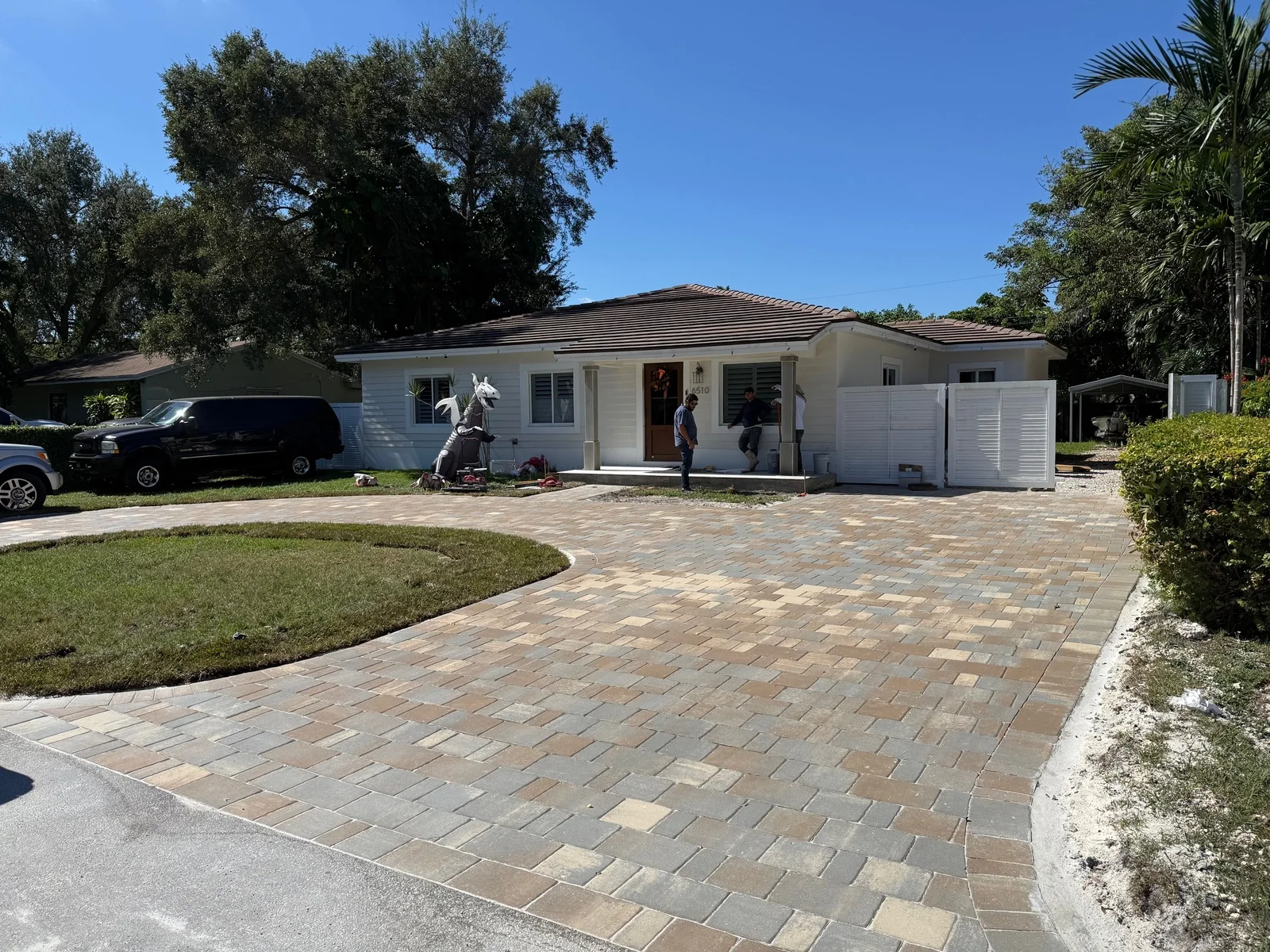
What a driveway asks of the ground under it
Width matters more than people expect. A drive built to the minimum feels fine until somebody steps out of a car onto wet grass every time it rains, and the edge course starts breaking down from being driven over.
A driveway is the only paver surface on most properties that carries a vehicle, and that changes everything under it. Passenger cars are not the design case; the design case is the delivery truck, the moving van, and the day somebody parks a loaded trailer on the apron.
The apron, where the drive meets the street, takes the worst of it. Vehicles turn there under load, which grinds and shoves the surface sideways rather than just pressing down. That is why aprons need the deepest base on the job and the most serious edge restraint.
Water is what ends most paver surfaces, and it rarely arrives from the sky.
Joint sand looks like filler between the pretty parts, and it does more work than anything else you can see. Sand packed into the joints is how one paver hands part of its load to the ones around it, and that sharing is what turns loose units into a surface. Lose the sand and the sharing stops. Each paver bears its own load, and that is exactly when rocking and cracking begin.
That hazy film you sometimes see on a newer patio is usually polymeric sand that was rushed. The sand binds when it gets wet, so it has to go into the joints dry and be swept completely off the paver faces before any water touches it. Then it gets watered in exactly the way the manufacturer says. Skip the sweeping and the binder sets on the surface instead of in the joint.
Base depth
Set by what the surface carries, not by habit. A walkway and a truck-bearing drive are not the same excavation.
Compaction
A compactor can only reach so far down. That is why aggregate goes in lifts, each compacted on its own, instead of one deep pile with a firm crust on top.
Fall
Away from the building, always, at about an eighth to a quarter inch per foot. That small slope decides where every storm ends up.
More driveway work
We bring this work to properties across the region. A few places that keep us busy:
What it asks of you afterwards
Small problems stay small on pavers if you catch them. A low spot fixed early is a quick reset. Left alone, it collects water and grows. Beyond watching for that, keeping the joints full and clean covers nearly everything a good install asks of you.
The upside of sealing is mostly cosmetic and practical: richer color, easier cleanup, a bit more hold on the joint sand. The downside is commitment. A sealed surface needs another coat every few years, and once it starts wearing unevenly it can look patchy. We will give you our honest opinion on yours before you decide.
If one thing gets a phone call right away, make it a raised edge. Once a paver sits more than about a quarter inch above its neighbors, somebody is going to catch a toe on it. On a commercial property that is a liability issue, and it is a maintenance one too.
Pick clay brick if you want a surface that still looks like the day it went in twenty years from now. Its color is the fired clay, so it stays put. You will pay more and have fewer shapes to choose from.
Travertine is quarried stone, so no two pieces look quite alike. Some people love that variation and some find it busy, so it is worth seeing a few units side by side before you commit. Its big practical advantage is temperature: in direct sun it stays cooler underfoot than concrete, which is why it shows up around so many pools.
Of everything we install for homeowners, porcelain is the newest. What it brings is density: it soaks up almost no water and resists staining better than nearly anything else. What it demands is precision, both in the base, which has to be truly even, and in the cutting.
Where these jobs go wrong
On the day the job wraps, all of these look like good work. The damage comes later, so the habits never get corrected.
Skipping the geotextile
When we tear out a failed paver job, a muddy base with no fabric under it is a common sight. The soil and the stone have blended into one weak layer. That is exactly what separation fabric is there to prevent, and why resetting pavers on top of that mess never holds.
Using the wrong sand in the bedding
Beach sand and mason sand are round, so they roll under load like ball bearings. Bedding needs sharp, angular concrete sand that locks together and keeps pavers where they were set.
Sealing too early
Fresh concrete pavers push a white residue to the surface as they cure. That is efflorescence, and it needs to finish before any sealer goes on. Seal in the first month and the haze can end up permanently under the coat.
Laying over the old surface
An overlay inherits everything beneath it. Settled spots and a soft base stay exactly where they were. If the base is what sank the old surface, the new layer just hides it for a season before the same failure comes back.
The pavers are a wearing surface. The base is the building.
Common questions
Will the new pavers match what I already have
You will know before we order anything. Plenty of repairs match exactly. Others come close, since concrete pavers shift color a little with sun and age and older lines get discontinued. When close is not good enough, we can move units from a less visible area onto the visible patch.
What happens to the old surface
Old surfaces come out completely before anything new is built. We haul the debris away and recycle the concrete and pavers wherever we have a recycler to take them. Nothing about removal gets billed as an add-on.
How do you keep it from settling again
Settled pavers almost always point to something underneath. We trace it, whether it is drainage, a soft base or a root moving in, and fix that first. Pavers go back down only once the reason for the dip is gone.
Do you work with HOAs and property managers
Regularly. We are used to submittals, board timelines, and phasing work so residents keep access. Tell us what your approval process looks like and we will work inside it.
Do you cover Miami, FL
Miami, FL is squarely in our regular area. We work there most weeks. If you send a few photos of the job, we can usually tell you a lot before anyone even comes out.
Is there a warranty
Yes. Get any contractor’s warranty in writing and read what it excludes. Ours is written and covers our workmanship. It is also clear about its limits, like a root that arrives later or a drainage change. The pavers have separate manufacturer coverage, and we give you those papers.
Tell us what you are looking at
Photos only tell us so much. Standing on the surface tells us the rest. One of us will come out, walk the property with you, check where the water runs, and put what we find in writing.
Quality you can stand on