Paver Drainage Repair, from the subgrade up
Re-grading so water leaves instead of sitting where it pools.
What actually goes wrong
The failure is almost always below the pavers. Sand washes out of the joints, water gets down into the bedding, the bedding migrates, and the surface drops. Everything you can see is downstream of that.
Every summer in South Florida is a stress test for the ground under a paver surface. Heavy rain comes fast, and the sand under most properties moves when that water flows through it. A base that would get by up north has to be built better to last here.
Tree roots lift more pavers than people expect. They chase water and the base holds water, so once a root grows into that layer it keeps raising the surface above it.
We would rather lose a bid than skip the base work, because the base work is the job. Everything above it is finish.
How we run this job
We come look at it
We come out and see it with you. The walk covers the surface and where the water goes after it leaves. You get a plain answer, and if the fix is smaller than you feared, we tell you that first.
You get the plan in writing
Scope, materials, how long it takes, and what it costs, written down before anybody starts. No verbal numbers that change later.
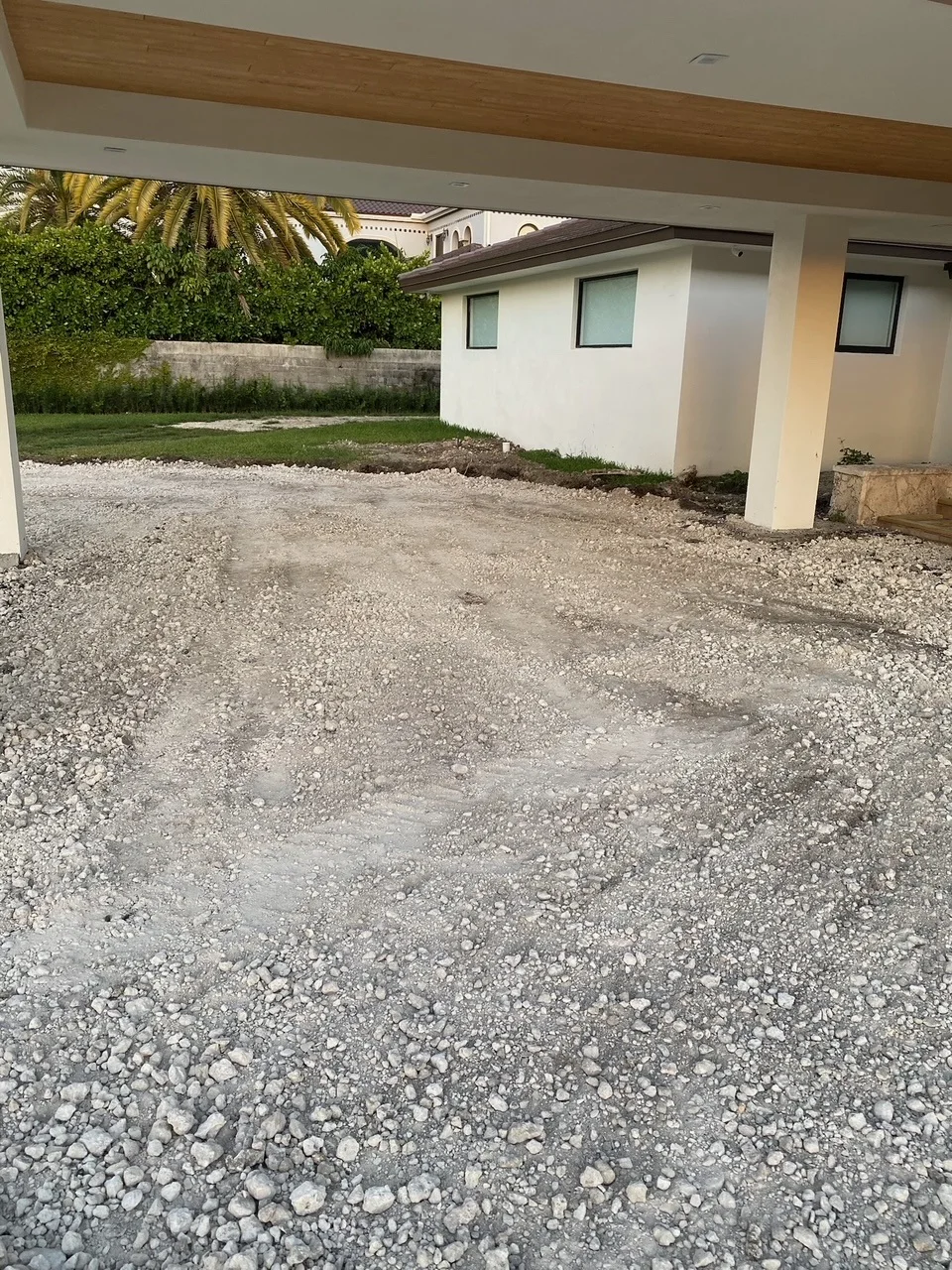
We build the base first
Dig to depth, compact the aggregate in layers, screed the bedding. Nobody ever sees this part again, which is exactly why most failures start here.
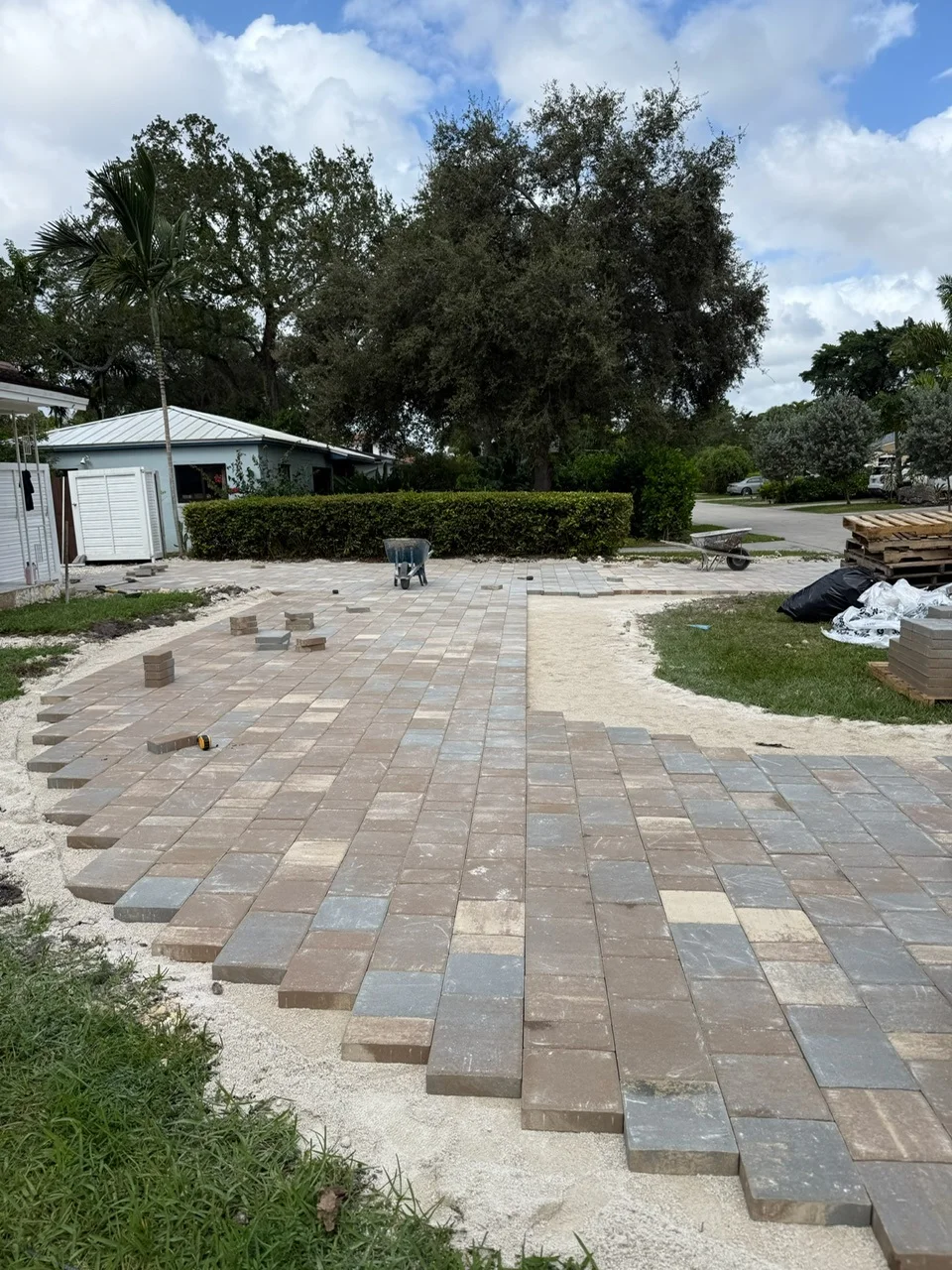
Pavers go down and get cut in
The field goes down to the pattern, edge cuts happen on site, and the perimeter gets a restraint so nothing creeps.
Joints get filled and the site gets cleaned
Sand swept in and compacted, the surface washed down, and the property left the way we found it. We haul our own debris.
Working out what actually failed
Repair starts with diagnosis, not with lifting pavers. The surface tells you where it failed; it does not tell you why. Pull up a sunken section without answering the why and you have bought a season.
The usual why is water: a downspout discharging at an edge, an irrigation head hitting the same spot twice a day, or a neighboring grade sending runoff across a corner. Second most common is a root. Third is a base that was never compacted properly.
A good repair is invisible. That means keeping the units that came up, blending replacements so they do not read as a patch, and matching the joint sand so the repaired area does not sit a shade different from the field around it.
A sunken paver is a symptom. The base under it is the disease.
We think about where water will run before we think about pattern or color. Every paver surface needs a gentle fall, roughly an eighth to a quarter inch per foot, pointed away from the house or building. It is subtle enough to go unnoticed and steep enough to work. A flat or backward pitch shows up in the first heavy rain.
The question to ask is where the water ends up after it leaves the pavers. On a commercial site that answer drives part of the design. A tight lot with no fall available might need a channel drain at the low edge, a permeable section draining into a stone reservoir, or a regraded planting bed. Building any of them during the install beats cutting the job back open later.
People expect rain to be what wears out their pavers. In practice, a field with properly filled joints sheds most rainfall without trouble. The failures trace back to concentrated water: a gutter dumping at the border, irrigation hitting one spot day after day, or the neighboring lot draining across the corner.
Fall
Set at roughly an eighth to a quarter inch per foot, away from the structure. Subtle to walk on, and the reason water leaves instead of standing.
Restraint
A perimeter edge restraint is what stops the field creeping outward and the joints opening from the outside in.
Joint sand
Structural, not cosmetic. It transfers load between units, which is the whole reason a field of loose pavers behaves like a surface.
Other repairs we handle
This service runs across our whole region. Some of the areas where we do the most of it:
What it asks of you afterwards
Sealing is maintenance you sign up for. Once a surface is sealed, it looks best if it gets recoated every few years, and skipping that leaves it patchy. In exchange you get deeper color and stains that lift with less scrubbing. Some owners love that look. Others prefer pavers left natural. Either is a reasonable choice, and we will tell you which suits your surface.
On a commercial property, a lifted paver is a liability item before it is a repair item. An edge that rises more than about a quarter inch above the surface around it is enough to catch a toe, so it deserves a quick response rather than a spot on next year’s list.
Pavers that went down on a proper base do not ask for much. Every so often, look at the joints. If the sand is low, refill it, and if leaves or dirt are packed in, clear them out. Watch for settling and deal with it while it is small.
If budget is tight, clay brick is usually not where we start, since it costs more and comes in fewer shapes. If the priority is a surface that looks the same in twenty years, it is the answer. Its color is the fired clay, and that does not fade.
Travertine gets requested for pool decks because it stays noticeably cooler than concrete under bare feet in the sun. It does want a sealer if the area sees oil or heavy staining, and as a natural stone, expect variation from one unit to the next.
Porcelain pavers have only recently become common on homes. They are very dense and take on almost no water, so stains have little to hold onto. The catch is the install. Porcelain shows every flaw in the bedding, so the base has to be exact, and cuts need the right blade and a slow hand.
What we see when somebody else did it
Nothing on this list shows when the work is new. Each one waits a while before it surfaces, which is how it keeps getting repeated.
Laying over the old surface
It is the shortcut that costs the most later. A new surface on top of a failed one goes down fast and cheap, and it still sits on the same ground. If the base caused the original failure, the overlay hides it for one season.
Skipping the geotextile
Between the native soil and the base, there should be a geotextile fabric. It keeps the two from mixing. Without it, fines migrate into the aggregate until the base weakens, and the settling that follows comes back after every surface repair.
Using the wrong sand in the bedding
Sand looks like sand until a truck rolls over it. Sharp, angular concrete sand grips. Rounded sand, the mason or beach kind, rolls under the load and lets pavers slide out of place.
Sealing too early
A new concrete paver needs to cure and let its efflorescence work out before it gets sealed. Seal it in the first month and you can lock a white haze under the sealer permanently.
The pavers are a wearing surface. The base is the building.
Common questions
How long does the job take
A typical paver drainage repair job runs two to five working days once we start. Base work is the slow part; laying the field goes quickly. Weather moves things, and in summer we plan around the afternoon storms rather than pretending they will not happen.
Do I need to be home while you work
Most owners are at work while we are. What we need from you is access to the area and a water source. If the gate locks or there is a pet in the yard, tell us ahead of time. Should we run into a surprise, we will call you the same day.
Will the new pavers match what I already have
It depends mostly on whether the line is still made. If it is, we can usually get close, though sun and age shift the color of concrete pavers a little over time. If it has been discontinued, we show you the options before ordering, and that can include borrowing units from a less visible spot.
What happens to the old surface
We remove it. Breaking out and hauling the old concrete or pavers is a normal part of our scope, and where a recycler is available, that material gets recycled instead of landfilled.
How do you keep it from settling again
Most of the time it comes down to the base. If it was laid too thin or compacted in one pass, we dig it out and rebuild it in lifts, then check that water is leaving the area the way it should. Fixing the surface without the base just repeats the problem.
Do you cover Miami, FL
Yes. Miami is where Paverson is based, and we work across the city regularly. Reach us by phone or at info@paverson.com and we will tell you honestly how soon we could get there.
Have somebody come look at it
The fastest way to get a real answer is to have one of us stand on it. We will walk the property, look at where the water goes, and write up what we find.
Quality you can stand on