Travertine pavers set level on a base built for stone
Travertine looks and feels different from a concrete paver, and it asks more of whoever lays it. We bed it precisely, cut it with care, and tell you straight when sealing is worth doing in the salt air out here and when it can wait.
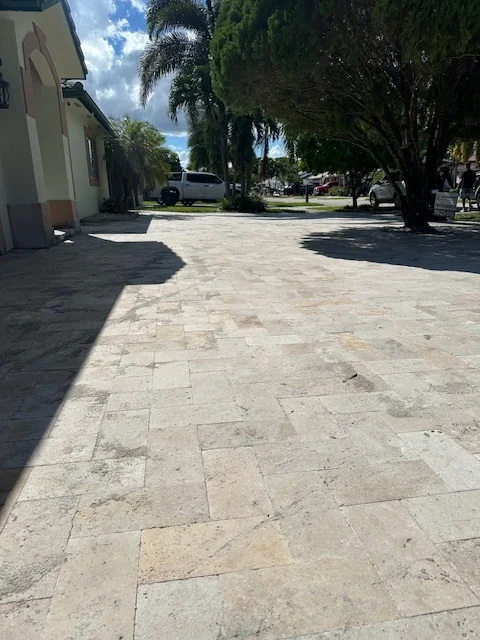
Quarried stone, and no two pieces alike
Travertine is a natural limestone, laid down over a very long time by mineral-rich water. You can see that history in it: veining, small natural voids, and a tone that shifts between ivory and warm tan from one unit to the next.
Concrete pavers come out of a mold, so the units on a pallet are close to identical and the color runs through each piece. Travertine trades that sameness for character, and most people who choose it want the variation they will see across a finished field.
Pale stone also runs cooler in direct sun than a concrete paver does, which you notice the first summer afternoon you cross it barefoot. On a drive or a walk that bakes from lunchtime on, that is a real difference and a big part of why people ask for it.
The same openness that gives travertine its texture lets it soak up water and whatever the water carries, oil and salt included. That one trait drives the sealing decision and most of the upkeep, so it is worth understanding before you pick a stone.
Finish changes how the stone behaves outside. Tumbled units have softened edges and a worn-in face that hides scuffs and gives some grip underfoot. Honed units are flatter and smoother, which looks crisp on day one but shows dirt sooner and feels slicker after a shower. For a drive or a walk under trees, tumbled is the more forgiving pick.
When sealing travertine earns its place
It is a judgment call. We would rather tell you a coat is optional than sell you one you do not need.
Seal where the stains will come from, and let the rest breathe.
Travertine is porous. Left bare, it takes in whatever lands on it, and an oil drip under a parked car can wick into the stone and stay there. On a drive, where cars sit and leak, a good penetrating sealer usually pays for itself. On a walk that only ever sees feet, it often is not needed at all.
Product matters as much as the decision. A film-forming coating can leave travertine glossy and slick, and one that traps moisture underneath can cloud over in a humid summer. Penetrating sealers that soak in and leave the face looking like stone are usually the better fit outdoors, and they wear away gradually instead of peeling.
Closer to the water, salt is the other concern. Salt air settles on the surface, and when it dries inside the pores the crystals can slowly wear at the face. A plain freshwater rinse now and then, more often after a windy, salty stretch, keeps that buildup down. A sealer slows it. Rinsing still matters either way.
Timing counts too. Stone that has just been laid and washed needs to dry out properly before anything goes on it, or the sealer locks moisture and any residue under the surface. We tell you when the field is ready rather than sealing on the last afternoon to close the job out.
A natural stone field shows every flaw in the bed
Units cut from natural stone vary slightly in thickness from piece to piece, and a pale field shows every high corner and every low edge. The bedding layer is where those small differences get taken up, so it has to be screeded precisely and held consistent from one end of the job to the other.
A careless bed shows up fast on stone. A corner catches a toe, a unit rocks when you step on it, or rainwater sits in one shallow dip. An edge standing more than about a quarter inch proud is a trip hazard, and on light stone it catches the eye as well.
Cuts deserve the same care. Stone chips and spalls along a rushed cut, and a field only looks as clean as its perimeter. We cut on site with a proper blade and an unhurried hand, and put cut pieces where they will draw the least attention.
Under all of it sits the same base as any good paver job, the layers our paver base repair page takes apart one at a time. Stone simply punishes a shortcut sooner than concrete does.
Joint sand needs extra care on travertine. Any of it left on the face when the joints are set can sink into the pores as a haze, and on porous stone that film is far harder to lift than it would be on a concrete paver. So the face is swept clean, then checked again, before any water touches the field.
Bedding
Screeded to a steady depth, so variation in the stone never becomes variation in the surface.
Cuts
Made on site with a stone blade and a slow feed so the edges stay crisp.
Restraint
Anchored into compacted base along every open side to keep the field locked.
Drives, walks and patios in stone
Travertine works on all three, though each one changes what we worry about.
On a driveway
The drive at the top of this page is travertine laid in full sun. Vehicles call for thicker units rated for the load and a base deep enough for a car parked there every night. Sealing is usually worth it here, because cars drip.
On a walkway
Foot traffic only, so the base is lighter and sealing is often optional. A cool surface underfoot is the whole appeal on a path you cross barefoot. Under the canopy, roots are still the main thing to plan around.
On a patio
Patios collect leaves, spilled food and the odd grill drip, so the sealing question comes up early. A patio also needs fall away from the house, so rain runs off instead of collecting by the door.
Pattern is the other choice. A mixed-size layout hides natural variation well, while a single size in a running bond puts it on display. We dry-lay a section on site so you can see how the stone reads before anything gets set.
A border is worth a thought on a stone drive. A soldier course of the same travertine along each edge frames the field, gives the restraint a clean line to sit against, and hides the small width differences between units right where the eye looks for them.
Keeping pale stone clean under the canopy
Upkeep on travertine is mostly a broom and a hose.
Leaves and seed pods from the trees overhead stain light stone if they sit wet for long, so sweeping them off before they break down does more than any product. Top up the joint sand when it runs low, rinse after salty, windy weather, and call about a dip while it is still small.
If the stone was sealed, the coat will not last forever. When water that used to bead on the surface starts darkening the stone instead, the sealer is wearing thin. A fresh coat goes on after a thorough clean and a properly dry spell, never over dirt or damp.
Stone is one choice among several. If the drive itself is beyond saving, begin with paver driveway replacement, and if a path is what you are planning, paver walkway installation covers it. Older stone that has sunk is often a paver base repair job, while a worn-out back terrace is a paver patio replacement.
There is more on travertine pavers in general, on our work in Coconut Grove and across Miami-Dade County, and you can see finished jobs in the gallery.
Stone questions people bring us
Is travertine slippery when wet
Tumbled travertine, with its softened edges and textured face, has decent grip when wet. Polished stone belongs indoors and has no place on an outdoor surface. A glossy sealer can also make a good surface slick, which is one reason we lean toward penetrating products.
Can travertine go on a driveway
Yes, with the right units and the right base. Cars need a thicker stone than a walkway does, and the base has to be built for a vehicle parked there every night. Sealing is usually worth doing on a drive because of oil drips.
Does the salt air damage it
Salt can wear porous stone over time as it dries inside the surface. Rinsing with fresh water now and then, more often after windy, salty weather, keeps it in check. Travertine that is bedded properly and gets that simple attention holds up near the water.
Will the color be uniform
No, and that is the appeal. Each unit varies in tone and veining, so we blend from several pallets as we lay instead of working through one at a time. That keeps a patch of darker pieces from clumping in one corner of the field.
Do the holes in the stone need filling
Many travertine pavers come with the natural voids already filled at the factory, while tumbled units often leave them open. Open voids collect a little grit and that is normal. If the look bothers you, tell us at the start so we can choose units to match.
Can you match travertine we already have
We can usually get close, though natural stone varies between batches and quarries, so an exact match is never guaranteed. Bring a loose piece or send a clear photo taken in daylight. We will tell you how close the new stone is likely to come.
Where the Grove sits
Talk through travertine with us
Call with what you are picturing, whether that is a drive, a walk or a patio. We will tell you which units suit it, whether sealing makes sense for how you use the space, and what the job involves from the first dig.
Quality you can stand on