Paver Driveway Sealing, built on a base that holds
Sealing that protects color and locks the joints without a plastic-looking sheen.
What actually goes wrong
The failure is almost always below the pavers. Sand washes out of the joints, water gets down into the bedding, the bedding migrates, and the surface drops. Everything you can see is downstream of that.
The ground under most of the region is sand sitting on limestone. It sheds ordinary rain easily. The trouble comes with the heavy afternoon storms, the ones that put down two inches in an hour, when the sand cannot drain fast enough and water starts carrying it out from under the base.
Tree roots lift pavers here too. The usual culprits are ficus, black olive and older shade trees, whose shallow, wide roots follow moisture straight under a walkway and push it up from below.
That is why the schedule on our jobs is mostly spent on the part you will never see again. The surface takes a day or two. The ground it sits on takes the rest, and the ground is what you are actually paying for.
How we run this job
We come look at it
Plenty of problems look worse than they are. One of us comes out, walks the property with you, checks the drainage, and gives you a direct answer, even if that answer is a small repair.
You get the plan in writing
Everything in writing up front: what we are doing, what it is made of, how long it takes, and what it costs. Nothing changes without you signing off on it.
We build the base first
Dig to depth, compact the aggregate in layers, screed the bedding. Nobody ever sees this part again, which is exactly why most failures start here.
Pavers go down and get cut in
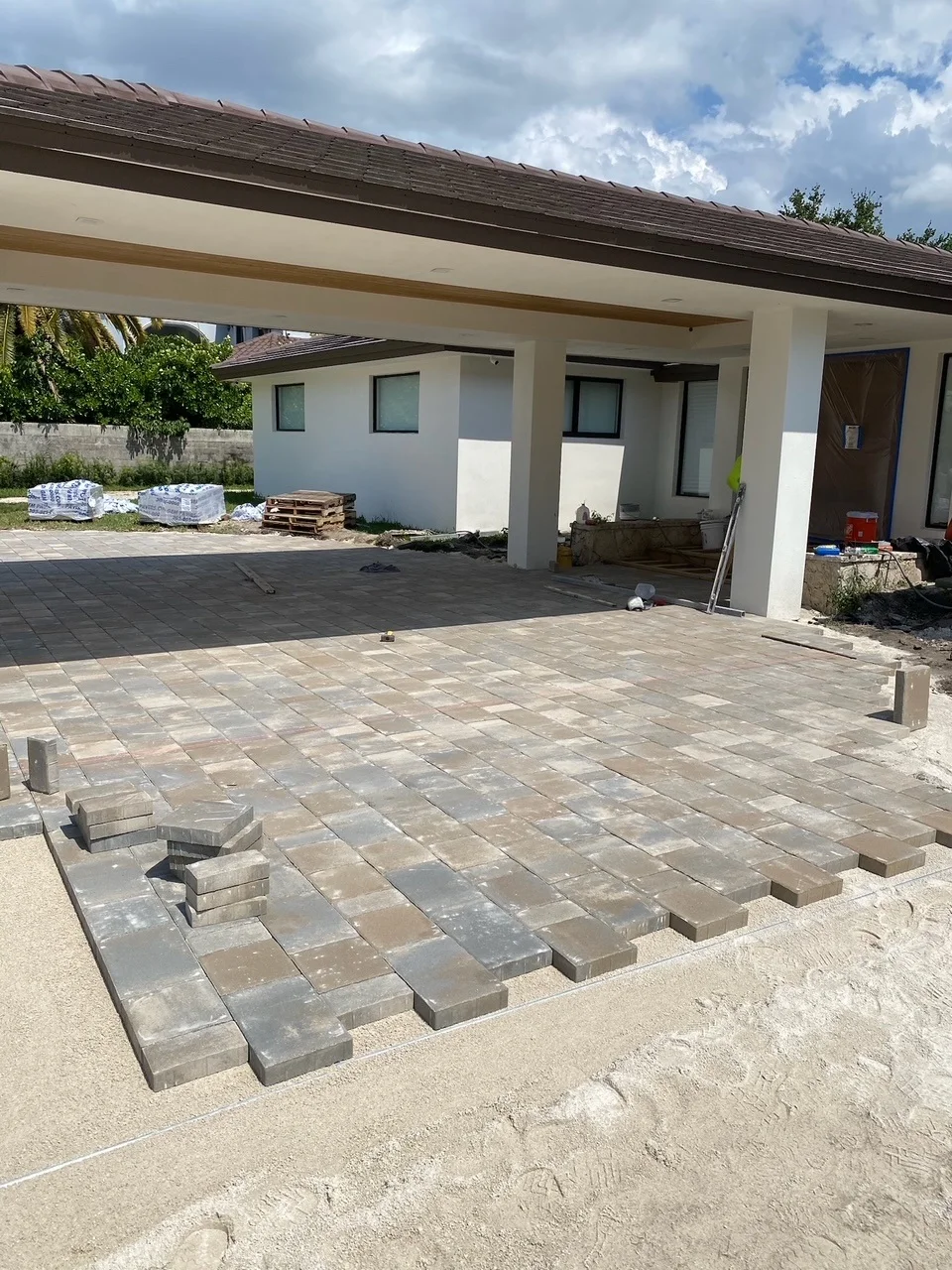
Field laid to the pattern, edges cut on site, and a restraint set around the perimeter so the field cannot creep.
Joints get filled and the site gets cleaned
Sand swept in and compacted, surface washed, debris hauled by us. You get the property back the way we found it, minus the problem.
What a driveway asks of the ground under it
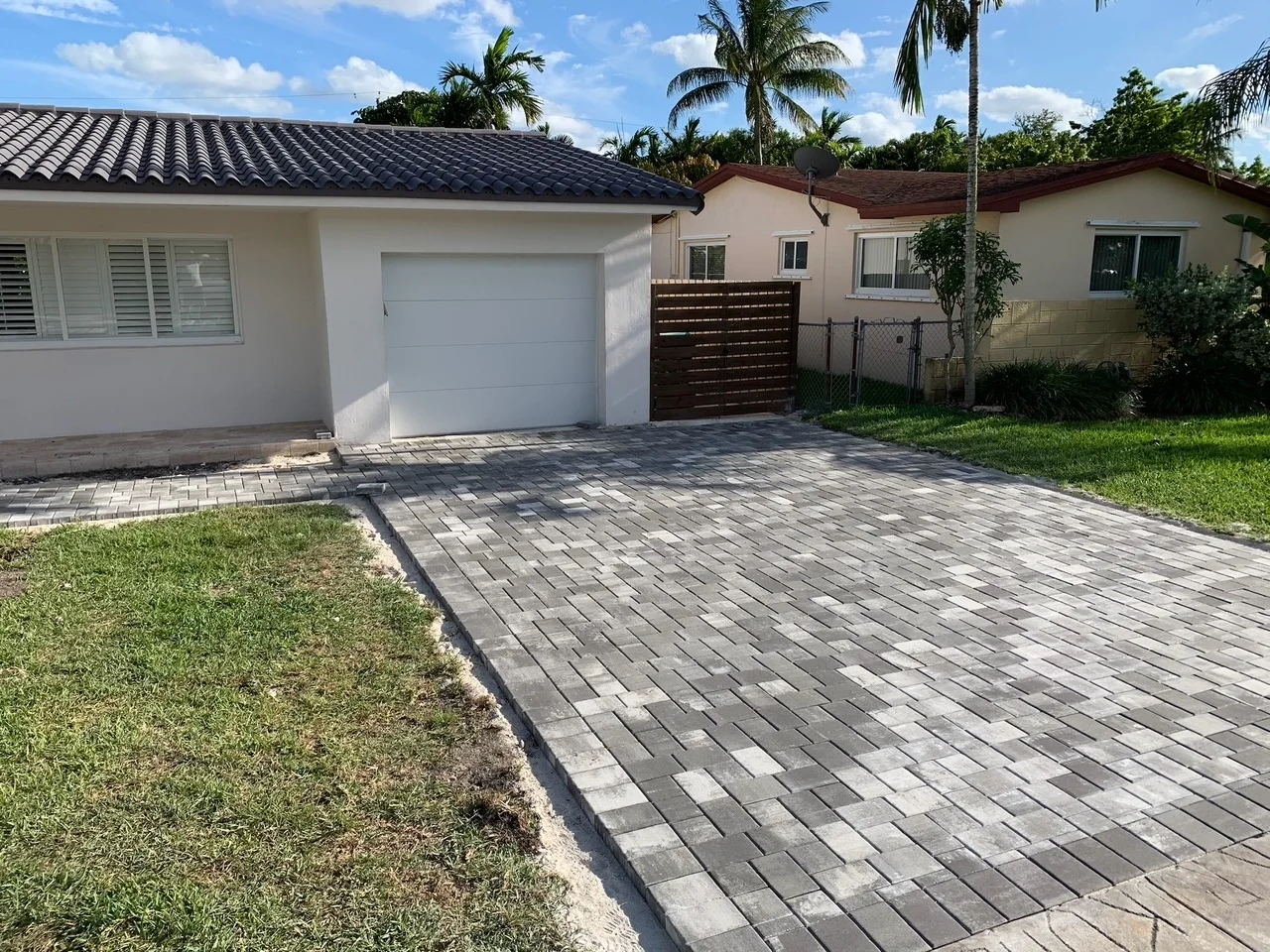
Width matters more than people expect. A drive built to the minimum feels fine until somebody steps out of a car onto wet grass every time it rains, and the edge course starts breaking down from being driven over.
A driveway is the only paver surface on most properties that carries a vehicle, and that changes everything under it. Passenger cars are not the design case; the design case is the delivery truck, the moving van, and the day somebody parks a loaded trailer on the apron.
The apron, where the drive meets the street, takes the worst of it. Vehicles turn there under load, which grinds and shoves the surface sideways rather than just pressing down. That is why aprons need the deepest base on the job and the most serious edge restraint.
The pavers are a wearing surface. The base is the building.
We think about where water will run before we think about pattern or color. Every paver surface needs a gentle fall, roughly an eighth to a quarter inch per foot, pointed away from the house or building. It is subtle enough to go unnoticed and steep enough to work. A flat or backward pitch shows up in the first heavy rain.
On a flat commercial lot, a channel drain across the low edge is often the cleanest answer. It catches sheet flow before it reaches a doorway or a parking stall. Where there is no fall to send water anywhere, a permeable section can let it soak through into a stone reservoir underneath, and sometimes the right move is regrading the planting bed alongside. We decide that during design, while it is still easy.
The rain that falls on your pavers is the least of it. A well-jointed surface sheds most of that. The water that undermines a base is water delivered to one spot again and again, from a gutter downspout, an irrigation head, or the slope of the property next door. We look for those sources on every walk.
Fall
We pitch the surface roughly an eighth to a quarter inch per foot away from the building, enough to shed water without anyone noticing a slope.
Restraint
A perimeter edge restraint is what stops the field creeping outward and the joints opening from the outside in.
Joint sand
Structural, not cosmetic. It transfers load between units, which is the whole reason a field of loose pavers behaves like a surface.
More driveway work
This service runs across our whole region. Some of the areas where we do the most of it:
What it asks of you afterwards
A paver surface that was built properly asks for very little. Keep the joints topped up, keep organic debris from composting in them, and deal with a settled area while it is small. That is genuinely most of it.
If you like the look of freshly wet pavers, sealing gets you close to that all the time. It also makes stains easier to lift and helps hold the joint sand. What it asks of you is a recoat every few years and some care in choosing a product, since the wrong one can look plasticky or trap moisture. We will be straight with you about whether yours needs it.
Our rule of thumb is a quarter inch. A paver edge lifted more than about that much is a trip hazard waiting for someone, and it should move to the top of the list. On commercial sites, add liability to the reasons, since a fall there is more than a maintenance problem.
Clay brick keeps its color essentially forever because the color is the fired clay itself. It costs more, comes in fewer shapes, and it is the right answer when you want a surface that looks the same in twenty years.
Concrete in the midday sun can get uncomfortable on bare feet. Travertine stays noticeably cooler, which is the main reason it is the paver people ask for around pools. The tradeoffs are that natural stone varies from piece to piece and that it should be sealed anywhere it is likely to get oil or heavy staining.
Porcelain pavers are dense enough to be close to stain-proof, which makes them easy to keep looking new. They are also the newest option in residential work and the least tolerant of a poor base. Any unevenness in the bed comes through on top, and cutting them well takes patience and the right blade.
How this gets done badly
None of these are visible on the day the work finishes, which is exactly why they keep happening.
Using the wrong sand in the bedding
Bedding wants sharp, angular concrete sand. Rounded mason sand or beach sand behaves like ball bearings under load and lets the pavers wander.
Sealing too early
Give new concrete pavers time before sealing. They have to cure and let efflorescence work its way out. Sealing during the first month risks catching that white bloom under the sealer, where it stays for good.
Laying over the old surface
Skipping the tear-out saves time and some money. It also keeps every defect in the ground below. If a weak base is what wrecked the old surface, the new one hides that failure briefly and then repeats it.
Skipping the geotextile
Without a separation layer, the subgrade and the base slowly trade places. Soil particles ride water up into the stone while the stone presses down into the soil, and the base gets thinner every year. Surface repairs do nothing for that kind of settlement.
If nobody talks to you about drainage, they are quoting a different job.
Common questions
How long does the job take
A typical paver driveway sealing job runs two to five working days once we start. Base work is the slow part; laying the field goes quickly. Weather moves things, and in summer we plan around the afternoon storms rather than pretending they will not happen.
Do I need to be home while you work
No. We just need a way in and a water source to hook up to. If you want to check in, call us anytime, and if we hit something we did not plan for, we will be the ones calling you that day.
Will the new pavers match what I already have
What matters most is where the repair sits. In a back corner, a close match is usually fine. By the front door it needs to be better, and if the line is discontinued we can borrow pavers from a less visible part of the surface for that spot. Either way you see the options before we order.
What happens to the old surface
You do not have to deal with it. Our crew breaks out the old surface and hauls it away, and the concrete and pavers are recycled wherever a recycler is available. Haul-off is already in the scope.
How do you keep it from settling again
Settling is a symptom. The cause is almost always water or a weak base, and occasionally a tree root. We correct whichever one it is, rebuild the base where it failed, and then relay the pavers, so the spot has no reason to drop again.
Do you cover Miami, FL
Yes. Miami is where Paverson is based, and we work across the city regularly. Reach us by phone or at info@paverson.com and we will tell you honestly how soon we could get there.
Let us walk the property
The fastest way to get a real answer is to have one of us stand on it. We will walk the property, look at where the water goes, and write up what we find.
Quality you can stand on