Paver Trip Hazard Repair, built on a base that holds
Removing the lip somebody is going to catch a toe on.

What actually goes wrong
When a paver surface goes wrong in Florida, the pavers are rarely the thing that failed. Water got into the base, the base moved, and the surface followed it down. Fix the surface only and you are back in two years.
Dig down in a lot of coastal yards and you hit water sooner than you would expect. With the water table that close to the surface, rain has less room to go down and more reason to move sideways, and sideways water takes the sand out from under driveway edges.
Tree roots lift more pavers than people expect. They chase water and the base holds water, so once a root grows into that layer it keeps raising the surface above it.
So the real question to ask anybody bidding this work is not what pavers they use. It is how deep they excavate, how they compact, and where they think your water goes. The answers tell you everything about how long the job will last.
How we run this job
We come look at it
We look at it in person, with you there if you can be. The crew member who comes out checks the surface and the drainage around it and tells you straight what is happening. A smaller fix, when that is the truth, is what we recommend.
You get the plan in writing
Scope, materials, schedule, and cost on paper before a shovel moves. The number you approve is the number, not an opening position.
We build the base first
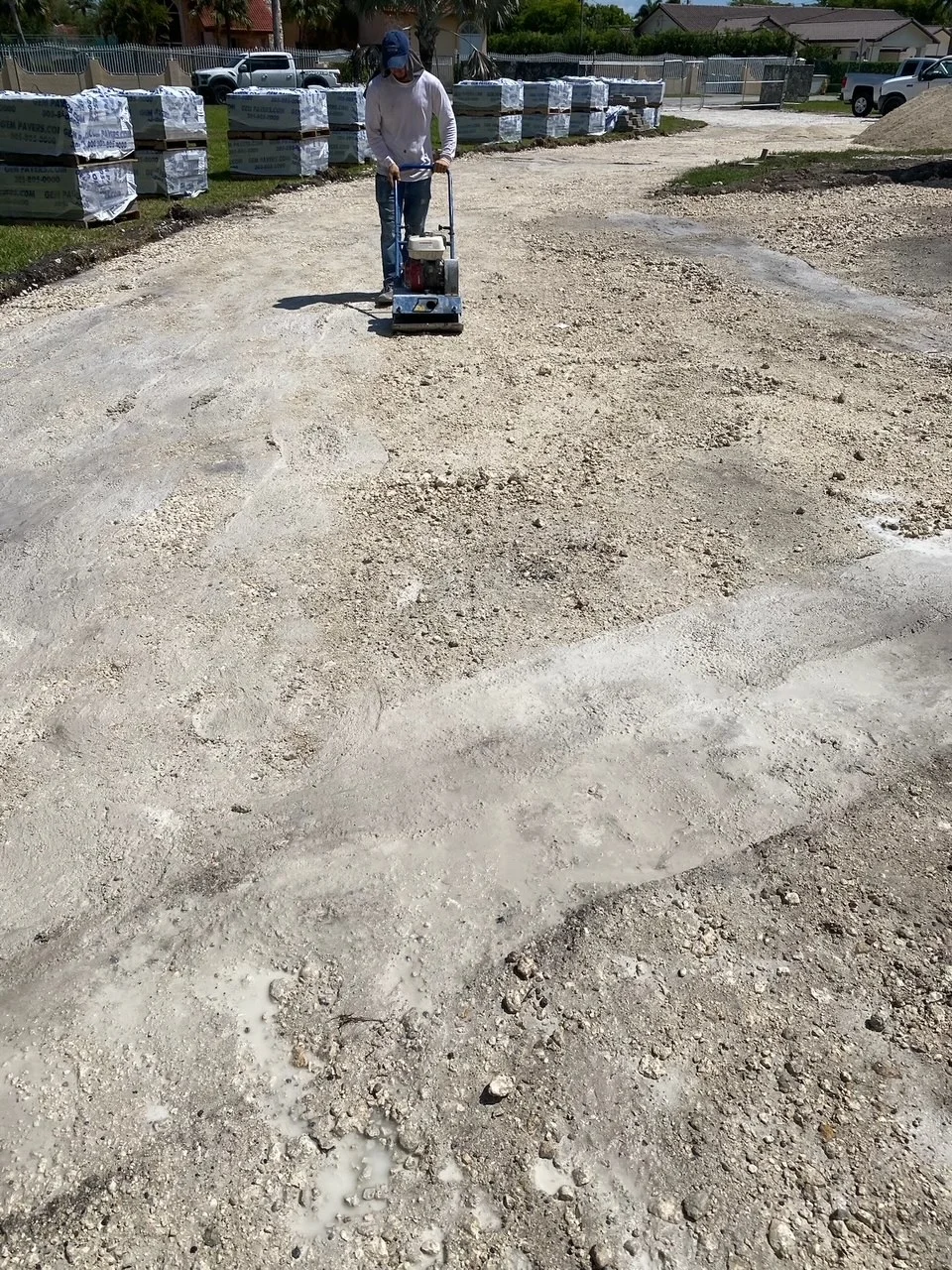
Dig to depth, compact the aggregate in layers, screed the bedding. Nobody ever sees this part again, which is exactly why most failures start here.
Pavers go down and get cut in
Field laid to the pattern, edges cut on site, and a restraint set around the perimeter so the field cannot creep.
Joints get filled and the site gets cleaned
Sand swept in and compacted, surface washed, debris hauled by us. You get the property back the way we found it, minus the problem.
Working out what actually failed
The usual why is water: a downspout discharging at an edge, an irrigation head hitting the same spot twice a day, or a neighboring grade sending runoff across a corner. Second most common is a root. Third is a base that was never compacted properly.
A good repair is invisible. That means keeping the units that came up, blending replacements so they do not read as a patch, and matching the joint sand so the repaired area does not sit a shade different from the field around it.
Repair starts with diagnosis, not with lifting pavers. The surface tells you where it failed; it does not tell you why. Pull up a sunken section without answering the why and you have bought a season.
Water is what ends most paver surfaces, and it rarely arrives from the sky.
On a flat commercial lot, a channel drain across the low edge is often the cleanest answer. It catches sheet flow before it reaches a doorway or a parking stall. Where there is no fall to send water anywhere, a permeable section can let it soak through into a stone reservoir underneath, and sometimes the right move is regrading the planting bed alongside. We decide that during design, while it is still easy.
The rain that falls on your pavers is the least of it. A well-jointed surface sheds most of that. The water that undermines a base is water delivered to one spot again and again, from a gutter downspout, an irrigation head, or the slope of the property next door. We look for those sources on every walk.
The grade under a patio or walkway has one job: get water off and away from the building. The pitch that does it is roughly an eighth to a quarter inch per foot. Underfoot it feels level. In a downpour you can watch the water move. Lose that fall and you get puddles, or worse, water running back toward the foundation.
Fall
About an eighth to a quarter inch of drop per foot, heading away from the building. You will never feel it. The water will.
Restraint
A perimeter edge restraint is what stops the field creeping outward and the joints opening from the outside in.
Joint sand
Structural, not cosmetic. It transfers load between units, which is the whole reason a field of loose pavers behaves like a surface.
Other repairs we handle
This service runs across our whole region. Some of the areas where we do the most of it:
What it asks of you afterwards
Our rule of thumb is a quarter inch. A paver edge lifted more than about that much is a trip hazard waiting for someone, and it should move to the top of the list. On commercial sites, add liability to the reasons, since a fall there is more than a maintenance problem.
The main job is the joints. When the sand drops below the edge of the pavers, add more. When leaves collect in them, sweep them out before they rot and start growing weeds. A properly built surface really does not need much beyond that.
Whether to seal is your call. A good sealer brings the color up a shade and makes an oil drip or a spill easier to clean off. The tradeoff is upkeep, since it wears and has to be reapplied every few years, and the wrong product can leave a plastic shine or trap moisture underneath. We will tell you which way we would go on yours.
Porcelain looks clean and stays clean, because it is dense enough that almost nothing soaks in. It is newer to residential work than the other materials, and it is less forgiving. An uneven bed under it shows, so we spend extra time on the base, and the cuts are slow work with the correct blade.
Concrete pavers carry their color through the whole unit. Sun will mellow it slowly over the years, and there is no surface layer to wear off. Expect some shift in the first year or two while the paver finishes curing, which is normal. This is the material behind most of the driveways, patios and walkways we build, because it is predictable to lay and easy to match later.
If budget is tight, clay brick is usually not where we start, since it costs more and comes in fewer shapes. If the priority is a surface that looks the same in twenty years, it is the answer. Its color is the fired clay, and that does not fade.
The shortcuts that surface two years later
You cannot see any of these when the crew packs up. They show up later, which is why they keep happening.
Sealing too early
A new concrete paver needs to cure and let its efflorescence work out before it gets sealed. Seal it in the first month and you can lock a white haze under the sealer permanently.
Laying over the old surface
When someone asks us to pave over what they have, we look at the old surface first. If the base is why it failed, an overlay keeps that problem and puts a nicer face on it for a season. Quick and cheap, and still broken underneath.
Skipping the geotextile
Fabric between the ground and the base is a small step that keeps the base doing its job. Sandy soil especially wants to wash up into the stone layer above it. When it does, the base loses its strength and you get low spots that come back no matter how often they are reset.
Using the wrong sand in the bedding
Sand looks like sand until a truck rolls over it. Sharp, angular concrete sand grips. Rounded sand, the mason or beach kind, rolls under the load and lets pavers slide out of place.
If nobody talks to you about drainage, they are quoting a different job.
Common questions
Will the new pavers match what I already have
New pavers start out looking newer than the ones already down, because concrete pavers change color a little with sun and age. Sometimes the match is exact and sometimes it is close. When a line is discontinued or the difference is too obvious, we walk you through the options before anything gets ordered.
What happens to the old surface
You do not have to deal with it. Our crew breaks out the old surface and hauls it away, and the concrete and pavers are recycled wherever a recycler is available. Haul-off is already in the scope.
How do you keep it from settling again
Settling is a symptom. The cause is almost always water or a weak base, and occasionally a tree root. We correct whichever one it is, rebuild the base where it failed, and then relay the pavers, so the spot has no reason to drop again.
Do you work with HOAs and property managers
Yes. If your board only meets monthly, we plan the job around that meeting. Submittals and phased work that keeps residents moving are normal for us, so tell us how approvals run.
Do you cover Miami, FL
Yes. Miami is where we are based, so it is about as close to home as our work gets. Give us a call and we will tell you when we can come out.
Is there a warranty
Yes. The written warranty is ours and covers how the job was built. The product warranty belongs to the paver manufacturer, and we include that paperwork. Some things sit outside our coverage, mainly new roots and changes to drainage, and we point those out clearly.
Have somebody come look at it
Send a couple of photos or just call. We will tell you what we think is going on, what it would take to fix, and whether it needs doing now or can wait.
Quality you can stand on